
The monsoon’s failure is no longer a forecast—it is a fact with a price attached. The previous month was the fifth driest June since records began in 1901, with all-India rainfall of 99.5 mm, about 40 percent below normal. The weather office expects July—the month that matters most for the kharif crop and reservoir storage—to deliver less than 94 percent of its long-period average, alongside above-normal maximum and minimum temperatures over most of the country.
The consequences have been swift. Retail inflation rose to 4.38 percent in June, breaching the Reserve Bank’s target band for the first time since December 2024. Food inflation quickened to 5.32 percent, from 4.78 percent in May. These are early numbers, recorded before the full weight of the rainfall deficit has passed through to mandis and retail counters. If July disappoints too, the price pressure for the coming quarter is already written in the fields.
Thus, the question before policy makers is not whether to respond, but with which instrument.
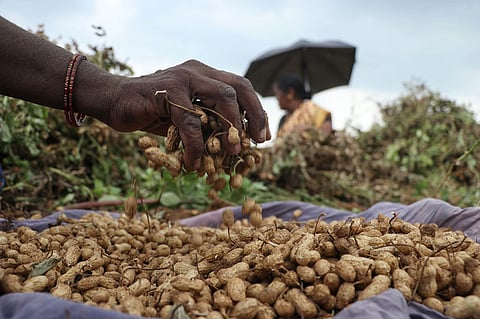
The distress in the fields is more telling than the price print. Kharif sowing in early July was down almost 21 percent from the same point last year. The sharpest decline is in oilseeds, down over 39 percent, with soybean acreage—the backbone of the domestic edible oil economy—shrinking by roughly two-fifths. For a country that imports more than half its edible oil requirement, a failed oilseed season inflates next winter’s import bill. That bill is being compounded by the West Asia conflict, which has kept crude oil volatile, raising the cost of shipping and fertiliser while threatening the sea lanes through which India’s energy and edible oil imports move. Pulses face a similar arithmetic.
The window for corrective action in agriculture—seed supply and advisories for short-duration varieties where late rains permit re-sowing, and the early securing of import lines before world markets sense India’s need—is measured in weeks. Each week spent in reassurance that the situation is being monitored is a week conceded to scarcity.
The temptation now will be to read the inflation target breach as a case for monetary tightening. It should be resisted. The Monetary Policy Committee was right to hold the repo rate at 5.25 percent with a neutral stance, and it should hold its nerve in the months ahead, for this is a supply shock, not a demand problem.
The June rainfall failure owed to an unfavourable phase of the Madden-Julian Oscillation, unusual typhoon activity over the western Pacific that suppressed low-pressure formation over the Indian Ocean and evolving El Niño conditions. None of these forces responds to the cost of credit. Dearer money will not conjure rain, sow soybean or cheapen tomatoes; it will only tax an investment cycle that the economy, with growth projected at a modest 6.5-6.8 percent this fiscal, can ill afford to lose.
India has been here before: the framework of flexible inflation targeting was designed precisely so that the central bank could look through transient food-price spikes rather than chase them. The RBI’s legitimate concern is the second round—the seepage of temporary food prices into wages, rents and household expectations. But that risk is best met not with a pre-emptive hike, which would signal that Indian monetary policy is hostage to the weather, but with credible supply management by the government and plain communication from Mint Street that it can tell a monsoon from a mania.
The burden of action, therefore, lies with the Centre, and the good news is that its cereal cushion has rarely been thicker. Central pool stocks of rice and wheat stood over 604 lakh tonnes in April, nearly three times the buffer norm of 210.4 lakh tonnes. Cereal inflation is thus a solved problem awaiting administration: calibrated open market releases should begin now, on a published calendar, so that traders cannot profit from uncertainty and prices are defended before they rise rather than after. But India’s food inflation no longer lives in cereals. It lives in perishables, pulses and edible oils—precisely the commodities where capacity is thinnest.
The agenda is familiar and unglamorous. Import windows for pulses and edible oil must be opened early, predictably and for fixed periods, since markets punish panic buying and reward foresight. Vegetable supply chains deserve treatment as critical infrastructure: transport priority for perishables, expanded cold storage, and price intelligence used to move stock before local shortages become national spikes. Rain-deficit districts need drought contingency plans invoked without euphemism, alongside expanded employment guarantee works to protect rural incomes, and an early, honest allocation of reservoir water among drinking needs, power generation and the rabi season to come. None of this makes headlines; all of it is cheaper than the alternative.
Beyond this season lies the structural truth that policy can no longer defer: a warming climate is making the erratic monsoon the rule rather than the exception, with longer dry spells punctured by destructive bursts of rain. An economy in which food claims nearly half the consumption basket of the poor cannot go on treating each failure as a surprise, to be managed by an empowered group of ministers in a fortnight of alarm.
What is needed is standing machinery—real-time integration of sowing, storage, price and trade data; import protocols that trigger automatically at thresholds rather than at headlines; and sustained investment in irrigation, dryland farming and climate-resilient seed. These reforms have been debated for a decade; what has been missing is not diagnosis but follow-through.
It is possible that August will redeem July, and that this season’s anxieties will be filed among crises averted. Policy is not entitled to that optimism: the costs of preparing for a drought that does not arrive are trivial; the costs of failing to prepare for one that does are counted in the diets of the poorest. The rains may yet keep their promise. But policy should not bank on it.
P K Santhosh Kumar | Professor & Director, Centre for Budget Studies, Cochin University of Science and Technology
(Views are personal)
