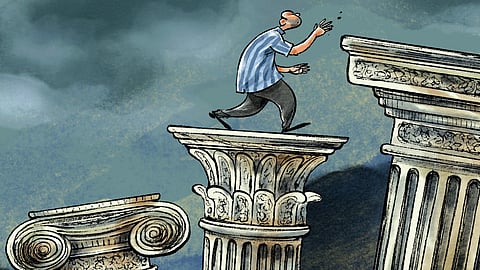

Democracy is a political discourse built on the poetics of difference. Everything, from a cliché to a policy of monoculture, tends to defeat both diversity and democracy. A philosopher friend of mine remarked that while the slogan ‘liberty, equality, fraternity’ may be critical, it is not complete. It needs a second triangle: ‘diversity, difference and dialogue’.
To turn democracy into an everyday affair, of late, the logic of number has embodied an electoralism that has diminished the idea of difference. Electoral democracy has become a pursuit of majoritarianism and authoritarianism. Difference suddenly seems to have acquired a sense of impotence. But one has to emphasise that the difference provides both the identity and dynamics of democracy.
Two stories illustrate the power of difference, the logic of variety. The first is about the scientist K S Krishnan, the first director of the National Physical Laboratory. I remember he had come home to visit my parents when I was 8. My younger sister sat regally on his lap in a pavada. Krishnan asked her quietly, “What colour is your pavada?” She quickly replied, “Red”. He smiled and said, “Red is a convent school colour. Sivappu encompasses more nuances, more shades than the standard Indian red can visualise.” He emphasised that when colour provided the gradient of difference, it came impregnated with multiple meanings. Standardising colour was not the answer to difference.
Colour, in the sense, is not just a nominal difference. It implicates the social and adds a sense of responsibility. This was brought out brilliantly by the scientist C V Seshadri. He pointed out that obsolescence threatened diversity. That natural indigo disappeared with the emergence of the synthetic dye. But Seshadri showed how Uzramma and the Dastkar group reconstructed the original dye by working with craftsmen’s memories. The dye, they explained, were a set of relationships, a way of work, of livelihood, and a life-world of relationships. The dye from memory became a reinvention. Colour added its own political implications.
One wants to emphasise that both these anecdotes show the critical life-giving nature of difference and diversity. Difference creates a gradient of possibilities that makes new alternatives possible.
It is in this context that one remembers the legend of Nikolai Vavilov, one of the pioneering scientists of genetic diversity. For Vavilov, diversity was both life-giving and critical. Stalin condemned him ideologically for it and sent him to a gulag, where he was tortured over 400 times. But in immaculate clerical style, his briefcase was sent back to his office. When his office staff opened it, they found a new set of plants that had never been classified. For democracy, thus, difference and diversity were not just formal properties but life-giving parts of evolution.
A second set of points on a more cultural angle was made by the Kannada author U R Ananthamurthy, who pointed out that translation mediated difference. The author pointed out an interesting riddle. A book like the Ramayana exists in over 300 variations. In fact, translation here expresses the poetics of difference and the geography of vernacular imaginations. The solution doesn’t lie in producing a Tulsidas Ramayana. One must produce multiple Ramayanas to capture the differences. Ananthamurthy stated that’s how the power of the vernacular and the local returns to story-telling. The standardised no longer expresses an affinity to truth.
The second great emphasis on difference and diversity came from the logic of memory. Memory is not an item of the past. It is an inherent part of living rhythms in most cultures. Orality is still crucial today and memory can blind one. During the independence movement, Anand Coomaraswamy argued that Indian nationalism must fight a guerilla war against the museum. The museum is an act of taxidermy. It freezes cultures. It destroys diversity. A living culture is an embodiment of something alive, dynamic and contextual. It is in a continuous process of experiment, which museumisation freezes. Coomaraswamy stated that museumisation is an act of taxidermy that mummifies culture. The differences tradition keeps alive, modernity destroys in the act of preservation.
Diversity, in that sense, is always a life-giving gift. It demands that we mediate between differences. Even in modern times, one needs a new social contract between the oral, the textual and the digital. They are three forms of information, but the right to information has to recognise the right to orality too. Oral memory is a critical part of information today. One needs to preserve story-telling in ways which keep narrators alive. A right to information that focuses only on the digital is incomplete and poor in the understanding of history and the future.
This is where civil society comes in. Civil society has to sustain imaginations that go beyond the state. Civil society has to sustain the informal, the marginal, the minority and the defeated. One of the sadnesses of diversity is that people today don’t see civil society institutions as maintaining the pedagogy of difference.
Difference, thus, needs its own anthropology. Difference also needs its own dynamic. One proceeds from diversity to dialogue and dialogue needs its own set of social rules, its own idea of playfulness. Difference in that sense, triggers the alternative imaginations and makes the poetics of the future possible. It is in this context that difference, rather than being seen as an act of disruption, becomes an ethical fact. It is a challenge that needs new forms of experimentation and new kinds of performativeness. Difference has both, the poetics and a mythology that needs articulation. Language, thus, becomes central to diversity. Between language, interpretation, invention, poetry, literature, make sure that diversity is both self-sustaining and life-enduring.
One has to emphasise that diversity simultaneously raises ecological, aesthetic and political challenges. Take a simple question. India is responsible for thousands of rice plants, but how does one sustain the aesthetics and ethics, the taste and the calorific value of each of these plants? Democracy is as much about nature as it’s about culture. It needs a new discourse that goes beyond transparency, electoralism and the separation of powers.
Shiv Visvanathan | Social scientist associated with the Compost Heap, a group researching alternative imaginations
(Views are personal)
