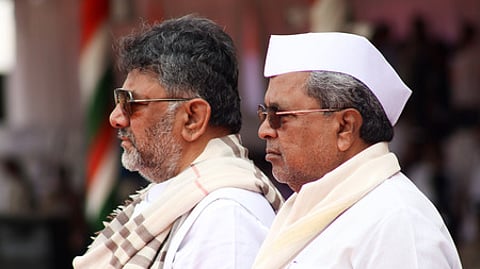

Finally, the much-debated change of guard in Karnataka was taken forward by the Congress’s central leadership and the state has a new Chief Minister. For the past few months, it was becoming increasingly clear that D K Shivakumar taking over was not an ‘if’ but a ‘when’ question.
While it is true that in the past, similar promised transitions in Congress regimes had not been carried forward in Chhattisgarh, Rajasthan and Madhya Pradesh, the Karnataka case seemed different. Shivakumar has been a key strategist for the Congress and a party loyalist close to the central leadership. It was also increasingly clear that outgoing CM Siddaramaiah, in his second term, would not lead the party in the 2028 Assembly polls. A new leader needs at least two years to establish himself in the position and take the campaign forward.
The leadership change has wider implications for the state’s politics, the Congress’s internal dynamics as well as the strategy of the leading opposition party, the BJP. Interestingly, in all this commotion over the past few weeks, very little was heard about the distant third player in state politics—the Janata Dal (S), a part of the NDA whose leader, H D Deve Gowda, would no longer be in Parliament three decades after relinquishing the post of the Prime Minister.
DKS’s takeover was not without its share of political drama. In the run-up, both the outgoing CM and the successor consistently maintained that a change of guard would be decided by the Congress’s central leadership. When the final action began, Siddaramaiah kept asserting that he had been asked to step down and was thus making way. He did not accept the offer to move to national politics. Being an influential OBC leader who had the longest chief ministerial tenure in the state, the party’s central leadership was keen to placate him. His son was made a minister, as were some key followers.
As is already evident, the real challenge for the new CM lies in expanding his ministry. Most of the 135 Congress MLAs (save Siddaramaiah) see themselves as potential ministers in the DKS ministry. Fourteen slots are filled and another 20 remain. The new government’s stability and capacity to take forward governance would rest on providing appropriate ‘political accommodation’ to its aspiring legislators and managing dissent.
The social coalitions that political parties have built up in Karnataka have played a key role in their success. For the Congress, the 2023 Assembly victory was on account of a rainbow coalition that included carving away a slice of the Lingayat vote from the BJP, strengthening its support among the Vokkaligas in Old Mysore, retaining support among the non-dominant OBCs and strengthening its base among Dalits and minorities.
Siddaramaiah’s chief ministership in 2023 was, among other things, a recognition of the non-dominant OBCs he represented. On the other hand, the new CM hails from the dominant Vokkaliga caste, indicating a clear attempt at social balancing. The new state Congress president is from the non-dominant OBCs and the Deputy CM is a Dalit. Both the non-dominant OBC ministers hail from the Kuruba (shepherd) community, to which Siddarmaiah belongs. So the next expansion would need to cater to the wider rainbow coalition the party hopes to sustain.
The new CM will surely be a man in a hurry. He will need to work on the five guarantees implemented. He has already extended the free bus travel concession to students, but will need a re-look at the way some of the guarantees have been implemented. As the minister for Bengaluru in the Siddaramaiah government, DKS had promised several initiatives that he would now want to take forward too. The Bengaluru development portfolio has been passed to the capable hands of Krishna Byre Gowda.
Past changes of guard in Congress governments in Karnataka (1989-1994) were accompanied by a drift in governance. The party would expect its new CM to ensure this does not repeat. Also, after 1985, Karnataka has never seen a ruling party win consecutive majorities in the Assembly. The new CM will want to reverse that trend.
Meanwhile, the BJP has its fair share of challenges. Factionalism within the state unit is patently visible. This has prevented the party from launching a unified attack on the government. Its alliance with the JD(S) for the 2024 Lok Sabha elections was stitched to ensure a unified fight against the Congress. The BJP contested as many seats as it had won from the state in 2019, as it had to leave three seats to the JD(S). But Assembly elections involve different political calculations. The BJP has never won a majority by itself in the state, which it will hope to do this time. Yet, any alliance with the JD(S) would require them to share a significant chunk of seats.
There are already murmurs on both sides on whether an alliance is feasible for the Assembly election. Deve Gowda’s absence in the Rajya Sabha may be one indication of the emerging trends. Further, the new CM has already spoken of consolidating his electoral base in the Vokkaliga heartland. The JD(S), whose presence is largely in the same Old Mysore region, thus faces a stiff challenge.
It’s sure that Karnataka is in for two interesting years of political action. Each passing day is witnessing an interesting twist. While this keeps politics vibrant, citizens will be hoping for a greater focus on governance from the ruling party.
Sandeep Shastri | Vice President, Nitte (Deemed) University, Bengaluru, and co-author of Indian Youth in a Transforming World
(Views are personal)
