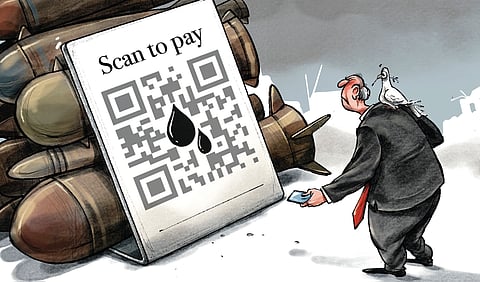

In a single Thursday, the war over Iran shifted from the brink of a catastrophe to the cusp of a deal. On June 11, President Donald Trump threatened to strike Iran “very hard” and seize Kharg island, through which nine-tenths of Iranian oil flows; by nightfall, he had called off the strikes, announced an agreement “approved” by all parties—Iran among them—and predicted a signing in Europe within days. It was at least the eighth time since February that he cancelled strikes at the last moment—a rhythm of ultimatum and reprieve that should temper any euphoria.
Yet the breakthrough is more of a declaration than a fact. Tehran offered no confirmation; its semi-official Fars news agency said Iran had agreed to no memorandum of understanding, though it judged an eventual approval likely. Israel went further, refusing to recognise any agreement, with Prime Minister Benjamin Netanyahu reportedly blindsided by the announcement. The framework, brokered in late-night exchanges between Qatari and Iranian negotiators, focuses narrowly on reopening the Strait of Hormuz and lifting the US naval blockade, while deferring decisions on Iran’s nuclear programme and over $16 billion in frozen Iranian funds. Trump stressed that the blockade remains in effect until the ink is dry.
That a deal remains elusive after 100 days of conflict reflects irreconcilable ends, only partly papered over. Washington’s mix of strikes, blockade and coercion seeks hard limits on Iran’s nuclear and missile programmes and its proxies, plus freedom of navigation. Tehran, reconstituted around Mojtaba Khamenei and an ascendant Islamic Revolutionary Guard Corps after Ali Khamenei’s death, treats its energy lifeline, sanctions relief and security guarantees as non-negotiable. The result is a double blockade around Hormuz—American warships throttling Iranian ports, while Iran restricts the waterway carrying a fifth of the world’s seaborne oil. Iran declared the strait closed after Thursday’s attacks; Washington insists shipping still flows.
Into that gap has stepped a crowded field of mediators. Qatar has emerged as the indispensable broker of the present draft, its envoys hammering out the text with Iranian negotiators while its emir pressed the case with Trump by telephone. The UAE and Pakistan, too, urged restraint. Earlier direct talks hosted by Pakistan had collapsed over what Tehran called excessive demands, and Oman’s quiet neutrality continues in the background. The latest escalation has again unnerved the Gulf, exposing the paradox its leaders long dreaded—that dependence on the US as guarantor offers no insulation from the costs of its military choices.
Israel remains the great complicating variable. The original Iran ceasefire pointedly excluded Lebanon, and Israel’s continuing bombardment there—more than 2,000 killed and over a million displaced—keeps reigniting the wider war. Hezbollah’s leader Naim Qassem has rejected a US-brokered truce as tantamount to surrender, while Iran insists Lebanon falls within any understanding and warns it will resume operations if the strikes persist. That Netanyahu was neither consulted before Thursday’s announcement nor willing to acknowledge a deal feeds a suspicion that Israel has little interest in US-Iran diplomacy succeeding—and ample means to derail it.
The prognosis, then, is hopeful but unproven. The choreography that produced Thursday’s reprieve could unravel within a news cycle, as it has before. Markets have exhaled—oil eased, equities rallied—but the toll is heavy. The World Bank this week cut its global growth forecast to 2.5 percent, the weakest since the pandemic, warned of a fall to 1.3 percent should the war reignite; it projected global headline inflation climbing to 4 percent through 2026 against 3.3 percent last year. A settlement that secures navigation while deferring the nuclear question and frozen funds is less a peace than a pause dressed as one.
For India, the war has turned lethal and personal. In four days, American forces attacked three tankers carrying Indian crews—the Marivex, the Settebello and the Jalveer—accusing each of moving Iranian oil in defiance of the blockade. Aboard the Settebello, three Indian seafarers were killed, while the Jalveer’s 20 Indians were evacuated to Oman. With some 320,000 Indians on the world’s commercial fleets, at least 562 near Hormuz, seafarers’ safety has now become an acute dimension of the crisis.
The structural exposure is no less severe. As the world’s third-largest oil importer, importing over four-fifths of its crude, India has lost some 3 million barrels a day once routed through Hormuz and draws half its gas from Qatar and the UAE. Sustained disruption inflates the import bill, widens the current-account deficit, stokes inflation, and strains a budget the finance ministry concedes is now at risk. Having trimmed Russian purchases under American tariff pressure, New Delhi has swung back towards Moscow and bought its first Iranian cargo in seven years—a sign that resilience means diversifying supply, deepening reserves and accelerating renewables.
The war also shadows India’s connectivity ambitions. Chabahar, its half-billion-dollar gateway to Central Asia and the spine of the International North-South Transport Corridor, lies within the very theatre being bombed. The India-Middle East-Europe Economic Corridor (IMEC), conceived to link Mumbai to Europe via the Gulf and Israel, was already stalled by Gaza and now founders amid a Hormuz crisis at its centre, with Saudi-Israeli normalisation slipping from precondition to afterthought. The paradox is that the same chokepoint vulnerability that strengthens these corridors’ long-term rationale makes their near-term execution impossible.
All of this tests India’s cherished strategic autonomy, revealing both its value and its limits. The doctrine lets New Delhi maintain ties with Washington, Tel Aviv, Tehran and the Gulf. Yet a war in which an American blockade kills Indian citizens shows that autonomy preserves manoeuvre only when matched by initiative. At next week’s G7 in France, Prime Minister Narendra Modi should press for a ceasefire grounded in accommodation, not exhaustion; ring-fence Chabahar; sustain IMEC; and harden India’s energy and maritime defences.
The 100-day war has taught the region that there are no short wars, only long bills—and India, the fastest-growing major economy and an indispensable power in the Indian Ocean, must shape the peace that ends them, not merely foot the bill.
Ausaf Sayeed | Former Secretary, Ministry of External Affairs and former Ambassador to Saudi Arabia and Yemen
(Views are personal)
