
Every year, India mints roughly 15 lakh fresh engineering graduates. Add to this the fact that one in every six humans on the planet is Indian. By a reasonable arithmetic of talent, we may aspire to have roughly one in six of the world’s most valuable deep-tech companies founded on Indian soil. Why is that not the case?
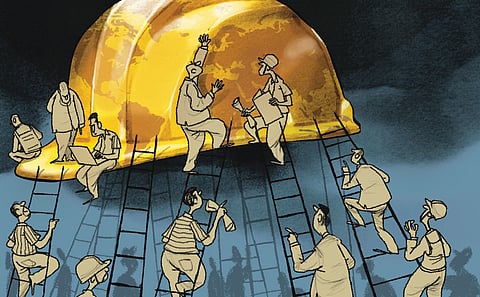
As artificial intelligence absorbs more routine cognitive work, the engineers whose value endures will be those who build. Now imagine a pavilion under which a nation of builders can invent, design and make. Such a structure can be raised by four pillars—standing for four reforms—bearing equal load. Erect three to perfection and leave the fourth unraised, and the roof never goes up. Raise even one weakly, and the whole structure tilts. Each of these four reforms addresses a different stage in the making of an engineer.
Signal that building matters: Entrance exams to India’s elite engineering institutions—most prominently, the IITs’ Joint Entrance Examination—are analytically demanding. The challenge is that they stand today as the only signal reaching students, parents and schools—and that signal asks nothing about building, making or the hands-on work that defines an engineer. This signal shapes the behaviour at every level in society.
We propose a ‘maker portfolio’ as a supplementary admissions component. Structured documentation of sustained, hands-on work—a project designed and built, a device assembled, an experiment run. It need not be sophisticated, but it must be real. Candidates would still clear the JEE; after that threshold, the portfolio would carry meaningful weight—as a tie-breaker, bonus or a dedicated pathway for a small number of seats. Once that signal lands and behaviour changes, students tinker, parents stop dismissing making, schools create space for projects.
Forming builders in schools: The science curriculum in grades 9-12 is heavily weighted toward abstract theory and examination-ready content. Real-world applications—the very hook that makes science truly exciting for a 12-year-old—appear as sidebars rather than entry points.
Imagine, instead, a classroom where every student winds a coil and watches the small motor they have built begin to spin, or aligns lenses into a working telescope and turns it toward the moon. The brushless DC motor was conceived by engineers who had spent years with motors in their hands, not invented in a lecture hall.
School science textbooks for the grades should be reimagined around four principles: every concept grounded in a real-world application, regular open-ended projects rather than only confirmatory labs, every student producing a tangible artefact and non-essential topics excised to free classroom time for what matters. These artefacts feed directly into the maker portfolio—what you build in school can help you reach an elite engineering institution.
Forging teachers into builders: Most of India’s school science teachers were themselves trained in the same theory-heavy, examination-oriented system within which they now teach. Many entered the profession before hands-on pedagogy was widely emphasised. They are part of a system that asked one thing of them in training and now asks something different in their classrooms.
We propose a national, mission-mode teacher training initiative anchored by the IITs and National Institutes of Technology. Their faculty would design and lead modular, practice-based programmes—low-cost experiments and the facilitation of open-ended student projects—through in-person workshops paired with sustained online mentoring. Teachers who have built become teachers who can teach others to build.
Making engineering colleges engineer: Suppose a student arrives at an engineering college genuinely excited to create. What do they typically find? More theory. More examinations. More lectures. Laboratory sessions, where they exist, are largely confirmatory—in a typical electrical engineering lab, students do not assemble circuits on breadboards but encounter pre-built apparatus on which they may only turn knobs and press buttons.
We propose a substantial transformation of the BTech curriculum: required, assessed exposure to fabrication, electronics and computational tools from the first year; multi-semester design-build-test projects that take a problem from concept to working prototype; and interdisciplinary studios, maker spaces and industry-linked challenges in place of some theory-heavy electives. Every graduate who leaves campus should be able to point to something they built, not just a transcript of courses passed.
Each of these reforms has been attempted, in isolation, somewhere in India over the past several decades. The overall system has not shifted. The reason is structural.
Reform undergraduate curriculums but leave admissions unchanged, and students arrive having optimised their adolescence for entrance examinations rather than for making. Reform school science but leave teacher training unchanged, and the new curriculum collects dust in a government document. Reform teacher training but leave admissions unchanged, and students and parents will rationally ignore making, because it carries no weight in the one thing that decides their future.
This is the structural truth of the pavilion. The only intervention that works raises all four pillars together, each to its full height, so that the same message—building matters—holds firm at every stage.
The maker portfolio must explicitly value low-cost, locally constrained forms of making. India already has over 10,000 Atal Tinkering Labs in schools across the country—many of them in government schools—and work produced in these labs should count directly toward the portfolio. What matters is not the sophistication of the tool but the evidence of genuine engagement. Designed with equity as a constraint, not an afterthought, these reforms can actively broaden access, not narrow it.
This proposal needs no new institution or regulatory body. NCERT can redesign school science textbooks; UGC can recognise experiential learning; the All India Council for Technical Education can mandate minimum hands-on credit requirements. IITs and NITs can pilot maker portfolio-based admissions and anchor national teacher training. Industry can contribute problem statements, mentors and commercialisation pathways.
What is needed is coordination and the political will to treat all four pillars as a single structure. These pillars can raise the roof—but they must come up together.
Harish N Dixit | Professor, Centre for Interdisciplinary Programs, IIT Hyderabad
Anurag Tripathi | Associate Professor, Department of Physics, IIT Hyderabad
(Views are personal)
