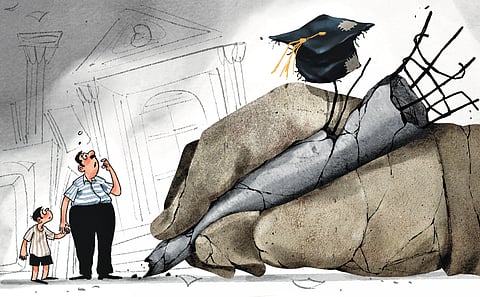

Our education system suffers from deep-rooted pedagogical and systemic challenges. Though schemes such as the Sarva Shiksha Abhiyan, the Right to Education Act, 2009 and the National Education Policy (NEP) 2020 have significantly expanded access and enrolment, the system continues to struggle with quality, equity, retention and relevance. A largely rigid, textbook-driven and examination-oriented education system fails to nurture children's cognitive abilities and holistic development. A massive shortage of teachers and faculty, infrastructure gaps and occasional campus unrest further compound the problem.
Let us start with school education. Government schools constitute the backbone of our education system, accounting for 69 percent of institutions and about 50 percent of enrolments. Though the scale is enormous, infrastructure and outcomes show uneven progress. Public spending on education hovers between 4.1 percent and 4.6 percent of GDP, falling well below the NEP 2020 target of 6 percent. Even past governments have never achieved this target. There is near-universal enrolment at lower levels, but problems of retention, equity and learning quality persist. The gross enrolment ratio demonstrates progress that tapers off at higher levels. Children dropping out of school is a worrying phenomenon. While retention levels have improved, especially at the secondary level, cumulatively only one in two students entering class 9 reaches class 12, and over one-third of those in Class 1 do not reach class 9. Dropping out is attributed to economic pressures, migration, child labour, early marriage, poor infrastructure and perceived low learning returns.
Learning outcomes, as per Annual Status of Education Report 2024, paint a concerning portrait of 'schooling without learning". About 49 percent of those in class 5 can only read class 2 texts fluently, and only about 31 percent can perform division. This low proficiency is largely attributed to rote and textbook-heavy teaching methods that dominate our classrooms.
Our education system fails to identify a child's strengths and weaknesses and to encourage him or her to explore knowledge beyond the classroom. A uniform, tailor-made education system with a rigid textbook-and-exam-centric regime does not cater to the diverse attributes of children. This stands in stark contrast to children's multifarious learning capacities. The system prioritises rote memorisation and uniform content delivery over experiential learning, play, inquiry, arts, practical skills, ethical reasoning and real-world problem-solving. This ‘one-size-fits-all’ approach ignores individual interests, learning styles, paces and talents, funnelling students toward high-stakes exams like the Joint Entrance Examination and National Eligibility cum Entrance Test. The result is widespread stress, anxiety, disengagement and career mismatches. NEP 2020 seeks to address this through multidisciplinary, flexible learning, reduced content load, experiential and competency-based methods and the 5+3+3+4 curricular structure. However, as of 2025-26, NEP remains largely on paper as its implementation has been uneven.
The recent revision of textbooks presents a selective and majoritarian interpretation of history and culture, marginalising diverse regional, linguistic, religious, caste, and minority perspectives. It would probably result in social division instead of promoting pluralism. Some articulations of the "Bharatiya" perspectives tend towards ideological saffronisation, erasing syncretic elements, thereby creating a culture of mismatch, especially for marginalised groups. The three-language formula has sparked resistance in non-Hindi-speaking states like Tamil Nadu, Karnataka and Kerala, leading to withholding of central funds. Such policies highlight tensions between national integration and linguistic diversity.
Now let us deal with higher education, where chronic under-funding persists. Funds are disproportionately diverted to elite institutions while state universities crumble. This makes the NEP targets unattainable. R&D expenditure in India has been stagnating at 0.64-0.7 percent of GDP, and universities contribute only 8-9 percent of national R&D. In contrast, among the world's advanced economies, South Korea invests 4.8 percent, Israel 5.4 percent, the US 2.8 percent and China 2.1 percent.
Declining research output and global rankings further highlight these shortcomings. Research output in India grows only in quantity, while quality remains low, accompanied by brain drain and an underfunded National Research Foundation. Centralisation of the examination system, thanks to the Supreme Court as well, has eroded federalism and institutional autonomy. Apart from constant question paper leaks in high-stakes centralised examinations conducted by the National Testing Agency, such a system curtails universities’ ability to set their own admission criteria. Institutions are left with no choice but to admit students pursuant to counselling, absent curriculum flexibility and the ability to cater to disparate needs of the institution. Each university should have the freedom to set a vision for how community needs are to be served and how levels of excellence are to be achieved. Students from state boards, rural areas and regional-language mediums are put at a disadvantage. This fuels the coaching industry, putting an avoidable burden on parents and students alike. The way forward is decentralisation of the examination system through innovation and alignment with local needs.
The shortage of faculty is critically high. As of January 31, 2025, 28.56 percent of sanctioned teaching posts were vacant, with professor-level vacancies standing at 56 percent. The position of state public universities is equally worrisome, registering about 40 percent faculty vacancies. Though premier institutions like the IITs produce world-class talent, brain drain remains significant, with one-third of IIT graduates migrating to foreign countries. But even these premier institutions are not able to maintain the prescribed student-faculty ratio. Theory-heavy curricula limit integration of practical, interdisciplinary and emerging skills such as AI, critical thinking and soft skills. Overall graduate employability is between 42–56 percent. The curriculum is not aligned with industry expectations, resulting in modest placements.
Politicisation of campuses has intensified, turning universities into ideological battlegrounds. In the Academic Freedom Index (AFI) 2026, India ranks 156th out of 179 countries. There has been a steady weakening of freedom to research, teach and express views. Intimidation and motivated investigations against faculty and students for not adhering to foisted ideological norms are antithetical to the purpose of universities being centres of learning. Meritless appointments erode universities’ autonomy and compromise learning outcomes. Key posts of vice-chancellors and faculty are often filled with perceived loyalists and those ideologically aligned with the political class, bypassing merit.
Unless school education caters to the needs of the students; unless university education gets rid of adhocism; and unless autonomy and diversity become the ‘mantra’ of higher education, the future will remain somewhat bleak.
Kapil Sibal | Former Union education minister
(Views are personal)
(On X @KapilSibal)
