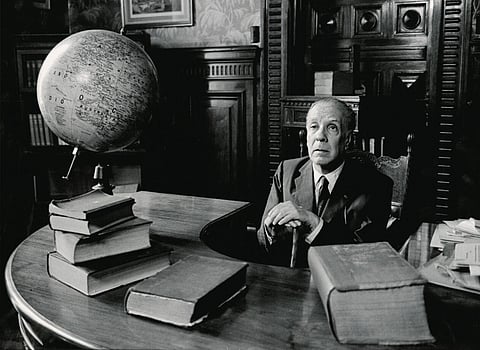

In his one-paragraph fable ‘On Exactitude in Science’, Jorge Luis Borges imagines an empire whose cartographers become so obsessed with accuracy that they produce a map as large as the empire itself. It matches the territory point for point. The result is a masterpiece that nobody can use. Borges’s point is simple: every map leaves something out. When a map claims to represent everything, it stops helping us understand where we are.
In India, we now live with two such maps. One is drawn by the cartographer of dreams, Narendra Modi. The other is sketched by Rahul Gandhi, who sees in the same dreams the makings of a nightmare. These maps are laid over the same territory, and yet they do not line up. The result is a peculiar double vision: we inhabit two countries at once and are at home in neither.
Modi’s map is bright with ambition, infrastructure and civilisational purpose. He claims to have lifted India from an era of drift into an era of execution. Roads, bridges, expressways, factories, digital payments and welfare schemes all form part of a narrative in which “stability and development at an unprecedented speed and scale” have replaced the instability and “mis-governance” of earlier regimes.
What makes Modi’s map attractive is not merely its optimism but its legibility. Roads lead somewhere. Airports appear where there were none. The citizen can point to a bridge, a welfare transfer, or a railway station and say: there, that is the future. The map offers destinations. It tells Indians not merely where they are, but where they are headed.
Rahul Gandhi’s map is dominated by institutional decay and ecological loss. He sees a democracy in which “the BJP controls the institutions of the State… the legal system… the bureaucracy… the intelligence agencies” and even the Election Commission. The distance between election and selection, he argues, is shrinking. Level playing fields are history.
Yet the difficulty for Rahul Gandhi is not that his map is necessarily false. It is that a map made entirely of hazards is difficult to follow. A traveller may wish to know where the swamps and cliffs are, but he also wants to know where the road leads. Gandhi identifies dangers that many independent observers would acknowledge, but he struggles to show citizens what lies beyond the warning signs.
You could say the problem is also one of persuasion. Rahul Gandhi, for all his courage, may never be Prime Minister; he is like the salesman who turns up at your door and tells you the vacuum cleaner he is offering probably will not work. A moment later, Modi appears with the same machine and sells you two by showing you an image of your soon-to-be spotless house. The first model requires effort—you, the citizen, must roll up your sleeves and resist, organise and demand accountability. The second offers something closer to the ideal: buy the product and trust the company.
‘Bharat’ was recently represented at an innovation jamboree in Nice, where the leaders of India and France jointly inaugurated ‘Bharat Innovates 2026’, a showcase for Indian startups and venture capital. As a reasonable citizen of this cartographic wonderland, one might be forgiven for asking: what exactly have we innovated that is not packaging and scale? Yet, the spectacle works. Modi is an effective peddler of this dream.
Rahul Gandhi’s latest map, outlined in his speech to the INDIA bloc partners on June 8, is harder to inhabit. He spoke of “unity and resistance” and compared today’s unequal playing field to the colonial period. He may be substantially right. There is mounting evidence, from Great Nicobar to the managed dismantlement of opposition parties, that the system is skewed. Yet his own allies—Mamata Banerjee, Akhilesh Yadav and others—do not fully buy the argument that every defeat is the product of rigging. To admit that would be to accept the need for something like a sustained civil disobedience movement. Nobody is ready for it.
This is a country whose political culture is built on inertia. We are a civilisation more comfortable with meditation than mediation. Passive resistance—Mahatma Gandhi’s great insight—suited us because it allowed for the grace of restraint without constant confrontation. As new entrants like the Cockroach Janta Party discover, even mobilising the much-hyped Gen Z is hard.
The poor, who might once have been the natural constituency for street politics, have seen their anger blunted by welfare. People remain poor, but they are not destitute in quite the same way. Welfare is both a genuine gain and an effective tranquilliser. Ironically, Rahul Gandhi has also been a strong advocate of this model, from NYAY (Nyuntam Aay Yojana or minimum income scheme) to a more generous safety net, which means his own politics co-opts the very constituency that might otherwise be tempted by insurrection. The clientele for his cartography has been neutralised by the policies he supports.
In Borges’s story, the perfect map ends up in shreds, an object of pity in the desert. Our two Indian maps are nowhere near perfect, but they compete to cover every inch of the India of our imagination. Perhaps the country awaits the arrival of another cartographer, another map.
C P Surendran | Author whose latest volume of poetry is Window with a Train Attached
(Views are personal)
(cpsurendran@gmail.com)
