
The ironies of history from the Palace of Versailles eerily reverberate across the world. These halls gilded with gold leaf and over 350 mirrors hosted world leaders in 1919 who signed the Treaty of Versailles for peace. The treaty created a landscape of anger and fomented World War II.
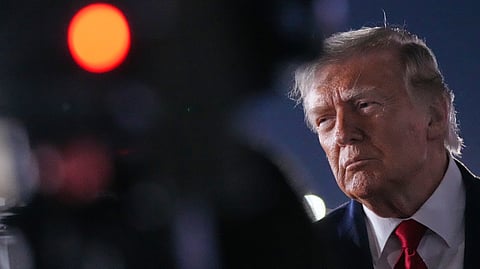
US President Donald J Trump, a fan of gilded halls, chose the same venue to sign the US-Iran peace deal. Folks at the US State department may have winced, but he went ahead! Déjà vu followed soon enough. The first clause in the 14-point MoU called for “the immediate and permanent termination of military operations on all fronts, including in Lebanon”.
The first casualty of what followed was also Clause 1. Within hours, the promise of peace unravelled as Israel carried out 12 air raids on multiple locations in Lebanon. Unsurprisingly, Iran called off the talks scheduled for Friday in Switzerland and closed the strait on Sunday.
The promise of peace is illusory, like a mirage on the desert—now you see it, now you don’t. Friday became a cacophony of contradictory news. Trump claimed, “We didn’t meet out of desperation, Iran did. They are FINISHED!”
And a few hours later, posted a poll endorsing the peace deal. Attacks continued on the Lebanon arena even as Israel and Hezbollah claimed agreeing on a ceasefire. The peace deal faces threats from within the alliance—a US intelligence report warns, ‘Israel would undermine the peace deal’.
The outpouring of vitriol is unabated. Finance minister Bezalel Smotrich wants Israel to ‘open the gates of hell’ in Lebanon. Another minister, Itamar Ben Gvir, a key ally of Benjamin Netanyahu, poured bile telling the US that the “security of our citizens are not forfeit”. He also called for an end to the “ping-pong” and said, “You don’t win with measured responses and restraint—you need to go berserk.”
The diatribe of Israeli ministers going berserk didn’t go unchecked. US Vice President J D Vance read the riot act, chapter and verse. Defending the peace deal, he asked, “What is your exact proposal? You’re a country of 9 million people. You can’t just kill your way out of solving every single national security problem that you have.” Vance also warned, “If I was in the cabinet of the Israeli government, I might not be attacking the only powerful ally that I have left anywhere in the entire world.”
The architecture of the agreement has troubling faultlines. On Lebanon, for instance, two parties signed it but the third party—the one bombing Lebanon—is not a signatory! Netanyahu ruled out any immediate withdrawal from Lebanon, saying that Israel’s forces would remain there “for as long as necessary”. He can say so because the deal is not binding on him. It is moot if Trump can prevail over Netanyahu.
The opening of the Hormuz Strait is riveted by confusion. There are 250 tankers and over 300 ships waiting for clearance of mines and clearance from insurers. The MoU says Iran will allow passage for vessels with no charge for 60 days. While Iran says there will be a fee after 60 days, on which the MoU is silent. The MoU says Iran will consult Oman and others to define the future of the strait. Iran has already initiated steps for fee-based passage. A Lloyd’s report states Iran has introduced mandatory insurance for all vessels transiting the strait.
The deal triggered a series of memes in the US, from letting Iran keep missiles to the $300-billion investment. The MoU specifies that the US and regional partners will design the fund for Iran’s reconstruction, but doesn’t specify who will pay. The thought outraged Republicans and the ambiguity has sparked apprehension among Gulf countries, who may be on the hook for the tab. Public ire has forced DJT and JD to reiterate that the US is not paying. The spin hasn’t found traction as yet.
The 60-day deadline is ambitious given the array of contentious issues—the Obama-era JCPOA took over 20 months. The nuclear issue demands expertise and time—who will pull out the uranium, what is the process of de-blending, who will monitor? Iran has assets frozen across the world, estimated at around $100 billion. What will be the process? What is the sequence—will sanctions be lifted first? Will there be conditions?
Interestingly, the ‘peace deal’ has been criticised in both Iran and the US. In Iran, the hardline supporters of the regime, especially the hard-line Paydari Front, chanted, “What about my leader’s blood?” Those against the regime, including those pro-Pahlavi and other agitators, feel betrayed as the deal strengthens the regime. In the US, Republican Senator Bill Cassidy tweeted, “Reagan is rolling over in his grave.” Further right, the MAGA group is outraged as they see the MoU as capitulation to Iran.
Vance has blamed Iranian propaganda for the anger among Republicans! A familiar rant is that Iran has got the better of the US both in war and the deal. The good news is prices are down and indices are up—the market has taken the peace as a given. Ironically, the MoU is scaffolded not by political conviction but by economic compulsions, the expediency of affordability afore the mid-term polls.
Napoleon believed he was conquering Russia. Trump thought he could do a Venezuela in Iran. Leaders who believe they are dictating the course of events, in reality, are commanded by them—swept forward by forces which subsume their vanity. “Kings are the slaves of history,” wrote Leo Tolstoy in War and Peace.
Read all columns by Shankkar Aiyar
Author of The Gated Republic, Aadhaar: A Biometric History of India’s 12 Digit Revolution, and Accidental India
(shankkar.aiyar@gmail.com)
