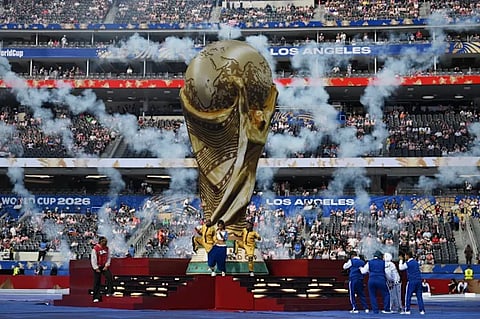

Is anyone even watching football in Bengal? For the first time in living memory, a World Cup is on but something is missing. A certain festive noise, a collective hum of frenzy that always rises in the East in sync with the event’s arrival. All the old clock towers in Calcutta would rumble to a stop for a month. A spell of magic would descend on drab alleyways and crowded trams. Conversations would go from animated to supercharged. Bets would be placed. Friends would fall out.
But there would be a sense of community in things that went unsaid. With each dazzling dribble and pass by the sorcerers of soccer, it was as if a world-historical moment was unfolding. If Brazil won, it was as if colonialism itself was being defeated and humanity was winning. There was hope.
The spectacle this time is very different. The gentle denizens of Bengal are too preoccupied. On what order of magnitude is the disturbance of equilibrium to be measured? The fact that they cannot bring their minds to focus on their beloved football is a fairly good yardstick.
Only those unfamiliar with Bengal would think that to be a trivial symptom. Those who know, they know. It’s a sign that the primary field of consciousness is too crammed with events that call for urgent attention.
For sport to be able to carry the meaning of life, for it to be able to bring vicarious fulfilment of desire, for it to spin magic, everything else has to stay equal. The ground beneath one’s feet must be stable, the sky must be blue, the morning fishmongers must go about with their singsong hollers.
Right now, things seem too fraught for Bengalis to be arguing over Messi and Mbappe. The question on people’s lips is not whether Neymar can move from the left wing to the centre. It is whether Mahua Moitra and Bobby Hakim have such lateral dexterity. Unthinkable? Well, people are ready to believe anything because too many things of that ilk have already come to pass.
Certitudes are collapsing all around, as eggless wonders rise! A wave of demolitions veered perilously close to even the venerable book bazaar at College Street—but mercifully stopped short of the ultimate sacrilege. Watching over all this is a goodly flock of ex-Trinamoolites. Some of them adept at Tagore. All great at dribbling themselves all the way to shifting goalposts.
In reality, what Bengal has lived through is a graded political transition from left to right, with a 15-year interregnum difficult to place within 2D Euclidean space, but the shift appears so sudden and profound that even its proponents seem a little disoriented.
Maybe it’s like what the late Priya Ranjan Dasmunshi of the Congress had once famously said—that Bengal’s politics is “left, more left and far left”. So it’s possibly a bit like shifting from left-hand driving. In the confusion, the wrong Suhrawardy was deboarded. As the new finance minister Swapan Dasgupta may have written in his former avatar, these things happen when you shift from halal to jhatka.
Judging from the flow of memes on the World Cup, Kerala appears in a psychologically more serene place than Bengal despite a fairly momentous political transition of its own. That also means the debates going on right now have the luxury of being more thoroughgoing and introspective. Of course there is that never-ending chatter flowing from the deep animus between the local Congress and Left, which always kept up even when Bengal was willing to dangle on the Dange Line.
But stripped of rhetoric, examined on fundamentals, V D Satheesan’s budget is not too dissimilar from Pinarayi Vijayan’s last, or what Dasgupta offered to Bengal. A bit of welfare, an open call to investors, some rearrangement of furniture inside a tight fiscal room.
Any deeper theoretical questions? Like how to measure relative poverty? You could pose those to any one of the 1.6 million Bengali guest workers in Kerala—where the term ‘Bengali’ is shorthand for all migrant labourers from distant lands. Bengal’s distress in recent times has been such that analysts have taken to eking out economic readings from even Jibananda Das’s poetry! “Instead of a world-weary soul coming back to harmony in Bengal’s beloved landscape, was he not actually talking about Jagat Seth’s trade exploits in Ceylon and the Malaya Sea and beyond?” they ask. Well, those days of financial dominance are long gone.
One day, historians will get to compare the playmaking skills of Swapan Dasgupta with the erudite Asim Dasgupta, the MIT-trained Marxist FM from the Jyoti Basu era.
Leave behind those two states that are usually rapt in navel-gazing, and you can behold Andhra Pradesh, where the mood is entirely different. The historic Amaravati bestows its name to the future. CM Chandrababu Naidu has got the entire state agog in his usual way—from Vizag on the coast, where a new Google data centre is coming up, to the new capital and the beautiful, hill-lined Vijayawada across the Krishna river.
Andhra Pradesh is also attempting a Cristiano Ronaldo-style bicycle kick on old ideas of population control, to nullify the limiting effects of delimitation. Again, we’ll pass that ball to future historians.
Read all columns by Santwana Bhattacharya
Santwana Bhattacharya
Editor
Follow her on X @santwana99
