
With so many people evidently out of step with others in public life, it might be useful to recall a natural law or two in our individual lives: that a convoy moves at the speed of its slowest ship and a team moves at the speed of its leader. So what is a suitable response if an individual is out of sync with his or her holding pattern?
The holding pattern could be long or short. For a newly-married girl, it could be that older women in the house with superior domestic skills make her feel at a disadvantage because they are faster and better at everything. For someone idealistic and hard-working in a bureaucracy or political system, it could be an agonising lack of vision, support, coordination and delivery.
It could be the smart sibling or the popular, charming one with lots of friends, who gives brothers and sisters a complex. It could be the horrible traffic, or a taxi driver who is deliberately taking the long route, or the unhelpful person on the phone, at the counter or the front desk.
What are we hapless humans supposed to do? We could look for inspiration to people in uniform, who have signed up for hours of standing still. Their mental discipline is admirable indeed. But a preliminary and necessary stage to keeping our cool seems to be to embrace our reality, to let God mark us “with his hammer of wind/ And his graver of frost”. This line is from the poem, To a Snowflake, by the English poet Francis Thompson. Published in 1897, it considers the delicate structure of a snowflake, seeing it as art sculpted by God using the forces of nature as his tools. In our case, these forces could mean our frequently difficult circumstances.
A classical instance of accepting reality and deciding to do something about it is the verse where Dasaratha decides to make Rama the crown prince; when grey hair, as though to pre-empt Kaikeyi, appears at his ears like old age whispering, “I am coming.” This is from Kalidasa’s Raghuvamsa 12: 2: “Tam karnamoolamaagatya/ Palitacchadmana jara/ Kaikeyisankayevaaha/ Rameshreernyasyataamiti.
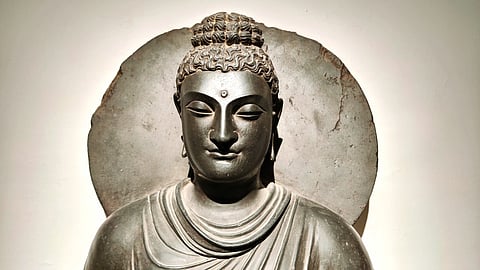
I don’t have a clue about how the armed forces, the police and the paramilitary stay calm through ‘alarums and excursions’, meaning the chaos they repeatedly face. It takes a level of training not available to civilians. But we do know that the Buddha’s secret of being detached even while staying connected to a bad-tempered, stressed-out world was to breathe. Prana, the difference between being dead and alive. To train the mind, which jumps about like a monkey, the ancient yogic method that the Buddha himself is known to have practised is Anapanasati or mindfulness of breathing. The ‘pole’ of breathing in and breathing out is what we ‘tie’ our mind to, which detaches us from difficulties outside. This personal method is actually doable in everyday life. The next time we want to throw a (wholly justified) hissy fit, we may like to try it.
Cheerful company can also help us develop a good attitude. No real friends? Let’s try books. What is reading but silent conversation, asked the 18th-19th century English essayist Charles Lamb. He’s worth reading even today for a new millennium Indian, because he speaks of things that people always need. Of these, would you agree that the gift of perspective is the best gift of all, because it puts our tiny lives into proportion and gives us a rock to stand on? I’d call it good religion.
Many bad things happened to Charles Lamb, but he tried to stay cheerful and admit laughter and the love of friends into his life despite its bleakness. He kept his sense of fun and gladness. Such people, whoever they are, cannot but encourage us.
Here’s what he wrote once in reply to a downcast letter from his friend Robert Lloyd: “O, Robert, I don’t know what you call sweet. Honey and honeycomb, roses and violets, are yet in the earth. The sun and moon yet reign in Heaven, and the lesser lights keep up their pretty twinklings. Meats and drinks, sweet sights and sweet smells, a country walk, spring and autumn, follies and repentance, quarrels and reconcilements, have all a sweetness by turns. Good humour and goodnature, friends at home that love you, and friends abroad that miss you—you possess all these things, and more innumerable, and these are all sweet things. You may extract honey from everything.”
Can you resist a person who says, “A laugh is worth a hundred groans in any market”? Or not chuckle when he says, “Tis the privilege of friendship to talk nonsense and have her nonsense respected”? Lamb was not in denial about his own life nor did he try to pretend his troubles away. “Pain is life—the sharper, the more evidence of life,” he said. But he did try very hard to live by the precept that duty is non-negotiable and that the doing of it must not be marred by bad grace.
“Our duties are to do good expecting nothing again, to bear with contrary dispositions, to be candid and forgiving, not to crave and long after a communication of sentiment and feeling,” he wrote. Echoes of the Bhagavad Gita itself. He insisted though, that to stay a willing prisoner of melancholy was to shortchange life. “Let us live for the beauty of our own reality,” he said. And so we could if we would.
Renuka Narayanan | FAITHLINE | Senior journalist
(Views are personal)
(shebaba09@gmail.com)
