
The subcontinent of India is a great teacher. Of world stature. It is a poor learner. Of world class.
Which other part of the world can claim to have given to the world philosopher-teachers and spiritual pathfinders like the Buddha, Mahavira, Adi Shankara, Tiruvalluvar, the Tamil saint-scholar Avvaiyyar, the Kashmiri mystic Lal Ded? Where else have risen minds such as those of Kabir, Nanak, Sri Ramakrishna, Swami Vivekananda? And scientist-scholars like Aryabhatta, Charaka, Sushruta, Bhaskara, Nagarjuna, Panini, Patanjali, Valmiki? Scarcely any, save perhaps the Greek, Roman and Chinese worlds.
Women of great transformational power who have been born to India in more recent times, such as Savitribai Phule, Ahilyabai Holkar, Pandita Ramabai, Irawati Karve, Muthulakshmi Reddy, Dakshayani Velayudham, Hansa Mehta would rank among all time exemplars.
But which other part of the world has learnt less and forgotten more than ours?
We claim antiquity as our natural partner. And of course it is. But we will be hard put for an answer if told and asked, ‘Yes, you are unquestionably ancient, perhaps among the oldest if not the oldest… but, by that token, are you the wisest, the most exemplary in the matter, say, of how you treat women, children, the numerically weak?’
If we were further asked to speak the bitter truth about the status of human rights in our country, the honest majority among us will admit our record is dismal. The smart minority among us, however, will proceed to point to our great motto that tells us ‘Truth alone triumphs’. But if reminded of simpler home truths like our record on the prevention of custodial torture, the number and class or caste profile of undertrials, the right to free thought and expression, the smart will invoke the vile record of the British Raj in these matters to show how we have emerged from those horrific times.
The testimony of history works with us when the villain is of foreign origin. The theatre of legends and the chiaroscuro of myths is more congenial when it comes to the report card of hard facts.
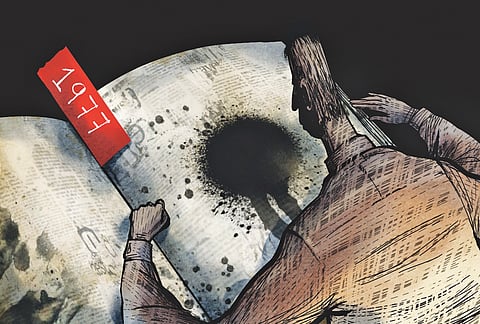
The nasty national Emergency promulgated in 1975 by a hapless President of India at the instance of Prime Minister Indira Gandhi was a hard fact. Hard as nails. We were in a kind of denial, an obligatory denial, when that fact was upon us. Poor learners that we are, we threw all teachings of public policy and political ethics to the winds, and for nearly two years, wallowed in half-truths, untruths and make-believe.
Yes, we had a charismatic woman as our Prime Minister at that time. She had liberated East Pakistan from its thraldom to become Bangladesh, thereby giving the lie to the notorious Two-Nation Theory that had led to murder, loot and rapine in unprecedented scales at the time of Partition. And she had impressed those who are impressed by such things with underground tests of nuclear devices which she assured us were for peaceful purposes.
But did all that justify her pushing India into an internal dictatorship? Heavens, no! Jayaprakash Narayan quoted , for Indira Gandhi to hear, Ramdhari Singh Dinkar’s famous line, ‘Sinhasan khali karo ki janata aagey aayi hai’ (Vacate the throne! For we the people have arrived). Not only was the throne not vacated, JP was arrested and with him countless others from the opposition.
But something else was also done then that was as diabolical as it was ingenious. The Indian National Congress’s president of the day, Dev Kant Barooah, said during the height of the Emergency: “India is Indira and Indira is India.” This was a conscious fluxing of the country with its then leader, knowing that the country had in its subconscious merged the motherland with the image of Mother India which, in turn, evokes the goddess Durga or Kali. Officers lost their spines, the highest court in the land succumbed to fear, a bulldozed media spread untruths on orders with efficiency.
This anniversary month of the nasty Emergency of 1975-1977 enables us to learn the lessons it has taught us by default. These lessons may be seen to include the following.
1. Aberrations in a democracy’s liberal tenets toward dissent cannot and do not last. They end sooner or later because the perpetrators, their heads turned to tin and their hearts to stone, invite public opprobrium. But they need to be called out. And in clear terms, like JP did.
2. The administrator class which forms the infantry of the Executive allows itself all too easily to be co-opted into political manoeuvring. It must resist this for it is meant to guide the political class by a vision and a code that belongs to a different order of values from those of party-driven politics.
3. Legislators should give their political leaders solidarity, but only to the extent that those leaders are in solidarity with the Constitution and its owners—the people—not with themselves and their flattering mirrors.
4. The Judiciary should please but one entity: its judicial conscience. It should practice but one morality: judicial morality. It should pray before but one deity: the scales of justice.
5. And we the people must, with the aid of a free and fearless media like Ramnath Goenka would be proud of, exorcise from our minds something Babasaheb Ambedkar warned us about: hero worship in the cult of personality. And we must, recalling Gandhi, Nehru, Patel, Azad and Rajagopalachari, banish from our consideration all calls for sectarian hatred and violence.
Great as our land is as a teacher, it needs to be no less a learner. India must never cease calling the emergency of 1975-77 what it was: a diabolical trauma. It must never cease to heave a breath of relief that the trauma ended. But India must do one better—make that trauma teach us how to make it impossible to recur.
Gopalkrishna Gandhi | Former Governor of West Bengal and Bihar
(Views are personal)
