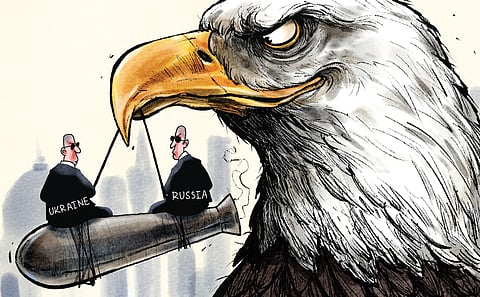

It was not surprising that Russia’s war in Ukraine gave way to the US-Israeli war with Iran, which surged through the past year to hog international attention. Fuel, fertiliser and food are of immediate concern to humanity, unlike geopolitics, which is far too esoteric to be felt in the blood and the heart. But that does not mean that the Ukraine war is any less important. Arguably, its outcome will be far more consequential from a medium- and long-term perspective.
There is a mystique about geopolitical conflicts that is seductive—brutal, but at the same time, pragmatic games played in ‘national interest’ with indeterminate timelines that often linger in the shade lost in thoughts, like a passenger train shunted to a rail siding to clear the main line so that express trains can pass.
The panoramic sweep of geopolitical conflicts makes the outcome harder to predict, as the Ukraine war exemplifies. To borrow from a famous Churchillian metaphor, they are like any political intrigues, “comparable to a bulldog fight under a rug. An outsider only hears the growling, and when he sees the bones fly out from beneath it is obvious who won”.
US President Donald Trump beat a quiet retreat from his self-imposed mediatory role in the Ukraine war once it dawned on him that the geopolitical conflict is far too complicated to lend itself to easy solutions. Ukraine President Volodymyr Zelenskyy proved more than a match for Trump. Trump’s hubris also alienated the Europeans who were kept out of the three-way talks between Washington, Moscow and Kyiv.
Meanwhile, the Persian Gulf beckoned Trump as a natural ally. The US President is acutely conscious of the importance of the petrodollar, which lubricates the American economy and gives massive purchasing power to its paper currency, providing an underpinning for American hegemony in world politics.
Above all, the Jewish lobby was knocking at the door of the Oval Office, beseeching Trump to fulfil his promise to ‘sort out’ the Iran question. Trump’s indebtedness to Jewish money to finance his expensive campaign for the presidency needs no iteration.
Indeed, Trump had everything going with Russian President Vladimir Putin at a personal level, and he probably believed in the legitimacy of Russia’s existential angst over Nato’s lengthening shadows on its western borders. Anyway, after the unhappy sojourn in the Persian Gulf, Trump is in great disarray and is desperately in need of a success story.
A reasonable starting point would be to reconnect with the main trends in big-power equations, which is not difficult because Trump is in a happy position of having friendly relations with both Putin and Chinese President Xi Jinping. Trump announced last week that he will visit China “at some point” this year, setting the stage for an unusually frequent series of face-to-face meetings between the American and Chinese leaders—potentially up to four encounters in 2026.
Trump and Xi have already met once this year for a summit in Beijing, Xi is expected to travel to the United States in September for a State visit, and again in December for the Group of 20 meeting. Unveiling a new US presidential plane on Friday, Trump indicated he would return to China for “a big conference”, namely, the Asia-Pacific Economic Cooperation summit scheduled for November 18-19 in Shenzhen. Trump has tended to skip Apec gatherings, but if he does attend this time, it will be a grand gesture to Xi. Shenzhen is China’s technological powerhouse.
Beijing has been a cooperative bystander all through Trump’s struggle with the Iranians. He would also draw comfort from the 45-page white paper that Beijing brought out on global governance earlier this month, in the middle of the Iran crisis, titled ‘More Just and Equitable Global Governance: China’s Principles, Proposals and Actions’.
The document is a sweeping statement on the future of the international order, highlighting China’s balancing act between global ambitions and financial restraint, and its evolution in recent years as the architect of a new global order notwithstanding. Amid the cacophony of the West Asian and the Eurasian wars, the document probably received insufficient attention. But its central message will not go unnoticed that while championing global governance reform and multilateralism, Beijing remains reticent to commit the scale of financial resources historically associated with global leadership.
Implicitly, Beijing is prioritising a cooperative relationship with the US. Trump would be pleased that his recent State visit to Beijing has turned out to be a success story.
However, when it comes to Russia, the tiding from the recent G7 Summit in France a fortnight ago is that Trump is teaming up with the European allies and is even willing to inherit Joe Biden’s proxy war. This came as a rude shock for Moscow, which was optimistic that once Trump was done with the Iran war, the White House would resume its pressure on Kyiv and its European mentors to settle the war on terms agreed with Putin at the Anchorage summit last August.
But to Moscow’s consternation, US secretary of State Marco Rubio last week scoffed at the very notion that there is any such thing as an Anchorage peace package. Earlier, in a congressional testimony, Rubio was also dismissive about Russia’s terms for a settlement, all but suggesting that a Russian victory in the war is to be ruled out.
Predictably enough, Moscow has reacted sharply. The rhetoric has dramatically shifted to bracket the US and Europeans as an indivisible entity that the Kremlin leadership has to contend with. For the first time, Putin admitted that the Ukrainian attacks deep inside Russia’s refineries and military assets—with the active support, if not participation, of the US and its European allies—is hurting the country.
The air is full of speculation that in the coming weeks, the Kremlin might order retaliatory strikes on the Nato countries in Europe, even risking the wrath of Trump and provoking a direct US intervention.
M K Bhadrakumar | Former diplomat
(Views are personal)
