
Like a pack of cards shuffled and reshuffled to randomise the stack before dealing out to the players, the Election Commission of India has announced major changes to the bureaucracy in West Bengal in less than 24 hours after announcing the schedule for state’s assembly elections. Characteristically, Chief Minister Mamata Banerjee reacted sharply, calling it “midnight mayhem”, complaining that it flouted protocol and suggesting it will hamper administrative work. For good measure, she claimed that all officers in West Bengal worked for the state.
The ECI’s challenge in West Bengal is extreme. It has opted for a two-phase election in a state where recent elections have been held in seven and eight phases. If chopping and changing the top officials is a first step, the aggressive-yet-predictable move reeks of the now-chronic distrust between state and central institutions. It must be considered as an exercise in ensuring a level playing field to kick off a free, fair and violence-free election.
The Trinamool Congress is already tainted with a reputation of unleashing violence before and after elections. The BJP has played victim in the past. But its local leadership—from the noisy Leader of Opposition in the state assembly, Suvendu Adhikari, to past state party president Dilip Ghosh—have warned that there will be retaliation. Ghosh has gone so far as to declare there will be more injuries than heads bandaged and legs in casts—in an obvious, oblique reference to Banerjee’s accident in 2021 after which she campaigned in a wheelchair.
For starters, Chief Secretary Nandini Chakravorty and Home Secretary Jagdish Prasad Meena have been moved out and are to be excluded from any position that has to do with the election process. It may not be a grudge order; the chief secretary was earlier summoned to Nirvachan Sadan in Delhi to explain why several ECI directives had not been implemented. Others on the chop-and-change list include Peeyush Pandey, who was temporarily replaced as Director General and Inspector General of Police by Siddh Nath Gupta, and Supratim Sarkar, replaced as Kolkata Police Commissioner by Ajay Kumar Nand. A statement from Nirvachan Sadan has promised more changes to follow.
As a demonstration of its powers and promise, which is an obligation under the Constitution, the ECI’s orders on the changes are a shock-and-awe exercise. Since the ECI is not required to explain its actions, the measures are open to speculation—including the most obvious one that the ECI is concerned about the bureaucracy following its orders promptly and fully.
Whether these changes would satisfy the ECI is a different matter. In the 2024 Lok Sabha elections, the ECI had shunted out the home secretaries of Gujarat, Uttar Pradesh, Bihar, Jharkhand, Himachal Pradesh and Uttarakhand, as well as the DGP of West Bengal.
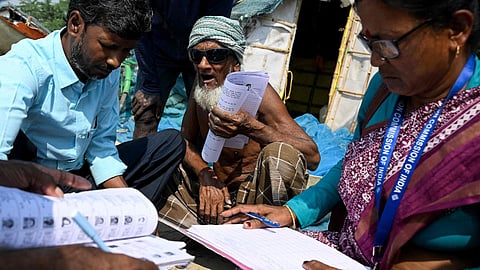
The necessity to have a truly acquiescent bureaucracy in place for the West Bengal election is understandable. The ECI is under extreme pressure because its final voter list for the state is still incomplete, with over 60 lakh names under adjudication and direction from the Supreme Court that it must continue to dispose of pending cases up until the last minute before polling day. With 294 constituencies with voter lists under adjudication, the public mood is volatile, political tempers are unpredictable and managing the environment difficult.
Chief Election Commissioner Gyanesh Kumar said on March 10 in Kolkata, “Political violence will not be tolerated, no elector will be placed under any kind of pressure, and anti-social elements will refrain from any acts of violence. If they try to indulge in such acts, then strong action will be taken.” Given the changes, Kumar can hope to deliver on his promise.
After the seven-phase 2024 elections, delivering a two-phase violence-free one that satisfies political participants and voters alike—some of the, still waiting for confirmation on their right to vote—is a daunting task.
In phase one on April 23, 152 constituencies from north to south Bengal will go to the polls. All these constituencies are located west of an imaginary line that splits the state vertically into two. As it happens, most of the seats won by the BJP will go to the polls on Day One. Of the 152 seats in the first phase, the BJP won 59, mostly from north Bengal, and Trinamool won 92.
Of the 142 constituencies to vote on Day Two—all of them in South Bengal and several along the 2216-km border with Bangladesh—the Trinamool won 123 seats against BJP’s 18. The districts with the most deletions and adjudicated cases are clubbed in the second phase—Murshidabad (11 lakh cases), North and South 24 Parganas. A third of the cases under adjudication are in Murshidabad and Malda (8 lakh), the latter voting in the first phase. There are 4.8 lakh cases under adjudication in Uttar Dinajpur, 5.9 lakh in North 24 Parganas, and 5.2 lakh in South 24 Parganas. These districts also have a high share of Muslims.
Amid these powder kegs, Kumar has a reputation to retrieve. The ECI’s credibility has been torn to shreds by three of the four principal parties in West Bengal—with the Trinamool, Congress and CPI(M) being on the same side. The gap between Kumar’s target and performance on the state SIR, with delays and a large number of legal proceedings, means that he now has to go an extra mile to ensure that eligible voters, purified and certified by the roll cleansing, get to exercise their franchise.
Shikha Mukerjee | Political commentator
(Views are personal)
