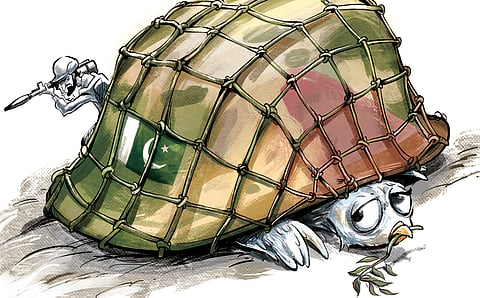

This Monday’s bombardment of a rehabilitation centre in Kabul, which killed more than 400 people, is the latest confirmation of the fact that the raison d’être of the Pakistan army is to wage war—across its borders and within. Within a year, it has fought Afghans to the west, the Baloch people within, and Indians to the east. But its history of friction with India illustrates this in the sharpest manner possible.
Both Atal Behari Vajpayee and Manmohan Singh sincerely wanted to break the cycle of hostility and violence that characterised India-Pakistan relations. The 1999 Lahore bus trip, when Prime Minister Vajpayee travelled on the first Delhi-Lahore bus service to meet his counterpart, Nawaz Sharif, was an overt overture to bury the hatchet. The Agra Summit of 2001 and the ‘Srinagar handshake’ of 2003, during which he extended his hand of friendship once more to Pakistan, despite the Kargil incursion in 1999 and the attack on the Indian Parliament in 2001, were generous attempts to strike new ground.
Manmohan Singh, too, believed in a paradigm shift in our relationship with Pakistan and in finding an administrative solution to the Kashmir issue. Speaking in Amritsar in 2006, he said, “Borders cannot be redrawn, but we can work towards making them irrelevant—towards making them just lines on a map. People on both sides of the Line of Control should be able to move more freely and trade with one another.”
He established a backchannel of diplomacy with Ambassador Satinder Lamba on the Indian side speaking with Pervez Musharraf’s confidant Tariq Aziz. The rough contours of greater understanding were taking shape, involving a more porous border for free trade, a joint consultative mechanism, phased demilitarisation and greater self-governance in Kashmir on both sides of the border. Confidence-building was the name of the game. As cabinet secretary, I too was involved in part, trying to oil the wheels of trade by speeding it up through faster customs facilitation and removing bottlenecks in train movements.
Then, with devastating effect, 26/11 struck. Just as the Kargil conflict had followed the Lahore bus diplomacy, the attack on the Indian Parliament had followed the Agra Summit. When Narendra Modi became Prime Minister, he too endeavoured to build a new edifice of peace with Pakistan. He invited Nawaz Sharif to his swearing-in ceremony, which the latter accepted. He met Sharif on the sidelines of two international meetings, and, most surprisingly of all, broke diplomatic protocol by flying to Pakistan on Christmas Day of 2015 to attend Nawaz Sharif’s 66th birthday and celebration of his granddaughter’s wedding at Raiwind, an unscheduled visit on his way back from official visits to Russia and Afghanistan. In a couple of weeks, the response came: vicious attacks on our air force base at Pathankot and on our army base at Uri.
The pattern is telling, even predictable—attempts to make peace, followed immediately by violence emanating from Pakistan. I recall from my days in the commerce ministry that, for years on end, we did not file a dispute against Pakistan for failing to extend the most favoured nation treatment to us, as they were required to under World Trade Organization rules. The effort was always to handle them with kid gloves in the hope that someday they would come to the negotiating table with us. A fond hope that is receding by the day as Trump cosies up to the Pakistan army.
Why is it so hard to make peace with Pakistan? Why does every attempt at peace lead to military or terrorist actions from their side?
Ayesha Siddiqa’s 2007 book, Military Inc: Inside Pakistan’s Military Economy, explains this well. She shows that the Pakistani army is not funded by the State and does not answer to Parliament. Instead, it is a self-financing economic behemoth that works outside normal financial controls. Through military welfare foundations such as Fauji, Shaheen, Bahria and the Army Welfare Trust, the armed forces operate banks, insurance companies, universities, bakeries, cement plants and private security firms. The Army Welfare Trust owns Askari Bank and Askari General Insurance Company.
Different branches of the military operate institutes of higher education including the National University of Sciences and Technology, Foundation University, Bahria University and Air University. Fauji Cereals and Fauji Foods are in the food business, and the Canteen Stores Department runs a large retail chain across the country. There is also Fauji Cement Company and security firms like Askari Guards and Fauji Security Services.
The businesses generate huge profits that are ploughed into real estate, spearheaded by the Defence Housing Authority, allotting large tracts of urban and agricultural land to retiring military personnel. The growth of the Pakistani military economy also stifled private initiative, as the military obtained huge concessions through tax exemptions, State monopolies and contractual preferences. Even foreign investment has to cope with military dominance. The special Investment Facilitation Council, formed in 2023, is co-chaired by the Prime Minister and the Chief of Army Staff.
Much of the Pakistani military’s growth as a major economic entity was made possible by generous US aid during the Cold War, especially during the Soviet occupation of Afghanistan and, later, after 9/11. The rise of military business, or “milbus” as Siddiqa calls it, has led to the creation of militant groups like Lashkar-e-Taiba and Jaish-e-Mohammed, created primarily to inflict a “thousand cuts” on India, although the Tehreek-e-Taliban has now emerged to torment Pakistan itself.
In the final analysis, India cannot deal with Pakistan as it is ruled by the army, notwithstanding the fiction of an elected government. It’s escalating the ongoing conflict with Afghanistan, as Monday’s strike showed. And continues its belligerent actions in Balochistan under foreign protection.
Without continued hostility, the Pakistan army cannot maintain its comforts. Nor can it allow true democracy to develop. Hence, peace in the region is a distant dream, particularly since a puerile American President thinks he can break into India’s market for agricultural products indirectly by fostering ties with the Pakistan army.
K M Chandrasekhar | Former Cabinet Secretary and author of As Good as My Word: A Memoir
(Views are personal)
(kmchandrasekhar@gmail.com)
