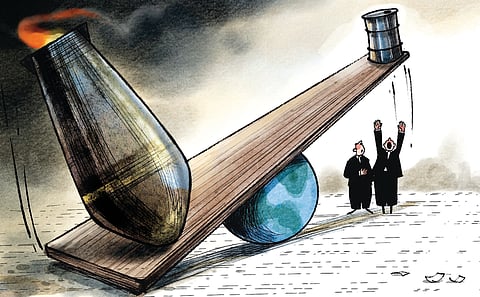

As oil prices continue to seek stability, a delinquency is reiterated—flirtatious by instinct, oil alliances often slip out of prospective marriage. The altar is disturbed again as the markets are spooked by the de facto closure of the Strait of Hormuz affecting a fifth of the world’s oil supply. Brent crude continues to breach new highs at $119 a barrel.
For a clearer sense of the present, we must go back a bit. In 1953, the nationalisation of Iran’s oil industry and the Anglo-Iranian Oil Company’s diminishing influence led to the complicity of Britain’s MI6 and America’s CIA in instigating a coup and ousting Prime Minister Mohammad Mossadegh to reinstate the Shah. The next 26 years lead to widespread discontent with the authoritarian rule of Reza Pahlavi, often accused of coercion and oppressive dictatorship. The 1979 revolution followed, sowing the seeds for decades of hostility between Iran and the West.
The current conflict isn’t limited to oil. It’s part of an attempt to reframe global power dynamics that has been on for the past few decades. After failing to deter Tehran from pursuing its nuclear programme and emboldened by a supposed euphoric oil glut, the US-Israel partnership is seeking to turn the screws on Iran again.
History shows that the weaponisation of oil has only morphed over the decades. In the 1980s’ Iran-Iraq war, Israel supported Iran, providing military equipment in a bid to avert Saddam Hussein’s victory. At the same time, the US provided significant covert support to Iraq. However, it’s now well known that the Reagan administration also facilitated a clandestine arms supply to Iran under the pretext of freeing American hostages held by its Lebanese proxy Hezbollah.
In 1987, under Operation Nimble Archer, the US targeted oil platforms in retaliation to Iran’s attack on a re-flagged Kuwaiti tanker. Later, in April 1988, during Operation Praying Mantis, Iran’s naval targets and command centres on unusable oil platforms were selectively destroyed, leading Iran to agree to a ceasefire with Iraq and an inconclusive end to their eight-year war.
Geopolitical instability nurtures market volatility. During the Libyan crisis, the UN’s approval of military action against the Muammar Gaddafi regime pushed oil prices to $127 in March 2011. However, the prices fell by end-October as news of the Libyan leader’s death spread. The possible end to the civil war offered hope for supplies to ease.
While Gaddafi’s was a personalised and populist State, the Islamic republic is a complex, institutionalised theocracy where individual executions would not alter the system. Historically, military events and political revolutions in major oil-producing nations coerce a befuddled market to nudge irrational valuations, sometimes far from the ground reality.
Resting on ideological differences and an obsequious US-Arab proximity, Iran’s continued attacks on oil and gas storage and processing facilities have earned its neighbours’ ire. West Asia is demoralised by a war thrust upon them by the US despite investments worth trillions in joint ventures beyond energy.
However, the unpredictability of the present White House incumbent leaves them no choice but to tacitly align with Washington. Rising energy prices may shore up the US’s balance sheet for now, but the senseless war is bound to inflict fiscal wounds on the American economy.
Opec members’ idle production capacity was expected to fill the shortfall. However, in hindsight, over-optimism prevailed. Conflicts in the oil belt always leverage collateral damage, as was evident during the Iraq war and the 2019 attack on Saudi refineries. In such times, storage is a major logistical impediment apart from production and transit. As inventories pile up, production cut-downs at wells or selective shut-downs are inevitable. Neither is an easy option, as some wells never regain full capacity and others suffer loss of pressure, thus turning unviable.
Though China buys 80 percent of Iran’s oil, it constitutes less than 15 percent of its total oil imports. Beijing’s long-term investments in Iran since 2021 have sought as much security as its energy investments in Saudi Arabia and the UAE. Its Belt and Road Initiative has invoked Chinese engagement with over 150 countries in energy, infrastructure and, of late, ‘green’ projects.
Beijing has often touted the idea of yuan-based oil trade. The two largest producers, Saudi Arabia and Iran, patronise the concept as it facilitates their growing trade profile with China. Tehran has lately transacted most of its oil in yuan, partly offsetting the revenue via import of Chinese equipment and maintaining the surplus as an external reserve.
Given this backdrop, a total closure of the Strait of Hormuz could financially cripple the Islamic republic, as tankers today continue to ferry Iranian oil to China through the waterway. With Iran’s ageing oil infrastructure needing large investments and Saudi Arabia’s foray into artificial intelligence and solar power, Beijing’s tutelage is much sought after. The present conflict will accelerate the transition.
Meanwhile, the selective waiver of sanctions on Russian oil and the release of massive amounts from emergency reserves by the US and its allies have failed to stabilise the global markets. Drone attacks on Qatar’s Ras Laffan complex, disrupting 20 percent of the global liquefied natural gas supply, has resulted in European gas prices to surge more than 50 percent.
Saudi Aramco’s Ras Tanura refinery, the largest in the kingdom that is located close to the Strait of Hormuz, produces some of the most environment-friendly fuel. Any major disruption of the behemoth could significantly impact oil exports, especially of premium products.
In 1973, during the oil embargo, the US defence secretary had hinted at military intervention as a last resort. In January 1975, secretary of State Henry Kissinger had repeated the hint. Arab leaders had then threatened to blow up their oil fields. Though the circumstances differ today, in an effort to pressurise America, safeguard assets from Iran’s strategic attacks and pursue “existential cooperation”, the Gulf producers could collectively cease exports. The price flare-up then would singe the markets real strong.
With prolonged uncertainty and rising scarcity, the markets could insidiously slip deeper into speculators’ arena. Physical oil cargoes are already trading at a considerable premium to the exchange-traded benchmarks in a ‘mispriced’ market scenario. If Brent crude consistently hits $150 at the exchange, it could stop either the war or the ticker.
Ranjan Tandon | Senior markets specialist and author
(Views are personal)
