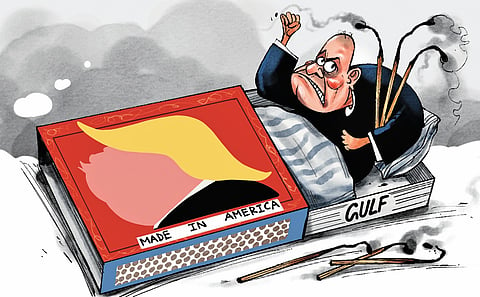

The Gulf is unlikely to ever be the same again. Not after this war is over. This shallow, roughly 1,000-kilometre-long semi-enclosed sea in West Asia is being redefined in a manner unimaginable since US President Jimmy Carter articulated a doctrine in 1980 that placed the Gulf at the centre of American strategic interests.
As we long learnt as students of international relations, the so-called stability of the Persian Gulf rested on a fundamental assumption: that American power could underwrite regional stability without fundamentally destabilising it. This was the logic of what might be called ‘outsourced security’—a system in which local regimes ceded strategic autonomy in exchange for protection. The US-Israel war on Iran has now exposed a central paradox of contemporary geopolitics: in an era of precision warfare and asymmetric retaliation, proximity to a hegemonic superpower does not guarantee security. It can generate exposure and intensify vulnerabilities. The Gulf states find themselves at the centre of this contradiction. What the ongoing war has done is expose the promise of American security guarantees for what they always were: contingent, transactional and ultimately indifferent to the vulnerabilities they created. The Gulf states are not the central actors of this war. But they are its most consequential geography: economically, strategically and politically.
The Gulf is often treated as a monolithic strategic bloc. It is not.
Saudi Arabia has long viewed Iran as its principal rival. Yet, it also understands the risks of systemic collapse across the Gulf. The prospect of regime change in Tehran does not promise stability; it raises the spectre of fragmentation. The memory of the Abqaiq attacks in 2019 continues to shape Saudi risk assessments: those strikes temporarily knocked out 5.7 million barrels a day of Saudi output or more than 5 percent of global oil supply. Vulnerability cannot be entirely mitigated, only managed. That lesson was not lost on the generation of technocrats now running Vision 2030—no sovereign wealth fund survives a regional conflagration.
The United Arab Emirates and Qatar present a different face of the same fragility. Dubai, emblematic of globalised urbanism, was designed as a node of flows: capital, labour, logistics; a Singapore for the Arab world. But flows reverse under conditions of risk. With expatriates accounting for roughly 88 percent of residents, the UAE’s success depends on perception, and war alters perception with an efficiency that no marketing budget can counter. Dubai’s dream of replacing Singapore as the destination for expats is on the verge of vapourising.
Qatar’s position is even more complex. As host to major US military installations and a long-standing interlocutor with Iran, Doha has cultivated calibrated engagement as a substitute for strategic depth; it has hosted quiet dialogue, including that between the Taliban and Western world. But mediation requires space, and war compresses it. As aviation routes are disrupted and energy infrastructure is targeted, Qatar’s role as a connector state is under intense pressure. In Bahrain, external vulnerability intersects with internal fragility in ways that neither the ruling family nor its Saudi patrons can fully manage. Meanwhile, Oman and Kuwait persist in ambiguity; Oman’s long-standing role as a diplomatic intermediary reflects not idealism, but a hard-won realism about the limits of alignment.
At the heart of this crisis lies, as we know, a fundamental paradox and structural irony that the Gulf’s rulers have long understood but preferred not to articulate: the arrangements built to deter attack have become the very reason to mount one. The bases that reassure them also make them targets. The weapons purchases that signal commitment also signal targeting coordinates. The Gulf states invested heavily in American security guarantees—and those guarantees are now part of what makes them exposed.
The Gulf’s model of development has been built on the assumption that economic interdependence mitigates geopolitical risk. That assumption is increasingly difficult to sustain. Disruptions in the Strait of Hormuz—through which a critical share of global energy transits—have immediate systemic consequences. In 2024, the strait carried around 20 million barrels of oil a day and about one-fifth of global LNG trade. Aviation hubs in Doha and Dubai, central to global connectivity, are exposed. The damage to civilian infrastructure across the Gulf, and above all the disproportionate burden borne by the region’s migrant workers, will mark a moment of reckoning.
It would be premature to speak of an American withdrawal from the Gulf. The United States remains the region’s predominant external power. But credibility is a function of assurances being met. If security guarantees are seen as failing, then they will be articulated through new hedging strategies, alternative partnerships and independent decisions made without Washington’s prior knowledge.
What may therefore emerge is not total rupture, but recalibration: a Gulf more inclined toward strategic diversification, greater autonomy and a more transactional approach to external partnerships—one in which American power remains relevant but is no longer assumed.
For countries like India, the stakes are immediate. The Gulf is an extension of India’s economic and strategic space —a source of energy, remittances and connectivity that no easy redirection can quickly replace. New Delhi’s policy must therefore be guided by patience and prudence: support de-escalation, preserve engagement across divides and resist even de facto incorporation into a conflict that destabilises its extended neighbourhood. The channels of communication with Tehran must be particularly maintained.
What this war has revealed is not simply the fragility of a region, but the exhaustion of a system—one that sustained itself for fifty years on the willingness of local actors to trade sovereignty for security, and on the American willingness to provide security without accountability. Both conditions are now in doubt. What replaces them will be improvised, contested and imperfect. But it will not look like what came before.
The era of outsourced security is ending. The era of its consequences has only just begun. It is important that India craft its policies on the basis of long-term interests rather than any cosy arrangements crafted with the despotic dictators of the region.
Amitabh Mattoo | Dean, School of International Studies, JNU; former member, National Security Advisory Board
(Views are personal)
