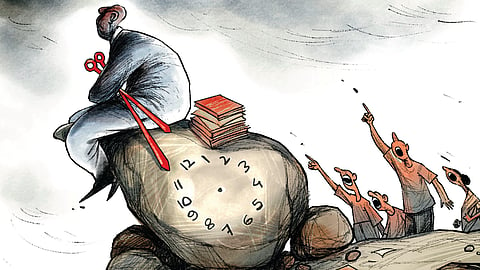

A year and a half into office, the National People’s Power (NPP) administration finds itself mired in a series of controversies that undermine public trust. While the incidents emerge one after the other, it only makes matters worse to find the NPP arrogantly refusing to acknowledge its mistakes or to explain and apologise for corruption, complacency and inefficiency.
The past few weeks have proved dramatic and damaging to the administration’s reputation.
These multiple controversies are of the NPP’s own making, and like its predecessors, the NPP refuses to own up to its mistakes. Led by the Janatha Vimukthi Peramuna (JVP), NPP has a history of being quick to condemn governments that preceded it. But now in office, it remains tight-lipped about fraud and inefficiency, responding only when forced to. It lacks openness and acts only when matters snowball. The NPP has proved slow to act against its members’ questionable conduct, responding only when public outcries intensify, threatening its foundations.
It all started when the government tried to brush aside the first doubt about its members’ sincerity. In December 2024, the new government was questioned about the purported doctorate of the newly appointed speaker, Asoka Ranwala, triggering a public debate over fake credentials. Mumbled excuses bought some time, but no action was taken against him for a false declaration. When it became a question of reputation, Ranwala, who repeatedly promised to produce documentary evidence, stepped down from the position. There was no inquiry, and the matter was swiftly swept under the carpet.
For months, allegations were levelled against the NPP for inferior-quality coal procurements. As the West Asia crisis raged on, Sri Lanka’s energy minister Kumara Jayakody resigned from his portfolio under severe public pressure on April 17. Jayakody had been indicted in a 2015 corruption probe. At the time, he was a procurement officer with the Ceylon Fertilizer Company, and his decision reportedly resulted in a loss of over Rs 8.8 million. Despite a mountain of criticism and a court indictment, President Anura Kumara Dissanayake did not remove him. Dissanayake insisted that he would not tolerate corruption in his government but chose to ignore Jayakody’s past record.
The Jayakody saga created a serious dent in the government’s reputation, with serious allegations being made against the minister for importing sub-standard coal for the Lakvijaya power plant, until his rather late resignation last month. The government maintained a volte-face, undeterred by months of public questioning and defeated a no-confidence motion in parliament using its supermajority in a house elected entirely on an anti-corruption platform. What broke the camel’s back was a national audit faulting the administration for the low-quality coal, which was affecting the power plant’s operations, necessitating diesel-powered generation when energy prices were increasing and threatening supplies due to external conditions. Soon after Jayakody’s resignation, Dissanayake appointed a special commission of inquiry, not just to enquire about his government’s questionable purchase, but to review coal purchases since 2009.
On April 30, Ranga Rajapaksa, a suspended assistant director from the finance ministry's external resources department, was found dead at his home. Forensic experts have ruled the death was due to self-inflicted injuries. He was recently suspended from his role at the ministry during an investigation into a cyber-fraud scheme resulting in a $2.5-million loss.
In a damning report, the National Audit Office found that the award of a coal tender to Trident Chemphar Limited, a company considered a shell in India, violated tender procedures.
In the $2.5-million heist, the plot has thickened, with the Criminal Investigation Department informing court that there had been an email compromise. For two months, the government closely guarded a secret until the organisation ‘Free Lawyers’ revealed it to the public, causing widespread public shock. The government quickly claimed the treasury had been hacked and attempted to play it down. But Sri Lanka has seen fiscal scams before and the coal and treasury scams combined fuelled public criticism anew, raising serious questions about corruption, mismanagement and irregularities. To date, the government has not spoken of actions taken to prevent recurrence or to ensure the security of financial systems. The opposition, meanwhile, has called for a full-day debate on the treasury heist.
The fraud has highlighted the government’s administrative deficiencies. The government broke its long silence, claiming that a hacker had compromised the system and announcing that an investigation is underway. It was discovered that the payments were sent to an account unrelated to the contractor.
As more questions are raised, the government attempts to manipulate the public narrative, reminding people of Machiavellian tactics of impression management through the utilisation of charm or by appearing competent or trustworthy, while concealing motives.
The NPP should remember that it was given a historic mandate to reform the system and implement rigorous safeguards, particularly for financial systems that were discovered to be vulnerable. It is an administration founded on an anti-corruption platform and reviving governance mechanisms to restore public trust. For decades, the JVP being the main constituent of the NPP, rebelled against the status quo and felt emboldened by the public rejection of the old political guard, which propelled it into office two years after the public uprising against the Gotabaya Rajapaksa administration. The NPP was installed to curb corruption, punish previous wrongdoings and ensure good governance.
The nation’s fiscal framework is under scrutiny, raising concerns not only about administrative ability but also about political determination. The government continues to offer lame explanations as people continue to lose faith. A band of apologists, screaming in chorus and attempting to create a counter-narrative, will not work in a country that has reeked of corruption and has been compelled to thrust traditional political parties out of office.
The government must put its house in order or perish at the next electoral cycle.
Dilrukshi Handunnetti | Award-winning journalist and lawyer; founder and director of Colombo-based Center for Investigative Reporting
(Views are personal)
(dilrukshi@cir.lk)
