
Conspiracy theorists were once called cranks and viewed with contempt by the sophisticates of society. Today, they dominate public discourse. Figures like Joe Rogan (who asks whether the pyramids or ancient Indian temples were built by superhuman technology), Tucker Carlson (who says Israel runs America instead of its electorate) and Candace Owens (who swears that the French president is married to a transgender woman) command larger audiences than traditional media. And, of course, many have seen aliens.
Just as gossip is a collective, if malevolent, approximation towards truth, conspiracy theories grope towards the idea that reality is maya: we do not see what we see. Almost all of this scepticism flows from our largely disappointing lives and the sense that legacy institutions, such as parliament or media, have failed. The real triumph of the conspiracy theorist is not that any one plot has been exposed, but that the conspiratorial imagination is becoming the default way of reading power.
How did this happen? Not through one grand betrayal, but through a series of small, individually rational choices—each perhaps justified on its own—that collectively produce an outcome no one explicitly intended. Each conspiracy theory chips away at public trust until the edifice collapses.
For decades, public truth was mediated through a small set of actors: State broadcasters, major newspapers and the judiciary. There was the belief that these institutions existed for public interest. That faith was largely true, or so we thought—because there was no social media then, not a million voices saying a million different things—if only to feel we all make a difference to the world.
One great reason for this shift is simple: every State apparatus entrusted with delivering justice is run by careerists. Naturally, no careerist endangers their job when the State’s interests are in question. It’s symbiosis. As philosopher Louis Althusser says, every apparatus justifies itself to the extent it consolidates state power. The conspiracy theorist’s credibility is sourced from the State not fully delivering on its promises, and also because that’s his or her career. The career of the outcast.
What ‘really happened’ was, until recently, mediated by time honoured institutions. That is now in question, replaced by rogue versions. It is the Walmart of narratives. You are free to choose depending on the mood of the moment. Truth, like an atom, is divisible.
So almost overnight, Tucker Carlson, held in contempt by Democrats, has become their uncrowned spokesperson as he interprets Trump as a war-monger and a puppet of Israel, the cornerstone of America’s deep state. Israel, until recently a victim nation, is now seen as the villain—though its ethno-supremacist policies have been consistent since 1948. What changed is our perception of the State. Carlson is one reason why. And with perception, reality too changes.
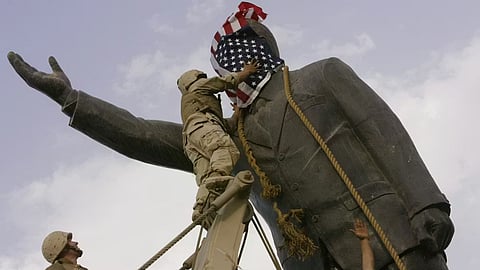
The Iraq war offers the clearest prototype. In 2002-03, US officials framed the invasion as a response to the imminent threat of weapons of mass destruction. Millions of lives and many orphaned children later, when no stockpiles were found, the war became its own critique.
Iraq was a turning point in the public distrust of the official version. But no single decision caused the mutant ‘sceptical’ gene of the present. It has been a cumulative process—what economists call the tyranny of small decisions. One man spits on the road, no problem; everybody does it independently, and it’s a problem.
In India, the 2021 Pegasus revelations showed that a powerful surveillance tool had been used against journalists, lawyers, and activists. Evidence-based reporting, coupled with patchy official responses, produced a framework of suspicion: if this much can be hidden, what else goes on behind closed doors?
Social media accelerates this logic. Platforms reward engagement, and nothing competes with nuance like the sudden revelation of a hidden pattern: the election “stolen”, the pandemic “engineered” for profit. Is it true? We don’t know
for certain. But it is in this grey mist of doubt that institutions begin to assume a spectral shape. And so, the world appears to be in a state of permanent riot.
And it is set to worsen with artificial intelligence. Deepfakes and synthetic audio blur evidence and artefact. Recently, Trump congratulated himself for Iran not executing eight feminist activists. Iran said the eight were AI creations.
Over time, the accumulated effect of these individual creative contributions is the loss of a shared, verifiable reality. Citizens once assumed that the State, however flawed, aimed at public interest. When that assumption erodes—not by decree, but by a thousand justified disappointments—conspiracy becomes the only intellectual tool that seems capable of explaining the world.
When verified investigations and wild fabrications are treated as equally plausible, public reasoning becomes a marketplace of mutually exclusive belief systems, each just in its own right, each propagated by its own media channels. Truth, like an atom, becomes divisible. The Iraq WMD scandal, the Snowden leaks and the Pegasus revelations re-taught citizens that there is always a “real story” behind the official one.
The triumph of the conspiracy theorist is not that they have been proven right, but that we now mediate the world through the outlier’s imagination. This is the new Matrix. And we have, with great dedication and equal abandon, thrown away the red pill.
C P Surendran | Author whose latest volume of poetry is Window with a Train Attached
(Views are personal)
(cpsurendran@gmail.com)
