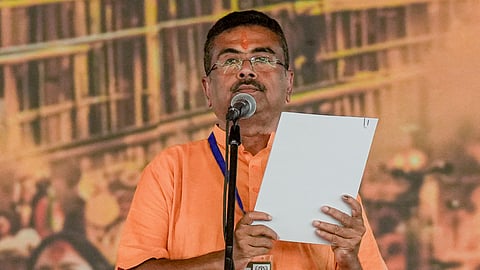

In the blazing midday sun on May 9, history did not merely turn a page at Kolkata’s Brigade Parade Ground. It erupted in a saffron surge that scorched away over seven decades of ideological inertia. For the first time in West Bengal’s storied annals, a saffron-clad stalwart ascended as Chief Minister. Suvendu Adhikari, 55, a celibate political phoenix who rose from the Trinamool Congress’s daredevil ranks, strode forward in resplendent saffron to take his oath. His attire was no mere fabric. It was a defiant drape of cultural reclamation in a state long bound by Congress complacency, Marxist misrule and Mamata’s machinations.
Moments earlier, Prime Minister Narendra Modi had driven alongside him in a saffron-coloured, open-top motorised ‘rath’, a chariot of conquest specially forged for this occasion cutting through streets electric with anticipation. Before that, Governor R N Ravi, who had rarely donned traditional vestments during his Tamil Nadu tenure, stood resplendent in a saffron kurta paired with a flowing Bengali dhoti and offered his prayers to Rabindranath Tagore, whose birth anniversary fell on the day, along with his wife in a matching sari.
The entire pandal was transformed into a saffron sea of humanity: flags fluttering, scarves waving, foreheads marked with vermilion resolve. Adhikari and his five Cabinet ministers, each a study in saffron symmetry, embodied the new colour and new contours the state had so decisively acquired. It wasn’t just symbolism. It was a statement declaring Bengal’s new cultural identity.
The mandate that propelled this moment was nothing short of a historic rupture. BJP’s victory, securing 207 seats and a commanding 45 percent vote share, spoke not in whispers but in roars of righteous resentment. Voters came not for incremental tweaks but for total transformation. For Modi, Amit Shah and the RSS’s loyalist cadre, this was more than electoral arithmetic. It was a cultural conquest that erased, in one sweeping stroke, 175 years of British imperial memory. Kolkata was the cradle of colonial conquest. It was from here that Warren Hastings, the first governor-general of Bengal in 1774, had administered an empire that stretched its tentacles across the subcontinent. The city that birthed the British Raj’s administrative spine now witnessed its symbolic demolition.
The BJP’s choreography was masterful, meticulous and farsighted. West Bengal was deliberately positioned as the last state to conclude its polls. A generous five-day interval separated the final voting phase from the count on 4 May, a date pregnant with purpose, coinciding with the birth anniversary of Jan Sangh’s icon Syama Prasad Mookerjee, the founder whose vision of integral Bharat had been buried under layers of leftist historiography. The swearing-in was fixed for May 9, evoking Tagore’s timeless legacy while stamping it with saffron sanctity. Even the decision to relocate the seat of governance from Banerjee’s pet project, Nabanna, back to the storied Writers’ Building signalled restoration. Designed in 1777 by Thomas Lyon as the East India Company’s clerical citadel, the building had housed the ‘writers’ who scripted colonial edicts.
Beneath this spectacle lay deeper roots that the BJP had patiently watered for 15 years. West Bengal’s soil had always been fertile for sanatani nationalism. It was the land of Raja Ram Mohan Roy, the rationalist reformer who lit the first lamps of renaissance. Bankim Chandra Chatterjee penned Vande Mataram, the national song that stirred generations. Subhas Bose forged an aggressive freedom movement that challenged the Raj. Sri Aurobindo elevated Hindu spirituality into a revolutionary creed. Swami Vivekananda became Hinduism’s global ambassador, thundering at the Parliament of Religions that India’s soul was eternal. These giants had sown seeds of cultural nationalism so profound that neither Congress’s secular dilution nor the Marxists’ materialist hammer could uproot them.
Yet for seven decades, these icons were consigned to archival dust. The Congress, the Left Front and later the Trinamool Congress converted Bengal into a soulless, splintered state. Vote-bank politics fragmented society along religious and regional fault lines. Infiltration from Bangladesh turned border districts into tinderboxes. Violence, often state-tolerated, chased away investors. Once an industrial powerhouse, Bengal became a byword for capital flight, deindustrialisation and extortion. Per-capita income, which stood at 127.5 per cent of the national average in 1960-61, plummeted to a humiliating 83.7 per cent. Its share of national GDP shrank from 10.5 per cent to 5.8 per cent.
The BJP spotted the opening. For 15 years, they worked silently identifying victims of humiliation, reminding Hindus of their endangered symbols of worship, warning of a future where demographic shifts could render them strangers in their own land. The anger that simmered through the Sandeshkhali horrors, post-poll violence and daily indignities finally boiled over. Hindus, across castes and classes, voted in unprecedented solidarity not merely rejecting the old regime but demanding restoration.
Yet victory brings its sternest litmus test. Adhikari’s government must now deliver more than rhetoric. The millions who queued under the summer sun expect bread with brotherhood, tangible development that heals rather than divides. They voted for Hindu solidarity; they now crave Ram Rajya in practice: governance that restores dignity to the dispossessed, revives investment without fear of goons, secures borders without appeasement, and rebuilds Bengal’s intellectual and economic sinews. The shift to Writers’ Building is emblematic of this deeper intent. No longer will the secretariat sit in a modern edifice severed from history. It returns to the very halls where clerks once penned imperial decrees and where revolutionaries later defied them. In moving there, the new dispensation declares that Bengal’s identity is neither a colonial relic nor a leftist laboratory, but a living continuum of Bharat.
Critics will carp, of course. Some will decry “saffronisation” as if cultural assertion were a sin. Others will lament the end of “secular” fiefdoms built on selective silences. But the mandate is unambiguous. Voters rejected the broken promises of the past—land reforms that stagnated agriculture, industrial policies that invited strikes over growth, minority politics that ignored the majority’s mounting anxiety and chose disruption instead.
The May 9 ceremony was not pomp for its own sake. It was a prophecy fulfilled. The seeds were planted by Bengal’s own nationalists. Roy’s reason, Bankim’s patriotism, Bose’s bravery, Aurobindo’s vision, Vivekananda’s vigour have finally fructified. History has been rewritten in saffron ink. The coming years will determine whether that ink becomes the permanent script of a resurgent Bengal or merely a bold first chapter. For now, one truth stands unassailable. The original soul of Bengal has returned home.
POWER & POLITICS
prabhuchawla@newindianexpress.com
Follow him on X @PrabhuChawla
