
Given the utterly vile news of post-poll violence, it’s as though no laws, no notions of morality or self-control were ever discussed or instituted in the many millenniums gone by. Human nature doesn’t seem to have changed from BCE or early CE, and instant communication only serves to bring more of our misdeeds to light.
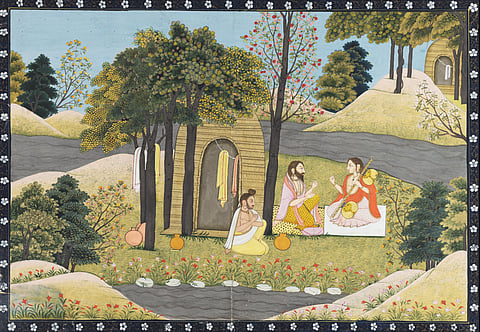
Then the thought steals in like the scent of summer jasmine that this month saw festivals relating to two vital change agents, one historical and one legendary: the Buddha and Devrishi Narada Muni. Narada Muni’s janmotsav usually comes just after Buddha Purnima. This year it was last week, on Sunday, May 3. It’s an interesting calendar quirk that the Buddha, the nobly born renunciate, dances for eternity with the first-known journalist of Indic culture.
It took me a while to appreciate this interesting fact: Narada Muni is actually a ‘journalist’ in the sense of someone who goes everywhere, meets everyone, observes everything and purveys information. Moreover, he is on everyone’s A-list of guests across the three worlds and is invited to every important event. His presence adds lustre to each gathering.
The thought follows that perhaps it’s hard for those who communicate ‘good’ and ‘bad’ as simple binaries to understand the special place that he holds in the scheme of things. What matters is that we modern Indians could try to understand Narada Muni’s intriguing role as a cultural messenger, simply because it could help us evaluate the importance of good intentions in communication today.
The fact is that though we laugh about Narada Muni being a meddler, we also know that he stirs things up not out of personal malice but to move matters along. He plays a key role in arranging the wedding of weddings—that of Lord Shiva to Parvati Devi—actively serving as both matchmaker and catalyst in the story.
But does he always succeed? He seems to fail resoundingly in the case of Savitri when he tells her that Satyavan is doomed. It only makes the willful princess more determined to subvert the natural laws. I used to think that Savitri’s ‘victory’ was not a victory at all but a piece of human trickery, vanity and greed; a cautionary tale. How Narada Muni might curl his lip at that.
But because it is so sophisticated of a story, the true meaning flies over our heads, and we take the story at its flat ‘modern’ and ‘Left-liberal’ interpretation, unaware of how she commands Yamaraja’s respect by her politeness and intelligence, and so gets her way. She thus becomes an example of good intentions backed by courage and determination.
Narada Muni’s most successful ‘press campaign’ is his indoctrination of Prahlad in Vishnu-bhakti. He drops in on Prahlad’s mother when she is expecting her child, and tells her many tales praising Mahavishnu’s beauty, glory and greatness. The baby in the womb hears everything and is born a staunch Vishnu-bhakt. He defies his tyrannical father, Hiranyakashipu, even submitting to several attempts by his father to kill him. Eventually, this triggers the descent of Mahavishnu into his fourth avatar, Narasimha, the man-lion, to finish off the tyrant and rescue the world from his oppression.
Moreover, it’s interesting that the legend of Prahlad’s peaceful non-cooperation and civil disobedience apparently inspired real-life rebellions, such as those of Meera Bai in the 16th century. There is a wonderful story that Meera had a letter smuggled out from captivity in Chittor to Tulsidas in Varanasi, asking what she should do since her in-laws forbade her from worshipping Sri Krishna—without whom she could not exist. Tulsi’s reply was revolutionary advice for a gently-bred woman, just thirty-one years old, who had never faced the outside world alone. He told her to disown her family just like Prahlad did. And Meera walked out, never to return. So, it would not be incorrect to surmise that 20th-century freedom fighters already had the weapon of civil disobedience in their playbook from their own culture. It was embedded in their psyche as an effective means of fighting back against tyranny, and they merely needed the broader unity of purpose and mass mobilisation to activate it.
Nor can we forget that it was Narada Muni who came across little Dhruva in the forest and taught the heartbroken child the mahamantra ‘Om Namo Bhagavate Vasudevaya’ to meditate on and attain the grace of Mahavishnu, as Dhruva ardently wished. And with what a glorious result.
Well before that, in the earliest epoch, Narada Muni brought Princess Devahuti together with Kardama Rishi, celebrated as among the early ancestors of mankind. Their son, Kapila Rishi, was none other than Lord Narayana himself, who took this form to gratify Kardama’s wish. He propounded the Samkhya philosophy, giving us an important perspective on and rationale for our lives as human beings.
Let us also remember and be grateful to Narada Muni for yet another important development in our theology and culture. Rishi Valmiki asked Narada if a perfect, virtuous man still existed on Earth. Narada Muni described Sri Rama, the son of Dasharatha, as that ideal man. This narration inspired Valmiki to compose the Ramayana in poetic verses after Lord Brahma prompted him to record the tale. And thereby, we got the immortal story of Rama, the neev patthar or foundation stone of so much of Indian identity, and well beyond. Fabulously, it was Narada Muni again who inspired Vyasa to compose the holy Srimad Bhagavatam. Our ‘first journalist’ seems to have been the ultimate influencer, and well worth celebrating.
Renuka Narayanan | FAITHLINE | Senior journalist
(Views are personal)
(shebaba09@gmail.com)
