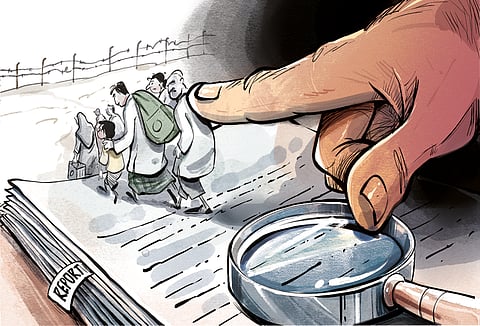

Last month saw the beginning of the process of conducting the 16th national census. A month later, the people of West Bengal gave a clear verdict to install the state’s first BJP government. In its first cabinet meeting, the new state government decided to allocate adequate land to the BSF close to the India-Bangladesh border so that they can construct many more border check-posts and prevent the entry of illegal immigrants.
The processes involved in both—the census as well as effective patrolling at the border—are expected to lend support to the process of the 3Ds—detect, delete and deport, as a section of the people of Assam has been demanding. However, considering the fact that the deporting part is too complicated, it’s perhaps better if ‘delete’ is taken to its logical corollary in the form of ‘dis-enfranchise’. Only that could eventually ensure that foreigners or non-citizens are not allowed to decide who rules India. Now that we have BJP governments in both Assam and West Bengal, achieving this objective would perhaps become a lot more easy.
The present generations may not be aware of the seriousness of this challenge. To understand it, one has to appreciate the magnitude and multi-dimensional nature of the challenges posed by the phenomenon and the attempts by previous governments to exploit the demographic changes for petty partisan gains.
First, the magnitude. The illegal influx of Bangladeshis is a vexed issue impacting Assam, West Bengal and other bordering states for several decades. Almost a century earlier, in 1931, Assam’s then Census Superintendent S C Mullan wrote, “Probably the most important event in the province during the last 25 years… has been the invasion of vast hordes of land-hungry Bengali immigrants, mostly Muslims, from the districts of Eastern Bengal.” What he further stated without mincing words sounds like a prophecy: “It is sad, but by no means improbable, that in another 30 years Sibsagar district will be the only part of Assam in which an Assamese will find himself at home.”
In recent times, the November 1998 report on infiltration by the then Governor of Assam, Lt Gen S K Sinha (retired), provided some eye-opening content. Prior to that, IPS officer E N Rammohan, then a director general at BSF, had stated in an official report in 1997 that, “As Additional SP in 1968 in Nowgaon, I did not see a single Bangladeshi village on Jagi Road or in Kaziranga. In 1982, when I was posted as DIGP, Northern Range, Tezpur, five new Bangladeshis Muslim villages had come up near Jagi Road and hundreds of families had built up their huts encroaching into the land of the Kaziranga Game Sanctuary.”
In a speech, Union Home Minister Amit Shah had rightly explained about the steady growth in the share of Muslims in Indian border populations. He pointed out that, according to the 2011 Census, the decadal growth rate of the Muslim population in Assam was 29.6 percent, which would not have been possible without infiltration. He also noted that in several districts of West Bengal, this growth rate exceeded 40 percent. In a few border districts, the growth rate was reported to have reached 70 percent.
Apart from the demographic anxiety caused by this infiltration, it paved the way for many security threats as well. The smuggling of cattle, arms and drugs, besides the possibility of terrorists making an easy entry into our border districts are some of the factors adding to the severity of the issue. As per rough estimates, between 7,00,000 and 20,00,000 cattle are smuggled across the border annually, with the trade value estimated at $500 million to $1 billion. Along with cattle, weapons and drugs, other contraband goods are also smuggled along with the exchange of extremist ideologies. In several cases, it has been noted that terrorists use smugglers and their paths through dense forests or riverine gaps to evade the security forces. Infiltrators can provide cover to terrorist acts by establishing sleeper cells, radicalising the local youth and merging with the local population to make detection exceptionally difficult.
Those who refuse to recognise the vote-bank politics being indulged in by some parties and the serious challenges emerging from the demographic changes must know that almost 15 years after the emergence of Assam Movement in the late 1970s, in April 1992, Hiteshwar Saikia, the then chief minister of Assam, stated that there were 30 lakh illegal Bangladeshi migrants in his state. However, two days later, he backtracked, declaring that there were no illegal migrants in Assam. Even Mamata Banerjee had once talked about the seriousness of issue while in the Lok Sabha, only to go into a denial mode later after becoming the West Bengal chief minister.
The centrepiece of the method in this madness is vote-bank politics, for which the Indira Gandhi government introduced the Illegal Migrants (Determination by Tribunals) Act, 1983 as a special law applicable only in Assam. Designed to protect infiltrators, this act—unlike the Foreigners Act, 1946 applied in the rest of India—placed the burden of proof on the complainant or police, and not on the person accused as an illegal immigrant. This prevented the very first step of detection, nipping the possibility of early deletion and deportation. When this law was struck down by the Supreme Court in 2005, the Manmohan Singh government introduced an administrative order specifically making the 1964 Foreigners (Tribunals) Order inapplicable in Assam. Thankfully, the Supreme Court again struck this down as unconstitutional.
We must ask why Muslims are treated as a vote-bank more than other communities. Writing decades ago, Muslim intellectual and social reformer Hamid Dalwai had suggested a reason: “Whenever Muslims are in a majority, they have refused to recognise the equal rights of non-Muslim minorities, and where they are in a minority, they have been generally reluctant to regard themselves as part and parcel of a non-religious nation. The revolts of the Muslims in the Philippines, Thailand and Ethiopia are merely expressions of their unwillingness to participate in a common social order on equal terms with others.” Might there be a remnant of this feeling in the present age fomented by political interests?
Vinay Sahasrabuddhe | Senior BJP leader
(Views are personal)
(vinays57@gmail.com)
