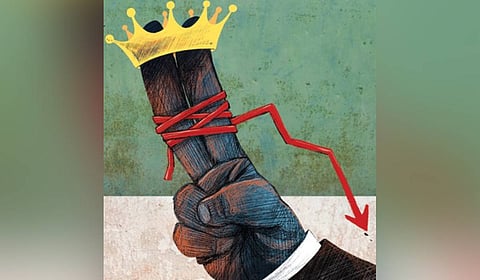

Upon his stunning victory 12 years ago, Narendra Modi addressed a gathering of party faithful and appealed to them that they give him “10 years to transform” the country. As we mark the twelfth anniversary of the Modi government, it is now clear that he has succeeded in ‘transforming’ India politically but has failed to do so economically. It is worth considering whether the political transformation that has been achieved is among the reasons for the failure on the economic front.
The emerging consensus among political and policy analysts across the country is that Modi has not been able to translate his political success into economic performance. Some, like economist Surjit Bhalla, blame the ‘deep state’ or the embedded bureaucracy for this. Indeed, even many close to and loyal to the Prime Minister often articulate this view, that the real impediment to better performance is the ‘rust in the steel frame’.
Some hold the BJP’s essentially inward-oriented, ‘swadeshi’ thinking on trade policy and the confusion created by multiple interpretations of Atmanirbharata and Make in India responsible. Some castigate Modi’s own ‘instruments’, his loyal ministers, for the inadequacies of the leader.
During the Congress era, inter-ministerial policy and personality differences would be spoken of openly and reported in the media. Differences between senior ministers like Pranab Mukherjee and P Chidambaram were open secrets. Such differences and rivalries exist in Modi’s council of ministers too, and some in the media are privy to them. But these are almost never reported.
My friend Parakala Prabhakar, a distinguished political economist, has for long held a very different view on the governance challenges faced by the Modi government. Be it the manner of announcement and execution of demonetisation, or the imposition of overnight lockdown due to Covid, or actions on issues like farm and land laws, foreign investment policy and so on. Parakala blames it all on managerial ‘incompetence’ at the political, not merely bureaucratic, level.
Perhaps Peter’s Principle—the celebrated management theory that “employees are continually promoted based on their success in previous roles until they reach a position where they are no longer competent” —also applies to politicians and senior ministers.
Moreover, it is one thing to win elections, quite another to steer the national economy, national security and foreign policy—the primary responsibilities of the Prime Minister—over a long period of time. Even Jawaharlal Nehru, who had a distinguished decade in office as Prime Minister from 1947 to 1957, began erring after that. The question may well be asked if Modi has outlived his welcome and diminishing returns have set in on the administrative and economic fronts, even as he continues to deliver on the political front.
Reflecting on that 2014 request of the PM, that he be given a decade for ‘transforming’ India, it seems clear now that his focus was mainly on the Indian republic’s transformation into a Hindu majority polity. On that objective he has largely succeeded, with southern India still outside the grip of Hindutva. The mixing of religious faith and prejudice into public life and politics has generated social and political tensions that are depleting the so-called ‘animal spirits of enterprise’.
A growing concern among business leaders, at home and overseas, about the direction of Indian politics is making them risk-averse as investors. An important reason for private investment not picking up, for the flight of capital and the tapering down of foreign direct investment may well be the wider political environment.
Economists often ignore the role of political management in influencing business decisions. Confidence in a government’s ability to deal with emergent political and security challenges, at home and overseas, reassures investors. It contributes to positive expectations and encourages risk-taking by investors. Any concern about a political leadership’s competence or determination to deal with such challenges contributes to negative expectations and risk aversion.
Consider two examples. It is not often recognised by economists and public policy analysts that a key trigger for the 1990-91 balance of payments crisis episode was the judgement of a variety of economic actors that the government of the day would not be able to handle the challenges at hand. It was the inability of the Vishwanath Pratap Singh and Chandrashekhar governments to act decisively on the fiscal and external front in 1990 that led to a loss of confidence in the economy and the rapid descent into the crisis of 1991. It was then the decisive actions of Prime Minister Narasimha Rao that restored investor confidence and stabilised the economy.
By contrast, in 2004 the defeat of the Atal Bihari Vajpayee government and the coming into office of a Congress-led coalition supported by communist parties triggered instability in the markets and unease among investors. The reassurance provided very quickly by the newly elected Prime Minister Manmohan Singh set at rest all such worries. In both instances, the quality of political leadership made all the difference to investor sentiment.
We are in a similar situation today. In 1991 and 2004, both business leaders and the media articulated their views openly and played their part in ensuring political action that helped restore investor confidence. Today, a largely timid media and a highly risk-averse and fearful business class are no longer exerting pressure on the political leadership to act in a reassuring manner.
All good news is celebrated in an exaggerated manner and all bad news is buried. Thus, when India was seen as being on the threshold of becoming the world’s third largest economy, there was much song and dance about it. Today, when it has slipped to the sixth position, few ask why. In 2017, Prime Minister Modi declared that the country’s national income would be $5 trillion by 2020. Very quickly, the goal was shifted to 2022, and then to 2025, and then forgotten. In 2026, the economy is just over $4 trillion.
Indian economy’s long-term average annual rate of growth from 1990 to 2025 is estimated to be around 6 percent. During 2000-12, the average growth rate was over 7 percent. For India to be regarded as a developed economy by 2047, the goal of Viksit Bharat, the average annual growth over the next two decades will have to be around 8 percent. The question to ask today is what was done over the past decade that the acceleration in growth experienced during 1990-2010 has not been sustained over the past decade.
Sanjaya Baru
Former newspaper editor and writer whose latest book is Secession of the Successful: The Flight Out of New India
(Views are personal)
