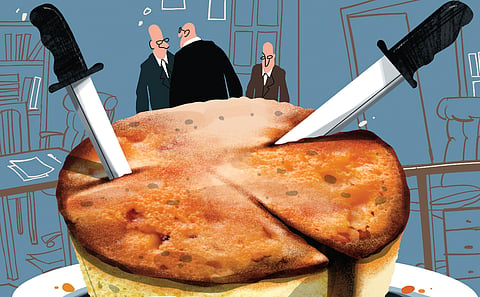

A cold war that could soon explode into something far hotter is probably the best way to describe the tension gripping the Tata Trusts and Tata Sons, which control a $180-billion conglomerate. The sparring has included allegations of broken promises, lawsuits on governance lapses and even the eligibility of the trustees. The battle for control over the trusts has spilled over into the Tata Sons board, bringing into question the continuity of N Chandrasekaran as chairman and the group’s new business investments that are haemorrhaging cash.
The root of the issue can be traced to the efforts of Noel Tata, chairman of the Tata Trusts and half-brother of the late Ratan Tata, to establish control over the group that bears the family name and to ensure a clearer line of succession for his children. Ranged against him are a number of Ratan’s confidantes—Mehli Mistry, Venu Srinivasan and Vijay Singh, among others—who were made trustees.
But the battle for control is also shining the spotlight on governance issues plaguing one of the most respected business groups that has long tried to portray itself as a family business with a difference when it comes to ethics and shareholder rights. It has even pitted the Tata Trusts chairman, who has de facto control of Tata Sons, against the second biggest shareholder of Tata Sons—the Shapoorji Pallonji family.
It’s the convoluted tale of a huge group with no clear lines of succession and a complex structure that sees a number of philanthropic trusts controlling an unlisted holding company, which in turn controls over two-dozen large listed companies. Corporate governance issues arise because the structure ensures that the Tata Trusts chairman can pull the strings of over 30 listed companies, despite actually owning only a minor stake in personal capacity.
Most big business houses in India see succession battles because they have too many claimants to the throne. The House of Tata has faced the reverse—succession has always been an issue because of the lack of eligible scions or sons who were interested in taking charge. A bit of business history is in order.
Jamsetji Tata had founded the group in 1868 and his son Dorabji succeeded him as chairman in 1904. Neither Dorabji nor his brother had a son. So the next chairman was N R Saklatvala, a cousin of the brothers. Saklatvala, in turn, handed over the group to J R D Tata, a member of the clan but not a direct descendant of the group’s founder. J R D, who had no children, would eventually pass the baton to Ratan Tata in 1991. Ratan would be the last person to be chairman of both the Tata Trusts as well as Tata Sons. And therein lies the problem.
The founder and his two sons, who were philanthropists, had set up a number of trusts. They had also set up Tata Sons as the group’s holding company. The trusts controlled about two-thirds of Tata Sons’ shares. The second biggest holding belonged to the Shapoorji Pallonji group, which holds about 18.5 percent. The rest of the shareholding is scattered, with a small number of shares belonging to various Tata family members.
Noel’s current battle for control is in some ways similar—and in other ways quite different—from the one his half-brother fought to establish his sway. Ratan Tata had to battle the group satraps even though he was J R D’s handpicked successor. The problem then was that Tata Sons was a holding company of the group only in name—it was not the majority shareholder in most of them. This would lead to the CEOs and managing directors of the various Tata companies to treat them as their own fiefdoms. They deferred to J R D because of his stature and respect, but saw little reason to do the same with Ratan.
Ratan took several steps to tackle this issue. Tata Sons charged royalties for use of the Tata brand by the listed group companies, and that was ploughed back into buying up shares in the companies. This ensured that, by the middle of Ratan’s tenure, Tata Sons was the major shareholder of most listed Tata companies. The control of Tata Sons over the group companies was thus firmly established.
Meanwhile, the trusts were the biggest shareholders in Tata Sons—and that wasn’t a problem till Ratan Tata was at the helm of both. The structural problems arose shortly after he decided to anoint Cyrus Mistry, the younger son of Pallonji Mistry and brother of Shapoor Mistry and Aloo Tata, wife of Noel Tata, as chair of Tata Sons after a year-long search. Cyrus became the chairman of Tata Sons, but Ratan Tata controlled the trusts.
The Ratan-Cyrus relationship turned sour because of many reasons including the fact that Cyrus thought many of Ratan Tata’s pet projects did not make business sense. It would lead to Cyrus’s exit, engineered by Ratan through handpicked trustees and other board members.
Ratan Tata would eventually choose Chandrasekaran, a former chairman of TCS, as the Tata Sons chairman. But the trusts remained under Ratan’s control till his death. Having never married, he did not have anyone to pass on the baton to. It was after his demise that Noel was voted chairman of the Tata Trusts for life, by the members of whom most were handpicked by Ratan. During Ratan’s lifetime, Noel only had a say in a relatively small part of the group.
Since taking over Tata Trusts, Noel has been trying to establish his grip over the trusts and companies. He is currently batting many of those who anointed him chairman. This battle is primarily to ensure that his son Neville and two daughters Maya and Leah would be in line of succession after his tenure. He has inducted all three in the Tata Trusts.
Meanwhile, the RBI would like Tata Sons to be listed—in accordance with its new regulations governing systemically-important core investment companies. So would the Shapoorji Pallonji group, because the listing would allow it to discover the value of its shares and monetise them as and when required.
There is little reason for Noel to want that. It’s the peculiar current structure that allows him to keep total control. And therein lies the cause of the tension engulfing one of India’s biggest business groups.
Prosenjit Datta | Commentator on economic issues
(Views are personal)
(datta.prosenjit@gmail.com)
