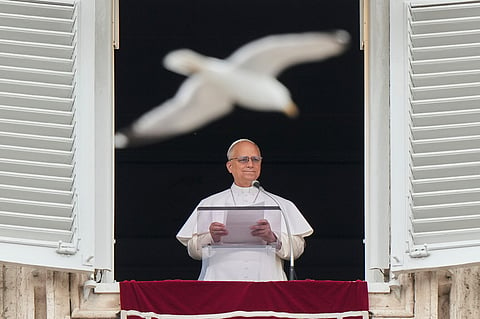

In the 5th century CE, Augustine of Hippo decided a debate in the Christian faith with a terse argument that remains quotable: “Roma locuta, causa finita (Rome has spoken, the case is closed).” It wasn’t exact, but it was catchy—and it signalled that the stand of the Roman Catholic Church on issues was decisive. About 1,500 years later, Josef Stalin ended another argument concerning Christians—the Catholics in the godless USSR—with another quotable quote that may also be inexact, because we have it only via Winston Churchill: “The Pope? How many divisions has he?” It signalled the irrelevance of religious authority in the face of geopolitical power.
This week, Rome spoke once again—to weigh in on a bare-knuckled contest that was looking like a foregone conclusion. In his encyclical titled ‘Magnifica Humanitas’, Pope Leo XIV spoke of artificial intelligence and natural stupidity—the stupidity of the powerful who treat the rest of humanity as expendable tokens, optimisable assets or obstacles limiting the efficiency of machines. The document stated that AI must not overawe human dignity but support the common good, that it should not be weaponised or operate surveillance systems, take life-altering decisions autonomously, trigger a digital arms race or endanger workers and vulnerable people. Broadly, it said that ethics is more important than efficiency. The encyclical supports slow-growing, tentative AI which is mindful of safeguards, and it opposes fashionably reckless investment in the AI arms race.
Channelling Stalin, the headlines dramatised the Pope’s message into a declaration of holy war against Big Silicon and its political allies. That’s a category mistake. When popes wanted to declare war, they preached a crusade. An encyclical is routine guidance on current issues, doctrine and morals to bishops, meant for wide dispersal. In the past, many encyclicals supported progressive ideas—and many did not. Regressive communications include injunctions to oppose birth control, the denunciation of Freemasonry in 1884 and the wholesale dismissal of modernism, agnosticism and individualism in 1907.
The most famous progressive communication was Leo XIII’s ‘Rerum Novarum’ (Of New Things) of 1891, which took a stand on social justice after the Industrial Revolution, described ideal relations between capital and labour, supported the workers’ right to organise and required the State to protect their interests. It was the first social encyclical, and by its standards, many successful modern States are actually failures, because they protect the interests of elites at the expense of ordinary people.
Leo XIV’s ‘Magnificent Humanity’ will go down in history, too, because it puts the human being at the centre of all things. The concept has a rather dark history, of course. Galileo faced the Roman Inquisition in 1633 and suffered house arrest because his universe was not geocentric—and therefore, not anthropocentric—undermining the church’s authority as the shepherd of the human race. Giordano Bruno was burned at the stake in 1600 for two crimes—rejecting a doctrine that was clearly illogical, and positing that stars are all distant suns in an infinite universe, which meant that the human race is not at its centre.
But the latest encyclical is extraordinary because it should no longer be necessary for a religious leader to weigh in on geopolitics. It should have been addressed by political and technology leaders—who are profiting from it instead. The encyclical distils anxieties expressed for years in public and on the internet. It speaks of new digital monopolies and slaveries, and a new wave of colonialism—which has always been made possible by technological advantage, from the superior weaponry and building skills of Caesar’s legions in 55 BCE Britain to superior shipbuilding in Europe during the age of exploration.
Over the last fortnight, commencement speakers at several US universities have been booed for mentioning AI because young people are uneasy about their prospects, as they see mass layoffs and a contraction in entry-level hiring. A fortnight ago, in the venerable Press Gazette of London, Rob Waugh reported that four journalists covering cryptocurrency, who have over 1,000 bylines in about 30 news outlets, may not actually exist except as social media profiles. This is on top of the uncertainties created by bots and AI-written academic papers. Meta’s independent oversight board, the last court of appeal for content moderation using human decision-making, is out of its depth as AI proliferates. And with drone wars in season, the threat of remote, autonomous munitions is keenly felt by all.
But the whole world is not breathlessly following the AI race—that’s just the impression we get from the coverage. A couple of days after Pope Leo signed his encyclical, Cornell University hosted a thought summit on community-centred AI, which opposes “extractive, environmentally harmful practices” and promotes “community-controlled” approaches to secure environmental justice, labour equity and data sovereignty, and promotes AI for the benefit of the many. Sounds like the open-source movement all over again, which was a reaction to Microsoft’s commercial monopoly.
Now, as AI companies tower over all of humanity, a reminder of ethics is timely. It should have come from legislatures long before a religious figure was goaded into action. But from the manner in which the encyclical has rippled across the world, it appears that even today, the Pope has his divisions.
Pratik Kanjilal | SPEAKEASY | Senior Fellow, Henry J Leir Institute of Migration and Human Security, Fletcher School, Tufts University
(Views are personal)
(Tweets @pratik_k)
