
For two decades, Sri Lankans have embraced iconic actor Thalapathy Vijay—Chandrasekaran Joseph Vijay—as one of their own. Cinema audiences across the island admire Vijay, whose popularity has often transcended ethnic and linguistic divides. This broad acceptance offers him a unique platform from which to contribute, at least indirectly, to a stronger understanding between Tamil Nadu and Sri Lanka.
While the path appears open for the new leader, Sri Lankans who have long admired Vijay, the film star, may view his emergence as a political figure through a different lens.
Vijay’s rise in politics cannot be attributed to stardom alone, although his popularity and effective use of social media have undoubtedly contributed to his success. It also reflects wider political currents across South Asia. In recent years, several countries in the region have witnessed significant political churn driven by public discontent, youth mobilisation and demands for political renewal. Social media has played an important role in amplifying these trends. While India’s political landscape is distinct, Vijay and his Tamilaga Vettri Kazhagam have emerged as an alternative for voters seeking options beyond the traditional Dravidian parties, the Dravida Munnetra Kazhagam and the All India Anna Dravida Munnetra Kazhagam.
What remains unclear is whether Vijay will follow the political path laid down by leaders such as M G Ramachandran and J Jayalalithaa or seek to carve out a distinct space of his own. Both leaders, at different points, shaped public discourse on the Sri Lankan Tamil question and adopted positions that reflected prevailing sentiments in Tamil Nadu regarding the conflict and the aspirations of Sri Lankan Tamils.
Vijay will need to navigate carefully the intersection of geography, ethnicity and politics. The distance between Arichal Munai in India and Talaimannar in Sri Lanka is barely 55 kilometres. Northern Sri Lankan Tamils have historically looked to Tamil Nadu for cultural affinity and moral support. During the armed conflict, political leaders in Tamil Nadu drew attention to allegations of discrimination, humanitarian concerns and the plight of civilians. Some also expressed support for greater autonomy and political rights for Sri Lankan Tamils. While overt support for separatist causes diminished significantly after the assassination of former Indian prime minister Rajiv Gandhi in 1991, the situation of Sri Lankan Tamils remains a subject of periodic discussion in Tamil Nadu, informed by historical, cultural and familial connections between the two regions.
Vijay presents himself as someone who takes pride in his Tamil identity and has expressed solidarity with Sri Lankan Tamils. He has spoken about questions of justice, rehabilitation, resettlement and equal rights. These remain matters of continuing concern, particularly amid ongoing debates about reconciliation and post-war recovery in Sri Lanka. At the same time, references to political ideas associated with the conflict years are likely to be viewed differently on either side of the Palk Strait and require careful handling.
In the run-up to the Tamil Nadu elections, Vijay stirred debate by advocating the recovery of Katchatheevu, an islet ceded to Sri Lanka in 1974. He questioned the Centre’s position on the issue and criticised the Congress for agreeing to the transfer. The remarks generated discussion in northern Sri Lanka, where fishing communities have long viewed the island as part of their traditional fishing environment. Even today, Tamil Nadu fishermen are permitted to dry their fishing nets on Katchatheevu, while Indian and Sri Lankan fishers come together annually for the St Anthony’s Church festival on the island.
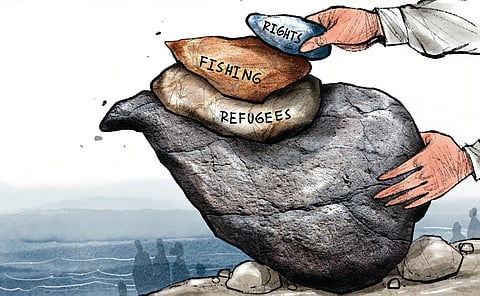
While there is little prospect of revisiting the island’s status, the debate has once again highlighted the sensitivity of Sri Lanka-related issues in Tamil Nadu politics. The more immediate challenge lies in the longstanding fisheries dispute. During the years of conflict, restrictions on fishing in northern Sri Lankan waters created opportunities for fishermen from Tamil Nadu. Over time, the presence of Indian trawlers in Sri Lankan waters increased, leading to recurring disputes. Sri Lankan authorities regularly detain fishermen for alleged illegal entry into their waters and seize boats and fishing equipment. Sri Lankan officials and fishing communities have also raised concerns about bottom trawling, a method of fishing prohibited in Sri Lanka due to its impact on marine ecosystems.
Vijay’s government has sought greater engagement from New Delhi on the recurring arrests of Indian fishermen and the seizure of boats and equipment. While any durable resolution ultimately depends on bilateral engagement between India and Sri Lanka, advocacy by the Tamil Nadu government can help ensure that the concerns of affected fishing communities remain on the policy agenda.
Then there is the sensitive question of how support for Tamil rights is distinguished from attitudes towards the LTTE. Vijay has consistently spoken about the rights, dignity and welfare of Sri Lankan Tamils. At times, however, statements or symbolism associated with the conflict years have prompted debate about the legacy of the LTTE in Tamil political discourse. The organisation emerged during a period of deep ethnic conflict and came to dominate the Tamil militant movement. Its legacy remains deeply contested, shaped both by its articulation of Tamil grievances and by its involvement in violence, including attacks on civilians and political leaders. For contemporary political leaders, the challenge lies in advocating justice and equality for Sri Lankan Tamils while avoiding the revival of divisions associated with the conflict.
When the war escalated in the 1980s, Tamil Nadu received large numbers of refugees from Sri Lanka, and many continue to reside there today. As chief minister, Vijay is well placed to support policies that assist those wishing to return to Sri Lanka while also addressing the concerns of those who have built lives in India and seek a long-term future there.
As Tamil Nadu’s chief minister, Vijay will not determine India’s Sri Lanka policy. Yet he occupies a position from which he can influence public discourse, advocate for the welfare of fishermen and refugees, and encourage stronger economic, cultural and people-to-people links across the Palk Strait. If approached pragmatically, these areas offer an opportunity to build trust and contribute positively to relations between the two neighbours.
Dilrukshi Handunnetti | Award-winning journalist and lawyer; founder and director of Colombo-based Center for Investigative Reporting
(Views are personal)
(dilrukshi@cir.lk)
