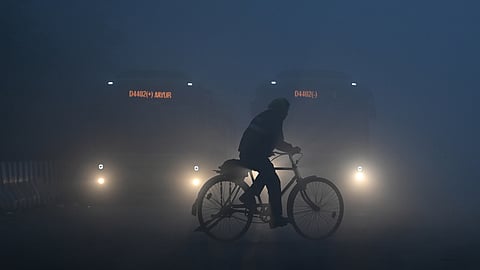

This year, the legacy and the social media were awash with warnings about the pollution apocalypse to come on Diwali. As ever, the blowback from the zealous proponents of gunpowder-based firecrackers was intense, hostile, threatening and evictive.
The politest jibes included “Go to Pakistan!” and the newest was “Go to Gaza!” No one said “Go to Nepal!”
India comprises three-fourths of the subcontinental landmass. On Diwali, geospatial imaging shows this mainland obscured behind a gauze of aerial pollution that extends in a perimetric flow into Pakistan in the west, Bangladesh in the east and Nepal in the north.
Sri Lanka escapes this battering ram because, largely, the celebrants are limited to the country’s 13 percent Hindu population, which is disciplined by the proscription on firecracker trade. The country’s defence ministry has criminalised the production of explosives “using raw materials and other chemicals issued for the firecrackers and fireworks industry”.
The southern hemisphere’s southeast trade winds that cross the equator into India’s high-temperature, low-pressure zone usually reverse their flow starting in October because India cools down by then—but the pollution from India is halted by ocean buffering and the distance of 1,600 km from northern India’s vast Diwali ground zero, the Indo-Gangetic Plain.
Nepal has no such luck. The country banned firecrackers as far back as October 2006. Its criminal code outlaws the import, transportation, storage and distribution of fireworks. Violators can face up to three years imprisonment and up to Nepali Rs 30,000 in fine. Whatever homegrown firecracker pollution exists is concentrated in Madhesi pockets in the Terai region, where Indian-origin firecrackers find their way from just across the border. Nepal’s upratcheting air quality index during the Diwali bracket is almost entirely blameable on pollution inflow from across the border.
In Pakistan, Diwali is celebrated by its Hindus, who comprise a mere 2.17 percent of the population, most of whom are concentrated in the Sindh province, which has Rajasthan and Gujarat to the east. Within Sindh, Hindus constitute slightly below 9 percent of the population. It is humanly impossible for Pakistan’s Hindu minority to create the fug of fumes that covers Pakistan’s east during Diwali. Pakistan’s Punjab Environment Protection Department said that even sluggish easterly winds carry smog from India’s north to Pakistan.
The air quality in Lahore—which anyway has a heavy aeropollution problem—barely over 400 km from Delhi, peaked on Diwali, although it had been at a five-year low in October. The day after Diwali, almost miraculously, Lahore’s air quality entered the non-hazardous zone. The AQI in the Sindh capital of Karachi, more than 1,000 km from Delhi, was satisfactory to moderate on Diwali—also probably because its celebrant Hindu minority is just over a mere 1 percent of the city’s population—lower than that of Christians.
Bangladesh has nearly 8 percent Hindus in its population, nearly all of them Bengali. Diwali is muted in the country because the predominantly Bengali festival of Kali Puja almost always falls on the same day as Diwali: Kartik Amavasya. The date vacillates annually with the lunar calendar, but the observances fall on the same night. However, Diwali in Bengal in India is typically boisterous, especially in Kolkata, nearly half of whose population is non-Bengali and is 60 km from Bangladesh.
Cooling air subsides over India’s northern plains of India and channels down the Indo-Gangetic Plain, cutting across Bengal into western and central Bangladesh. Satmaps show Diwali pollution pushing into these regions of Bangladesh riding these winds. Trans-boundary smoke drift characterises the border regions of western Bangladesh such as Khulna and Rajshahi, which are located directly downwind of Bengal.
Meanwhile, katabatic winds flow across India’s northeastern states into northern and eastern Bangladesh, where the AQI is significantly lower on Diwali, even though the Hindus in north and northeastern Bangladesh touch a quarter of the population—because Diwali is a very muted affair in India’s Northeast.
India’s Diwali pollution does not infiltrate Afghanistan—because the winds face off against the towering wall of the Hindu Kush and the Himalayas, and Delhi and Kabul are separated by 1,000 km. Nor does it reach Iran, because the pollutants dilute and disperse along the way.
If you place a compass point in the middle of the Indo-Gangetic Plain and draw a circle with a 1,000 km, it would encompass Nepal, Pakistan, Bhutan and Bangladesh. China falls within the roundel, but is shielded by the Himalayas and the Tibetan Plateau. However, Tibet is not entirely protected from the Diwali pollution. North-South river gulches like the Kali Gandaki and the Yarlung Tsangpo form natural channels through which diurnal zephyrs vault polluted air onto the southern Tibetan Plateau.
Diwali pollution is regionally omnipresent. There’s no denying it. As for Gaza: bombed to smithereens and with cordite its predominant smell, it had an AQI of 59 on November 8—idyllic compared to India’s.
Kajal Basu | Veteran journalist
(Views are personal)
(kajalrbasu@gmail.com)
