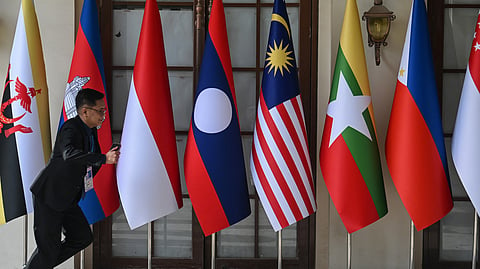

The word ‘jamboree’ probably accurately sums up what will unfold in Manila this Monday. As the 49th ASEAN Summit commences with the Philippines as the chair, the build-up to main summit of Southeast Asian leaders will be preceded by a flurry of meetings to set the tone and agenda, as well as multiple related mini-summits.
Most of this work is coordinated by the ASEAN secretariat. That and all the other coordinating group meetings in the run-up to the main event seek to align both the final declarations and review of the annual progress of the grouping. As an official process, it is a massive effort of many moving parts.
This year’s summit theme—‘Navigating the future, together’—remains critically distinct. For the first summit chaired by President Ferdinand ‘Bongbong’ Marcos Jr, it could not be more apt in describing what the bloc is facing given the turbulent world order at present, where fragmentation remains the key determinant of how systemic factors are shaped.
The year beyond the summit will be crucial for ASEAN’s relevance in the region and the larger cause of how multilateralism evolves in the current environment. Given this backdrop, this article focuses on the year’s core issues for the bloc and the manner in which the grouping may move prior to handing the chairmanship to Singapore in 2027.
The most interesting set of issues to watch out for during the summit will fall in three critical areas. First, how the ASEAN leadership under the Philippines addresses two of the core issues within the grouping—the situation in Myanmar, which remains far from seeing any resolution, and the manner in which geopolitics of the South China Sea is being shaped through the year. The question that looms large is whether either of these issues will find any long-term answers at the summit.
The continuing military rule in Myanmar and the kind of electoral process held over three phases from late last year to early this year have not gone down well either within the ASEAN or in the rest of the international community. While ASEAN’s principle of remaining out of the domestic politics of its member States may have held some significance in its early years, this option of ignoring the situation in member countries is no longer tenable.
Increasingly, the civil societies in countries such as Indonesia and the Philippines are coming out stronger against violence within States. ASEAN itself has been less than endorsing of the electoral results and the efforts of the Filipino special envoy to Myanmar has met with little success, though some progress is seen in terms of meeting the conflicting parties.
The situation also reflects the fact that the government of President Ming Aung Hliang is not in full control of the country and National Union government supported by the People’s Defence Force and various ethnic armed organisations have a hold on a bit over 40 percent of the nation’s territory. This unprecedented situation pushes ASEAN to continuously reiterate its original five-point consensus, which looks at an inclusive dialogue of all stakeholders. While the ban on inviting the Myanmar president continues, the ASEAN has been unable to deliver a resounding and effective result on the country. This remains far from being adequately addressed.
Through the past year, the bloc has had several rounds of meetings to look at furthering the Code of Conduct (CoC) for South China Sea. Even in January, when the Philippines took over the chair, it was assumed that the CoC would feature strongly in this year’s agenda, based on the host’s position and increasing geopolitical tensions in the area. There have indeed been intensive efforts throughout the year to finalise the negotiating rounds.
However, there is still some reticence to move forward on key issues, particularly on aspects such as the geographic scope of the CoC, the terminology used to address excesses in those waters, and the legally binding principles of the code. For the Philippines, securing a binding CoC remains critical—though such a move is supported by other claimant states, bringing China to the table to address it remains a challenge.
From New Delhi’s perspective, this will also mark the 23rd ASEAN-India Summit, where the key focus will be on aspects of how to improve maritime security cooperation. Key to this is the increasing importance both sides are giving to enhancing maritime domain awareness, particularly looking at evolving joint working on this crucial aspect.
However, the continuing trade imbalance will be an issue of concern for India. As far as the India ASEAN free-trade agreement is concerned, exchange of goods remains in a state of limbo with the FTA negotiations not being able to address the huge deficit that India faces and the clarity on rules of origin.
The five-year review of the ASEAN-India Trade in Goods Agreement is not likely to move ahead during this summit. While extending digital public infrastructure and enhancing supply chain initiatives are clearly two key aspects of the Plus-One dialogue with India, they still remain below optimum levels. Despite efforts, it’s slow progress on this eastern front.
(Views are personal)
Asian Axis / Shankari Sundararaman
Professor, School of International Studies, Jawaharlal Nehru University
