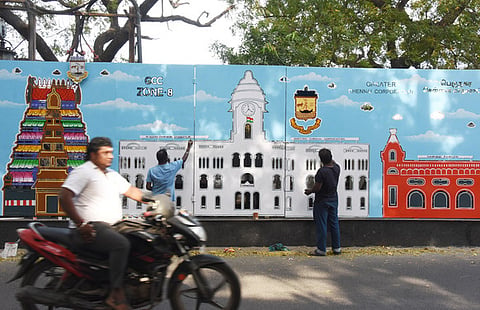

I love Chennai. ‘Impossible!’ my relatives and friends in Bengaluru and Hyderabad and Thiruvananthapuram exclaim. ‘How can you? What is wrong with you? The humidity would kill me before the mosquitoes do,’ says one. ‘You can’t walk on its pavements for there aren’t any!’ says another. Rubble, building debris, wires, cables, vendors and their wares occupy every square foot of footpath space in my city, I am told.
Adds a third : ‘And motorcycles… they are everywhere, swarming the road like they own it, criss-crossing at will through lanes of traffic, flying through the narrowest space between your car and the one in front, inviting headlong crashes, and if your vehicle as much as touches them, god help you. You are the culprit. Worse, they park at will, right in front of shops, leaving zilch space for pedestrians who have to squeeze through the two-wheeled self-willed ravagers.’
True, I admit. Very true. But just hold your fire for a minute, I say. Don’t you see that these armies of bikers are from a segment of society that has made good after generations of deprivation, and are now going from home to work and from work to home on motorised wheels, reflecting India’s emergence from its days of hopeless and grinding immiseration? My city’s motorcycles are also modes of transport, don’t you see, for women who are now mobile as never before, and going to their work-places, dropping children at school?
I do not think I convince my friends. ‘What about the metro stations?’ The criticism continues: ‘The less said the better’ I tell the complainant of my first Chennai metro ride when a group of the differently-gendered swarmed in, clapping rhythmically, making passengers start staring at their mobiles, toes or out-of-the-windows to void eye contact with the group.
I was a bit nonplussed, but only for a moment because one of them came up to me and gently touched my chin and said ‘Appa’ before walking off. My chin was altogether a stranger to that order of filial attention. ‘Oh, she was making fun of you… an old man.’ I say, ‘I am not so sure. Why do you think she did not think of her biological dad when she did that? Do you think the Thirunangai, as Kalaignar Karunanidhi most imaginatively christened the transgendered, replacing derogatory terms for them, can have no tender emotions?’ I am not rebutted this time.
‘Okay, but tell me, how do you bear the visual overload in your city? You cannot look at any vertical surface in Chennai without seeing posters, graffiti. Sprawling posters and painted images of politicians smile away through abducted pavements. They smile with knowledgeability in their eyes, as if to say they have solved the mysteries not just of public life, but of life itself. These know-it-alls have around their images which are larger than life of course, a string of smaller faces, those of their devoted followers, merging their smiles with their leaders’—as if to say they have arrived, reached their journeys’ end and are now in a state of bliss.’
I respond to say that, in an electoral democracy, politicians not only have a right but a duty to communicate with us, the masses. ‘Chennai,’ I continue, ‘has the whole political spectrum on its walls. I may not like some of the individual faces, but I rejoice in the fact that all their images are up there, rather than of just one leader, as happens in dictatorships. And when I see Kamaraj, Periyar or Annadurai in what may be called graffiti retros, I am pleased. Ambedkar is also prolific in Chennai! He is everywhere, never mind that he is not Tamil or Dravidian. He stands for change, for emancipation.’
My friends from outside Chennai are silent. Emboldened, I persist: ‘Look at Chennai’s auto stands. You will find in those another order of posters. You will see Bhagat Singh, the shahid, in Chennai. Who can call Chennai or Tamil Nadu insular or chauvinist? And wait—it’s not just Bhagat Singh. Auto and taxi ranks have Che Guevera up there too! My city may not win prizes for street aesthetics, but it gets an emphatic A for political vivacity.’
‘So, do you mean to say all is tickety-boo with your city?’
I pause and say, ‘No, it is not like that. No city is perfect; Chennai isn’t.’
‘Tell us then, what would you like changed in it?’
I find, I respond, the surfeit of advertisements of gold and jewellery to be in poor taste. The demonstration effect of those puts a premium on the evil of dowry which, despite being banned, has not gone away. Just imagine the crippling pressure they put on families with daughters to be married. If liquor and tobacco ads are considered baneful for the expense and social consequences, so must alluring images of gold and jewels be.
‘No other minus points?’
Well, no city has as many eateries serving hot-hot idlis and dosai and vadai and pongal as Chennai. And steaming, golden kaapi! But…
‘But?’
Their washrooms are—ayyo!—a holy mess. The fault is not that of the establishments but of us, the users. IIT Madras perhaps can be requested to come up with a plan to make Chennai the city with the country’s most advanced washrooms. Not just the ones in restaurants, but all public lavs as well. Can’t a city with world-class hotels and hospitals have public toilets that do not nauseate?
‘Forget it!’ I am told.
I will not, I say. I love my Chennai.
Gopalkrishna Gandhi
Former Governor of West Bengal and Bihar
