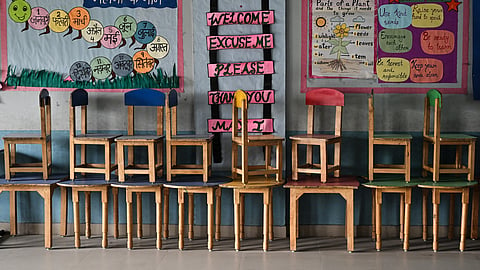

A teacher’s job is to teach. However, across India, governments routinely assign teachers other duties. They are made to count people for the census, prepare and verify voter lists, conduct surveys, collect data and manage relief work. As a result, classrooms often go without teachers for weeks.
The latest example is the special intensive revisions of electoral rolls. In Karnataka, reports indicate that about 30 percent of teachers were assigned to the exercise. Some schools merged classes. Principals of government degree colleges in Bengaluru said more than half their staff had been deployed. Sports trainers and librarians were included, too. One principal warned that students might finish the semester with almost no classes. Teachers across India have raised similar concerns.
Ironically, this is not a new problem at all. Teachers have long been the State’s default workforce. The usual defence is that government-employed teachers can be assigned other duties. But every public post has a purpose and a budget. Teachers are paid to educate. When diverted to election duties, the election machinery draws on the education budget, while students, unfortunately, bear the cost. Would a government hospital routinely send surgeons away to count households? No. And that is not suggested either. The point, however, is that teachers are treated differently because classroom losses are less visible. A missed lesson leaves no immediate result; its effects may emerge years later as weaker learning and fewer opportunities. But who cares! The children who lose out have no vote and little influence over government priorities.
The usual defence by the government is that teachers know local households and can help verify information. That argument is dated. Besides, if the problem is with scale, they call for an adequate workforce, not repeated and continuous borrowing from schools and colleges. The costs for students are also unequal. Children in well-resourced private schools may barely notice a teacher’s absence because staffing levels remain high, and parents can afford private tuition as well.
Public-school students often have no such backup. When their teachers are diverted, poor children lose more learning time, and the gap between them and their better-off peers widens. Missed lessons are difficult to make up and can affect college admission and future opportunities.
Despite such constraints, governments continue to demand efficiency, and schools are pressed to achieve 100 percent pass rates; some states even penalise teachers when results fall short. Government policy emphasises outcome-based education, but it forgets outcomes depend on inputs and the time spent teaching. If results fall, the teacher is blamed; if the survey is delayed, the same teacher is blamed again. Such pressure on teachers affects their morale, and learning suffers.
Unfortunately, our legal system also offers only limited protection to teachers. Section 27 of the Right to Education Act bars non-educational duties, except for the census, disaster relief, and elections. In Election Commission of India vs St Mary's School (2007), the Supreme Court said election duties must be balanced against the State’s obligation to provide education. It said teachers should ordinarily be deployed on holidays, non-teaching days or outside teaching hours. The Delhi High Court had also warned of the stress caused by assigning duties after a full school day. However, nothing much has changed on the ground.
At this point, it might help to look at how other countries handle such tasks. In many countries, census and election work are not heavily dependent on teachers. Some use linked administrative records for much of their census work. The US hires large numbers of temporary enumerators, while the UK relies on local electoral teams and data matching to maintain electoral registers. Australia employs casual staff; Brazil recruits citizens as poll workers. Teachers serve there too, but duties are limited and scheduled to reduce disruption.
No doubt, India is too large and diverse. However, the size of the country explains the scale of the task, not why teachers must bear its cost. A country of India’s size needs a larger and better-organised administrative workforce. Including teachers may be convenient, but convenience cannot be the sole basis for public policy when it disrupts education.
So, what could be done practically? First, the Election Commission should develop a permanent, trained cadre for year-round electoral roll work rather than assembling a workforce afresh for each revision. Second, governments should use non-teaching staff from revenue, municipal, panchayat and other departments before turning to teachers. Third, census and other time-bound exercises should recruit and train temporary workers, including graduates, retired employees and unemployed young people. Fourth, better use of existing records, including birth and death registers, ration cards, Aadhaar, utility connections and property records, could reduce the need for field verification. Data linking must, of course, respect privacy and legal safeguards. Fifth, when teachers’ participation is genuinely unavoidable, duties should be limited, scheduled outside teaching hours or on holidays wherever possible, but paid fairly. Sixth, Section 27 should be amended to narrow and time-limit the exceptions. In this regard, Karnataka’s proposal to shield teachers from non-educational work is a useful step. Finally, accountability must reflect the circumstances: teachers should not be penalised for results when the State has taken them away from classrooms for weeks.
M Visvesvaraya often spoke of India’s unparalleled potential. India’s potential depends on education, and teachers are central to realising it. Elections and the census are essential, but the State must provide the staff to conduct them. A teacher’s job is to teach. Let the government build its own machinery and let teachers teach.
John J Kennedy | Former Professor and Dean, Christ (Deemed) University, Bengaluru
(Views are personal)
