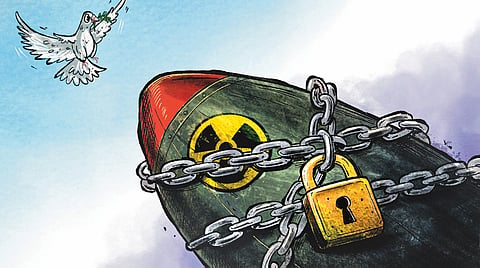

The importance of the Shenzhen summit between Donald Trump, Xi Jinping and Vladimir Putin rested on a simple question: could they make wars less likely and the world more secure? The answer isn’t straightforward.
A new nuclear order remains some distance away. The summit started a conversation whose progress will depend on political will, sustained negotiations and verification. Its relationship with the parallel Quad meeting deserves attention. Together, these engagements revealed the challenge of encouraging cooperation among major powers while reassuring countries concerned about their conduct.
The Declaration toward Peace commits the three governments to dialogue on reducing nuclear risks and preventing proliferation. It also addresses energy supplies, UN reform and international judicial jurisdiction. It specifies no nuclear ceilings, inspection arrangements or negotiating timetable. The declaration provides a starting point, with the substantive work still ahead.
Even so, the three leaders coming together offered value. The expiry of the New START in February removed the last bilateral treaty limiting deployed American and Russian strategic nuclear forces. China’s expanding arsenal adds another dimension. All three have reasons to seek greater predictability, although they approach negotiations from different positions.
Washington and Moscow possess much larger arsenals than Beijing. China resists arrangements that disregard this disparity. Russia considers American missile defences and other capabilities affecting its security. Washington seeks arrangements relevant to competition with both countries. Negotiators must identify measures each government considers worthwhile.
The immediate aim should be to reduce uncertainty. Reliable crisis communication, exchanges of information and clearer understanding of military intentions could help prevent miscalculation. Negotiated ceilings would require agreement on what is counted and how compliance is checked. Confidence grows when governments can confirm that others are honouring commitments.
Space belongs within this discussion. Satellites support military communications, navigation and warning of missile attacks. Disrupting them during a confrontation could cause a government to misunderstand an adversary’s intentions. Future talks should examine restraint in this field, although Shenzhen produced no specific agreement on space.
The meeting reflected concerns accumulating for months. War, energy insecurity, economic friction and nuclear uncertainty have increased the costs of confrontation. Each leader had an interest in exploring whether cooperation could reduce them.
Trump had an additional reason to seek diplomatic success. The Republican defeat weakened his domestic position, while leaving him substantial presidential authority. A successful negotiation was called for. His reputation also demands results. Putin and Xi, who may expect to remain in office after Trump leaves in January 2029, felt less pressure to agree early. They can also ask whether US commitments would survive a change of administration.
The leaders should now give their foreign ministers responsibility for establishing an agenda and timetable, supported by military and nuclear specialists. This step is yet to be announced. Regular reviews would help maintain momentum and reveal where political intervention is needed to overcome disagreement.
Progress in Ukraine and West Asia would improve the atmosphere for nuclear negotiations. Both conflicts have deepened distrust and demonstrated the limits of military solutions. Cooperation in reducing their intensity could help the three governments assess whether they can work together on more demanding questions.
Direct communication between Trump and Putin could clarify the possibilities for a settlement in Ukraine. Nato’s eastward expansion is central to Moscow’s explanation of the conflict. Negotiations must also address Ukrainian sovereignty, occupied territory and protection against renewed attack. Ukrainian and European participation will be necessary as arrangements develop.
West Asia presents another immediate test. Washington, Moscow and Beijing share an interest in preventing further escalation and protecting energy flows. Their cooperation could support negotiations with Iran. Tehran will make its own calculations, while Israel’s security concerns will require attention. Influence over partners has practical limits.
Reciprocal restraint, nuclear transparency and credible assurances could help diplomacy advance. Each concession would need an identifiable response. Progress would encourage further cooperation; another military escalation could rapidly destroy confidence. Nuclear dialogue should nevertheless continue through regional setbacks. Its survival cannot depend upon every other dispute first being resolved.
Meanwhile, the Quad summit in Manila addressed issues that matter to countries dependent on reliable sea routes, communications and trade. It remained a flexible forum for consultation and cooperation, with a growing security dimension. Its members should now explain how their initiatives benefit regional partners. Practical cooperation in maritime awareness, disaster response and infrastructure can strengthen regional confidence alongside wider diplomatic negotiations. Respect for ASEAN’s role remains equally important.
While India favours nuclear restraint to reduce global risks and Quad cooperation to build regional capacity, any major-power understanding must respect national sovereignty. Assessing emerging arrangements against security concerns regarding China and Pakistan, India’s regional participation should preserve its freedom of judgement, encourage practical stability measures, and strengthen a genuinely multipolar order.
Treaties must accommodate legitimate security concerns without giving any country permission to intimidate its neighbours. Verification must be reliable to withstand political suspicion. Leaders must also prepare their domestic audiences for compromise. Agreements become vulnerable when governments promise peace abroad while continuing to reward confrontation at home for advantage.
The opportunity now is to establish a process that continues beyond the summit. Ministers must meet, specialists must negotiate and leaders must remain engaged when difficulties arise. Easing the wars would help. Verifiable restraint would build confidence. Shenzhen will acquire lasting significance if this early effort develops into cooperation that governments can sustain and people can recognise through greater security.
Lt Gen Syed Ata Hasnain (Retd) | Governor of Bihar and former Commander of the Srinagar-based Chinar Corps
(Views are personal)
