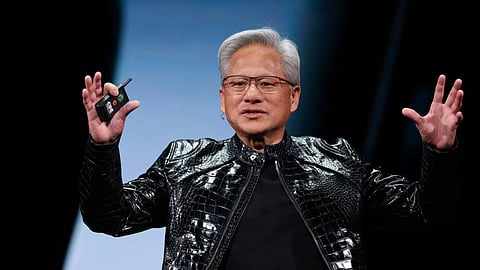

The dramatic resignation and reinstatement of Jensen Huang as Nvidia's chief executive shows what happens when the checks on a powerful corporate leader are allowed to weaken. The two events 11 days apart exposed the fact that through the AI boom, Huang has been treated less as a manager than an oracle. This has implications across the world, far beyond the toll it took in tech valuations.
Corporate governance, at its simplest, is the set of checks that stops the person in charge from putting the company, its shareholders and its employees at risk. Compliance manuals and annual reports record those checks. They do not replace them.
Why should one man’s private life matter so much to a company worth trillions? At the top of a large enterprise, a leader’s private life stops being private once it exposes the institution to legal, financial or national security risk. From then on, recklessness is a failure of risk management as much as a moral lapse.
Huang is hardly the first. Martin Sorrell built WPP into the world’s largest advertising group over three decades and left in 2018 amid an investigation into allegations of personal misconduct and misuse of company funds, which he denied. McDonald’s fired Steve Easterbrook in 2019 over a relationship with an employee, then sued him on finding he had concealed others; he eventually returned more than $100 million. Neither case was about prudery. Hidden relationships invite blackmail, skew decisions about who gets ahead, and leave shareholders exposed to sudden losses.
Boards are supposed to catch this, and too often they don’t. Companies list their independent directors and publish ethics charters, but when a leader is delivering extraordinary returns, oversight tends to weaken. Governance then becomes a shield held up by those in power rather than a check.
The tools to prevent this are not new. Independent directors can meet without the chief executive at every board meeting. Boards can require senior executives to disclose any close relationship with a subordinate, supplier or customer to the audit or nomination committee. Succession planning can be a standing item on the board’s agenda rather than something discussed only in a crisis. What is usually missing is the will to apply these rules to the person who has made everyone rich.
What interests me most, as someone who studies family firms, is how much Nvidia behaved like one. Family businesses are usually defined by concentrated ownership and control that passes down the generations. Nvidia fails both tests. Huang owns about 3.58 percent, less than Vanguard or BlackRock, and there are no dual-class shares to lock in his control. Yet he ran the company like a personal fiefdom. Whether a firm is a family business, it turns out, depends as much on how it behaves as on who owns it.
The family had an important influence in the functioning of Nvidia. Both Huang’s children, Madison and Spencer Huang, and his son-in-law, Nico Caprez, held influential roles. Madison, 35, trained in the culinary arts and worked in hospitality, not engineering. Yet, she rose quickly to become her father’s de facto chief of staff. Colleagues, according to reports, felt no one could tell her no.
The same reports describe her berating senior, long-serving executives before an India AI summit, and a marketing vice-president suffering a panic attack during one of her calls. More than a dozen experienced leaders are said to have left. Huang himself reportedly joked that staff should be “afraid of his daughter”.
Family business scholars Alain Verbeke and Liena Kano call it ‘bifurcation bias’: the habit of treating ‘heritage assets’—family members, old loyalists and emotional attachments—as inherently more valuable and exempting them from the performance and conduct standards applied to professional managers. Outsiders are held to harder targets than family members.
The bias also hurts the family members it is meant to favour. When a founder leaves, protection weakens for the children. The experienced professionals who might have helped are often the ones who have already left. In Indian promoter-run groups, where the next generation often joins the business young and rises fast, the risk is a familiar one. Nvidia shows that a widely-held Silicon Valley company is not immune to it either.
Even after the crisis broke, the instinct at the top was to hold on. Silicon Valley allies, online petitions and even some politicians campaigned for Huang’s return, and Huang said he would be “honoured” to come back—before it actually came to pass.
The damage went well beyond his personal life. Congressional committees had summoned executives over possible national security leaks. Moody’s lowered its outlook on Nvidia's credit, citing succession risk. An independent probe was still finding out how far the loss of trust ran. Bringing Huang tells markets and Washington that Nvidia could not be governed. The directors could not place the company before the visionary founder.
Good governance is supposed to be inconvenient. It exists because people make mistakes, and brilliant people are no exceptions. Investors, employees and business families should not mistake a rising share price or a charismatic founder for a well-run institution. The real test of a company is how it copes after its founder leaves, not how it performs while he is in charge.
Tulsi Jayakumar | Professor, economics & policy; and Executive Director, Centre for Family Business & Entrepreneurship, Bhavan’s SPJIMR
(Views are personal)
