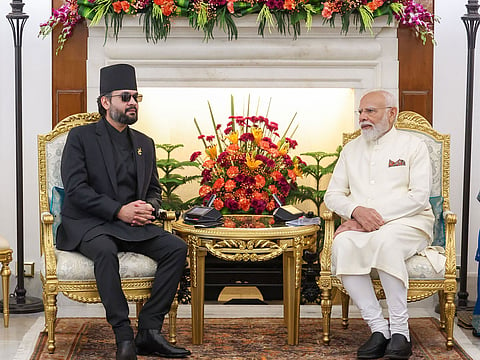

The Modi–Shah Joint Vision offers an ambitious blueprint for transforming bilateral relations. Yet, unless political goodwill is matched by institutional reform, economic pragmatism and credible implementation, even this promising initiative risks becoming another catalogue of unfulfilled commitments.
The relationship between India and Nepal has never suffered from a shortage of history, sentiment or political declarations. What it has often lacked is the ability to translate these advantages into sustained economic transformation and mutual strategic confidence. The Joint Vision adopted during Nepalese Prime Minister Balendra Shah’s visit to New Delhi on 22 November 2026 offers an opportunity to correct precisely this imbalance. Its ambition is unmistakable. Its success, however, will depend less on the breadth of its promises than on the willingness of both governments to confront the structural weaknesses that have constrained the relationship for decades.
The document, appropriately titled Viksit Bharat and Samunnat Nepal: Re-imagining the Partnership, represents a potentially significant departure from the traditional vocabulary of bilateral cooperation. Spanning ten pillars, it moves beyond familiar commitments on connectivity, trade and development assistance to embrace artificial intelligence, digital public infrastructure, innovation, education, climate resilience and youth empowerment.
This is welcome. But ambition should not be confused with achievement.
Beyond geography and sentiment
India and Nepal share an exceptionally intimate relationship, reinforced by an open border, extensive familial connections, cultural affinities and deep economic interdependence. Yet these very advantages have sometimes encouraged complacency. India has frequently assumed that geography and historical proximity would naturally sustain its influence, while Nepal has periodically viewed economic dependence on India through the prism of political vulnerability.
The resulting relationship has oscillated between extraordinary warmth and unnecessary mistrust.
Perhaps the most politically consequential element of the Joint Vision is its willingness to contemplate reviewing existing bilateral agreements, including the 1950 Treaty of Peace and Friendship, through mutual consent. This is more than diplomatic symbolism. The treaty has long been a contentious reference point in Nepal’s domestic political discourse, often portrayed as reflecting an unequal historical relationship.
India’s willingness to discuss its modernization signals confidence rather than concession. A contemporary partnership between sovereign neighbours cannot remain permanently anchored in institutional arrangements negotiated under fundamentally different geopolitical circumstances.
Yet the document stops short of establishing a concrete mechanism or timetable for such a review. That omission matters. Without a structured negotiating process, a politically significant commitment could easily become another unresolved item on an already crowded bilateral agenda.
The economic opportunity—and its limitations
The announcement of INR 15,000 crore in development assistance, including INR 3,500 crore in grants and INR 11,500 crore through a rupee-denominated line of credit, is substantial. It demonstrates India’s willingness to support Nepal’s reconstruction, infrastructure and energy ambitions.
But the real question is not how much India commits. It is how effectively the money translates into productive assets, employment and sustainable economic growth.
Nepal does not simply need more infrastructure. It needs an economic transformation capable of creating opportunities for its young population, reducing excessive dependence on remittances and expanding its productive base.
The proposed cross-border special economic zones, manufacturing parks, IT facilities and agro-industrial infrastructure could help achieve this. They also offer an opportunity to integrate Nepal into India’s expanding manufacturing and regional supply chains.
However, industrial parks do not automatically generate industrialization. Without predictable regulations, competitive logistics, reliable electricity, investor protection and access to markets, they risk becoming expensive monuments to diplomatic ambition.
Equally significant is what the Joint Vision does not adequately address: persistent structural impediments to bilateral trade. Nepal’s merchandise trade deficit with India remains substantial, while its export diversification and manufacturing competitiveness are limited.
A genuinely transformative partnership must therefore move beyond facilitating Indian investment to enabling Nepalese enterprises to compete, export and participate meaningfully in regional value chains.
Otherwise, economic integration could deepen asymmetry rather than reduce it.
Energy: From strategic promise to commercial reality
Hydropower remains perhaps the most compelling opportunity for mutually beneficial cooperation. Nepal possesses enormous hydropower potential, while India’s growing electricity requirements offer a natural market.
The proposed expansion of generation capacity, transmission networks and cross-border electricity trade could fundamentally reshape Nepal’s economic prospects.
Yet history counsels caution. Projects such as Pancheshwar have remained trapped in negotiations and disagreements for years. Their difficulties reflect not engineering limitations alone, but unresolved questions concerning water-sharing, project economics, environmental impacts and the distribution of benefits.
The Joint Vision’s commitment to accelerate these projects is therefore encouraging but insufficient.
What is needed is a transparent, commercially credible framework that establishes predictable electricity-purchase arrangements, fair benefit-sharing and workable disputeresolution mechanisms.
Importantly, Nepal must also retain the policy space necessary to diversify its energy relationships and pursue its legitimate development priorities.
A successful energy partnership cannot be built on strategic exclusivity. It must rest on economic competitiveness and mutual confidence.
A partnership for a new generation
Perhaps the most refreshing aspect of the document is its recognition that the future of India–Nepal relations will be shaped increasingly by technology, entrepreneurship and the aspirations of younger generations.
Proposals for a Nepali-language large language model, startup collaboration, digital parks, satellite applications and educational partnerships reflect a welcome understanding of the changing foundations of national development.
The proposed IIT presence in Nepal, alongside vocational training and expanded scholarships, could be particularly consequential.
However, the emphasis should not be confined to transferring Indian expertise. Nepal must be enabled to develop its own technological capabilities, research institutions and entrepreneurial ecosystem.
The ultimate measure of success will not be the number of training programmes conducted or centres inaugurated, but the extent to which Nepali institutions become capable of sustaining innovation independently.
This distinction is crucial. Development cooperation should build capabilities, not perpetuate dependency.
The missing strategic conversation
For all its breadth, the Joint Vision is remarkably restrained in addressing the geopolitical realities shaping the Himalayan region.
Nepal occupies a sensitive strategic position between India and China. Its pursuit of diversified economic and diplomatic relationships is both understandable and legitimate.
India, meanwhile, has genuine security interests arising from its open border and the broader strategic environment.
Neither reality can simply be wished away.
A mature partnership requires India to recognize Nepal’s strategic autonomy without interpreting every external engagement as a geopolitical setback. Equally, Nepal must acknowledge that geography creates legitimate security sensitivities that cannot be disregarded.
The document’s commitment to an open, secure and well-regulated border is important. But lasting confidence will require more sustained political dialogue, transparent communication and a willingness to address contentious issues before they escalate into public disputes.
Implementation: The ultimate credibility test
The decision to activate a High-Level Monitoring Group, meeting at least every six months, is sensible. Yet bilateral relations are already populated by committees, commissions and institutional mechanisms.
The problem has rarely been the absence of forums. It has been the absence of accountability.
The new mechanism should therefore be supported by publicly identifiable milestones, project-specific responsibilities, transparent progress reporting and clear deadlines.
A credible implementation framework would distinguish between commitments that can be delivered within twelve months and those requiring five or ten years. It would also identify financing arrangements, regulatory obstacles and mechanisms for resolving delays.
Without these disciplines, the Joint Vision risks becoming a beautifully drafted document whose ambitions progressively disappear into bureaucratic processes.
From influence to partnership
Ultimately, the significance of the Modi–Shah initiative lies in the possibility of redefining the psychology of the relationship.
India must resist the temptation to measure success primarily through strategic influence. Nepal, for its part, must move beyond viewing every dimension of economic interdependence as a potential threat to sovereignty.
The objective should be neither dependence nor dominance, but shared prosperity built on mutual respect, economic opportunity and institutional trust.
The Joint Vision offers the foundations for precisely such a transformation. Its ambition deserves recognition, and its forward-looking orientation marks a welcome evolution in bilateral thinking.
But history offers a sobering lesson: India and Nepal have never lacked shared aspirations. They have too often lacked the political consistency and institutional discipline required to fulfil them.
The real test of this new partnership will not be the declarations issued in New Delhi, but the factories that open, the electricity that flows, the young people who find meaningful employment and the trust that survives the next political disagreement.
For India and Nepal, the time has come to replace the diplomacy of promises with the politics of delivery.
(Views are personal)
Shishir Priyadarshi,
President, Chintan Research Foundation
