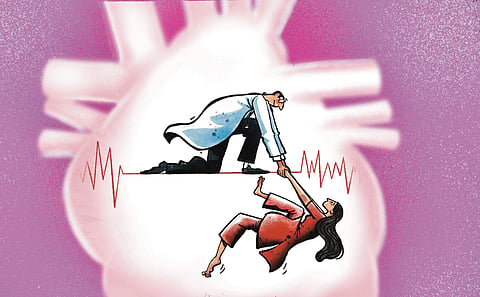

Never take women’s hearts for granted! That is not poetic counsel for romantic relationships, but hard-headed advice given by four professional guideline-framing medical groups in the US. Their report documents the growing burden of heart diseases in women, while highlighting differences in clinical presentations and diagnostic tests between men and women affected by coronary artery disease.
CAD most often manifests as angina (chest pain or discomfort that occurs usually on exertion and resolves in a few minutes with rest) or myocardial infarction (more prolonged discomfort which results in heart muscle damage and can be fatal). The former occurs when fat-laden fibrous tissue blocks coronary arteries. These prevent adequate blood supply to the heart muscle when it demands more oxygen during physical exercise or mentally stressful conditions. The latter occurs when relatively soft, fat-laden plaque-like lesions on the inner lining of the coronary arteries suffer a breach. Their exposed fatty core triggers formation of large clots which cut off blood flow through that vessel, causing heart muscle damage.
For long, both manifestations of CAD in women were neglected by physicians who relied on diagnostic criteria derived solely from recorded observations in men. Symptomatic manifestations of angina in women were often dismissed as ‘non-cardiac chest pain’ or ‘atypical chest pain’ not warranting serious attention. Men with CAD-related symptoms usually present with constricting retrosternal chest pain or pressure in the centre of the chest extending to or originating from the arm or report a suffocating sensation in the throat often accompanied by some breathlessness.
Women may describe chest discomfort as pressure, heaviness, tightness or squeezing, and they can experience frequent angina from ‘small vessel disease’ even when large-artery blockages are less extensive. Women are also more likely to report accompanying or standalone symptoms such as shortness of breath, mid-back pain, nausea, vomiting, indigestion, fatigue, dizziness and palpitations. Subtle and atypical symptoms may lead to delayed self referral for medical evaluation and even misdiagnosis by the doctor. Women may attribute their symptoms to work-related fatigue or stress while doctors may dismiss them as an anxiety disorder.
Even laboratory markers of cardiac muscle damage in an acute coronary event vary between men and women. In healthy people and the general population, men typically have higher baseline values of high-sensitivity cardiac troponin—a protein in heart muscle that helps control contraction, used as a biomarker—than women. High-sensitivity assays show lower 99th-percentile upper reference limits in women. While exact thresholds may vary among manufacturers of the assay, gender differences are evident within each assay. Applying male thresholds to women may miss myocardial muscle injury in women suffering a heart attack.
The underlying pathology and causal pathways too may differ. Women more commonly have disease or dysfunction of the smaller vessels in the coronary vasculature rather than in the large arteries. Women tend to have smaller blood vessels and often develop softer, more diffuse plaque buildup, which can be harder to spot on standard tests.
Female sex hormones, too, play a role. Estrogen offers some protection before menopause, with women tending to develop CAD later in life. It promotes production of nitric oxide which relaxes and widens the blood vessels for smooth blood flow. It also reduces inflammation and enables a protective blood lipid profile by regulating genes involved in lipid metabolism. The risk of CAD rises sharply after menopause. An early onset of menstruation is often associated with obesity and being overweight with higher coronary risk.
Abdominal fat accumulation (apple shape) is not common in women, where fat is more often deposited around the hips (pear shape). Metabolic effects vary between these locations. Abdominal fat is more often associated with inflammation in body tissues, an atherogenic lipid profile and glucose intolerance. A waist-to-height ratio of more than 0.5 spells trouble for the heart and blood vessels.
The polyendocrine metabolic ovarian syndrome, the new full form for PCOS, is a clear example of such conglomerate risk. Hormonal shifts, over the course of a woman’s life, shape her cardiovascular risk alongside acquired risk through unhealthy diets, tobacco smoke exposure, physical inactivity, stress and inadequate sleep. Pregnancy-related complications, autoimmune conditions, diabetes, high blood pressure, smoking and stress play important roles in influencing women's cardiovascular risk.
Women who do not smoke also acquire higher risk of CAD from second-hand exposure to smoke from family members or co-workers. Smoking reduces the levels of anti-atherogenic HDL cholesterol (which are usually higher in women), while increasing the levels of atherogenic ‘small, dense LDL’ fraction. Air pollution, with high levels of particulate matter 2.5, injures blood vessels, leading to increased fat deposition and blood clot formation in coronary arteries.
Among young women, the combination of oral contraceptive use and smoking markedly enhances the risk of blood clots in the coronary arteries. Diffuse coronary artery disease is more commonly seen in women with diabetes. Women tend to experience stressful conditions frequently, often internalising chronic stress to suffer damage to coronary blood vessels.
A new set of guidelines related to CAD in women were recently published in Circulation, a leading American medical journal. They were jointly framed by the American Heart Association, American Academy of Pediatrics, American College of Obstetricians and Gynaecologists and the Society for Maternal-Fetal Medicine. Sadiya Khan, from Northwestern University’s Feinberg School of Medicine and the lead author of these consensus guidelines, says that these guidelines are “empowering rather than frightening”.
Greater awareness of the rising risk and distinctive features of CAD in women enable them for better informed self-care for prevention and early self-referral for medical attention when symptoms manifest. All healthcare providers, from community to hospital settings, should become better aware of the magnitude, manifestations and medical needs of CAD in women so that they can provide competent and compassionate care.
K Srinath Reddy | Chancellor, PHFI University of Public Health Sciences; and Chair, Centre for Universal Health Assurance, Indian School of Public Policy
(Views are personal)
(ksrinath.reddy@phfi.org)
