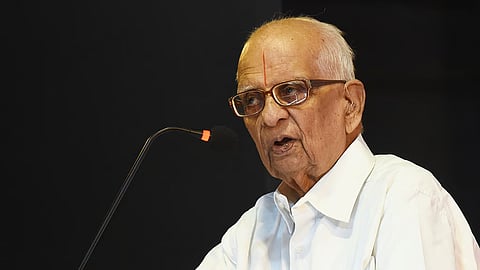

When a century is captured through K Parasaran’s rich intellectual life and unwavering moral compass, India’s legal history witnesses a rare convergence of span and substance. As he steps into his centenary year on October 9, the scholar-jurist embodies a rare institution by himself.
A polymath non-pareil, Parasaran belongs in the league of extraordinary personalities in post-independence India whose lives and contributions will remain eternally cherished. The distinguished jurist epitomises a rare combination of constitutional scholarship, courtroom advocacy, scholarly wisdom, professional discipline and personal simplicity with remarkable continuity and integrity. A person for whom honours went searching proved that there was substantive meaning in the breadth of his jurisprudential contribution and in the example he continues to set for generations of lawyers.
Parasaran’s journey post 1947 is singular for its accomplishment as well as enduring relevance. Born into a socio-cultural milieu that saw a display of legal excellence with the larger Anglosphere in the backdrop during the last days of the Raj, his ascent to the top echelons of legal practice was a transcendence enabled by remarkable abilities and personal values.
Perhaps the most distinctive feature of Parasaran’s intellectual personality is the coexistence of two apparently distant worlds: the sophisticated architecture of modern constitutional law and the timeless vocabulary of India’s civilisational wisdom.
On his centenary, memory also takes us back to Parasaran’s father Keshava Iyengar, a doyen of the old Madras Bar whose voice was heard in the halls of the then Federal Court of India in New Delhi. The Delhi continuum manifested when Parasaran succeeded Lal Narayan Sinha as the sixth Attorney General of India in 1983.
Though his career peaked in the national capital, Parasaran once thought he would be confined within two Chennai neighbourhoods. During several landmark cases throughout the 1980s and 90s, his practice was a bundle of legal advice, client counselling, contextual analysis and a highly-developed form of persuasiveness that made his submissions difficult to reject. Of particular interest was his entry into the portals of public memory through the First Judges case in 1981, which marked his ascent to a glittering career that made his janmabhoomi proud.
As a sought-after Senior Counsel in the late 1990s and early 2000s, he witnessed transformational changes in the country’s legal system. From 2010 onwards, his appearances remained focused on high-voltage litigations till 2018, when he was briefed to appear in the Ram Janmabhoomi case.
An act of destiny, he has often remarked that this case was probably the reason why he was given several positions in the earlier part of his career that added up to a stature considerable enough to appear in this once-in-a-century case. This inherent humility, which he has often invoked, elevated him in the pantheon of public opinion.
The persona behind his stature as a jurist was someone who nurtured friendships and observed utter simplicity, which led to him being popularly referred to as the ‘Pitamaha of the Indian Bar’.
Parasaran’s corpus of legal and cultural wisdom is an open-source library that has supported all scenarios; his advice comes with a personal charm charged by his intuitive intellect. He has zealously protected and fostered his varied, longstanding relationships—in this, he represents associational life as the thematic core of Indian societal imagination.
For a person who never indulged in self-promotion, it was providence that showered opportunities on Parasaran. After a meeting with him, one always returns with a sense of renewed optimism even in the face of adversity. His adaptability and keen curiosity about the changing legal profession have strengthened his relevance in this age of arbitration and interaction of global jurisdictions.
The legal engine is always in the perpetual motion of evolving jurisprudence. As Parasaran enters his centenary year, India celebrates not only his distinguished legal career, but also the enduring legacy of a jurist whose statesmanship illuminated courts, whose scholarship enriched jurisprudence and whose life showed that professional excellence and personal righteousness need never be separated.
As one of the few who still represents a generation of icons that India once produced, Parasaran’s career is a culmination of continuities. Ever observant with a knack of drawing apt analogies, his cross-references from the East and the West symbolise a sense of composite wisdom.
Today, K Parasaran is an ageless icon for a young India that is in search of a modern identity without severing its civilisational roots. Shatamanam bhavati, Shriman Parasaran!
S Vaidhyasubramaniam | Vice-Chancellor, SASTRA (Deemed) University
Amrith Bhargav | Advocate
(Views are personal)
