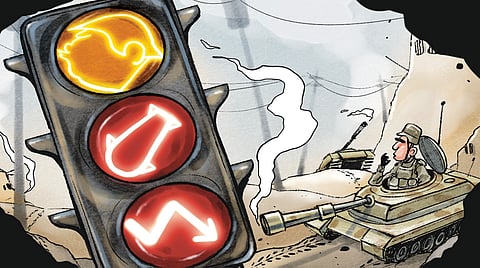

Speaking before the United Nations General Assembly in New York last month, US President Donald Trump laid bare the existential crossroads facing Washington’s seven-month campaign against Iran. Framing the conflict as a choice between signing a post-midterm diplomatic deal or initiating total annihilation, his rhetoric underscored a troubling reality: Operation Epic Fury, launched jointly with Israel in late February 2026, has been an Epic Failure.
Far from delivering the swift, decisive outcome intended, it has created a humiliating stalemate, with global ramifications for the US’s uncertain place in the world and domestic implications for the ruling party in the US. What Washington planned as a high-intensity decapitation effort targeting Tehran’s ballistic missile infrastructure and naval assets has instead evolved into a grinding, multipolar war of attrition.
The US now finds itself caught between an unwinnable air campaign and an unpalatable political compromise, while the global economy buckles under the fallout.
The core vulnerability in the American war effort stems from a fundamental operational mismatch. Unwilling to commit ground troops to a costly land occupation, a step the administration remains reluctant to contemplate for understandable domestic reasons, the US military relies on air dominance and standoff strikes, whose limitations are all too apparent. While stationary infrastructure and conventional naval installations in Iran have been degraded, airpower alone cannot eliminate Iran’s distributed, deeply buried, and asymmetric capabilities.
Tehran has also successfully broadened the theatre of operations far beyond its own borders. Houthi forces in Yemen have effectively choked commercial transit through the Bab al-Mandab, turning the Southern Red Sea into an operational hazard zone, while Iranian-aligned Shia militias in Iraq have executed drone and missile strikes against critical regional energy infrastructure, including Saudi Arabia’s East-West pipeline.
When Saudi leaders requested US air defence coverage to shield these vital supply routes, Washington demurred, constrained by a need to preserve its own dwindling supply of precision-guided munitions.
This refusal highlights a growing operational crisis within the Pentagon. Seven months of near-continuous combat sorties and high-rate missile defence interceptions have severely drawn down US and allied inventories of long-range precision strike systems, exposing the severe limitations of the Western defence industrial base.
The economic fallout of this strategic impasse extends far beyond West Asia. With transit through the Strait of Hormuz severely restricted and regional pipelines damaged, benchmark crude oil prices have again surged past $100, having hit a recent high of $114 five months ago. This sustained energy shock has reintroduced severe inflationary pressures into the world’s economies, squeezing consumers and creating significant political headwinds ahead of the US midterm elections.
For global markets, the ongoing hostilities have triggered a profound supply-side energy shock. With the physical blockade of Hormuz choking off roughly 20 percent of global petroleum transit and liquefied natural gas shipments, elevated crude prices have spiked shipping freight costs, doubled energy transit insurance premiums, and forced global central banks to abruptly halt planned interest rate cuts to combat reignited inflationary pressures.
Few major nations bear this macroeconomic strain more acutely than India. Highly exposed due to our dependence on foreign energy to fulfil over 85 percent of crude-oil requirements, India faces a sharp widening of its current account deficit (where every $10 surge in crude prices expands the trade deficit by roughly 0.5 percent of GDP) alongside persistent downward pressure on the Indian rupee, which has hit historic lows beyond ₹95 to a US dollar.
The severe disruption of Gulf trade corridors has simultaneously squeezed input margins across Indian manufacturing, chemical and aviation sectors, compounded by higher import bills for fertilisers and essential commodities, while stoking domestic retail inflation through heightened transportation logistics. The conflict poses a direct threat to India’s broader growth trajectory, threatening to trim our expected GDP expansion if high energy costs remain entrenched.
Meanwhile, Washington’s heavy reliance on secondary financial sanctions, has accelerated a structural shift in global finance. Member nations at the BRICS summit in New Delhi emphasised creating alternative non-dollar settlement systems to shield domestic economies from unilateral American leverage.
Concurrently, European central banks, including those of France and Norway, have quietly begun repatriating gold reserves from Federal Reserve vaults in New York back to continental Europe, reflecting a historic erosion of trust in American financial stewardship.
Far from triggering the immediate collapse of the Iranian state, the conflict has consolidated Tehran’s domestic political control. By demonstrating an ability to withstand direct bombardment while disrupting roughly 20 percent of global daily oil transit, Tehran has projected an image of regional defiance that has altered diplomatic calculations.
Elevated oil prices have provided windfall revenues to Moscow to fund operations in Ukraine, while Beijing monitors American failures with a keen strategic eye on the balance of power in the Indo-Pacific. Realising that US security guarantees are constrained, traditional American partners in the Gulf have even initiated direct bilateral discussions with Tehran to manage local stability.
Beyond the immediate economic fallout, the impasse severely erodes global confidence in the US as a predictable policymaker and reliable security guarantor. By initiating a major conflict without a coherent off-ramp, and subsequently being unable to provide protection for critical energy corridors due to depleted ammunition stockpiles, Washington has demonstrated both the volatile unpredictability of its foreign policy and its operational limits.
This stark gap between American strategic commitments and actual ability to sustain them is forcing all nations to diversify their security relationships, hedging against a superpower whose promises increasingly seem subject to domestic political whims and constrained military resources.
The war between the US and Iran has settled into a dangerous, unstable equilibrium. Washington possesses overwhelming destructive capacity, yet lacks the strategic leverage or political willingness to enforce a decisive outcome. Tehran lacks the capability to win conventionally, but retains sufficient asymmetric reach to hold its own against US attacks.
As military stockpiles run low and global markets adjust to prolonged instability, the Iran War serves as a stark demonstration of the limits of unilateral military force in an increasingly multipolar world.
Shashi Tharoor | Lok Sabha MP, Chair of the Standing Committee on External Affairs and Sahitya Akademi-winning author
(Views are personal)
(office@tharoor.in)
