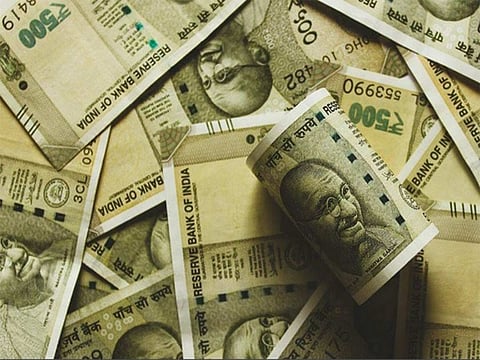

The Indian rupee typically makes news twice a year—when it falls, and then when it falls again. And sometimes as it keeps falling. The first dip is hailed by the regime-friendly as economy-friendly; the second triggers alarm across household and national budgets. This year has been no different. The political economy was shaken and stirred when the rupee crashed through barriers in May to touch 96.96 to the dollar.
The wise folks in Delhi could well have borrowed Chief Brody’s line from Jaws: the rupee was “gonna need a bigger boat”. The RBI dusted off the 2013 formula and floated a risk-covered dollar deposit scheme. Bankers expected $70-80 billion. The window drew $143.5 billion. On September 3, the rupee firmed up to 94.28; reserves touched a record $785.7 billion.
That did not change the equation. The US Fed raised rates, Brent went past $100 a barrel, the US 10-year yield touched 5.34 percent, and reserves fell $50 billion in four weeks. The RBI raised rates by 25 basis points, the first in nearly four years. The rupee closed the week at 96.72, a whisker from its May low. A one-year forward prices the dollar at ₹ 100.5. The century is already on the screen.
There is, as Milton Friedman reminded us, no such thing as a free lunch. The defence of the rupee carries a cost that feeds the loop. Every FCNR dollar came with a promise of redemption between 2029 and 2031. The RBI’s net short forward position, dollars it must hand back, swelled to a record $200 billion in August.
Net that out, and gross reserves of $734.6 billion shrink to nearer $535 billion. By that reckoning, India borrowed $133 billion and has fewer dollars to call its own than before the window opened. The kitty for the defence of the currency becomes the cache of doubt.
The dollar inflow flooded banks with rupees. To drain them, the RBI sold dollars today and bought them back for later, pushing the forward premium close to 4 percent. That has spawned its own arbitrage. Banks, Reuters reported, are pitching companies rupee loans swapped into dollars. Because the debt is repaid in dollars at the locked rate of 100.5, a loan costing 8 percent in rupees costs about 4 percent in dollars. The catch: the company now owes dollars, and is betting the rupee will not be weaker than 100.5 when the bill falls due. If it is, the scramble to hedge punishes the rupee.
The slide of the rupee is both cause and consequence of gyrations in the economy. India imports 88 percent of its crude, and the war sent oil past $100. Costlier oil weakened the rupee and compressed returns. On Friday the Nifty50 rose 1.3 percent to 22,520.45, snapping eight straight weekly losses, the longest such run in about a quarter century. The index is down 13.8 percent since December 31. The view from Mumbai is grim; the view from London and Singapore is worse. The rupee began the year at 89.94 to the dollar. Do the arithmetic: John Dollar, the foreign investor, has lost nearly a fifth of his money in nine months.
When the rupee falls, foreign investors sell. The outflows push the rupee lower prompting more selling. This loop is at the heart of rupee’s story. Foreign portfolio investors have pulled some $30 billion out of Indian equities this year, well past the record $18 billion of 2025; on Thursday alone they sold ₹12,944 crore. As the Red Queen tells Alice in Lewis Carroll’s Through the Looking-Glass, “it takes all the running you can do, to keep in the same place.” The $143.5-billion boat told the world India has dollars. The markets were asking a different question: is it worth holding rupee assets at all?
Consider the bond investor. India’s 10-year bond yields 7.23 percent. Hedging the rupee for a year costs close to 4 percent, up more than 60 basis points in the week the RBI raised rates. The foreigner keeps about 3.3 percent. The US 10-year Treasury pays 5.24 percent, and stress-free sleep.
The June tax exemption on government securities brought record inflows, which reversed in September once hedged yields fell below Treasuries. In the twelve months to July, the US drew over $1 trillion of foreign portfolio money, $942 billion of it into equities. The AI trade prices the dollar; oil reprices the rupee. The line attributed to John Connally in 1971—“The dollar is our currency, but it’s your problem”—has rarely been truer.
Which brings us to the remedy in circulation, a tax break for foreign equity investors. Capital gains tax is levied on gains. This year, for most, there are none to tax. Even in a good year, a 12 percent gain, an exemption returns 1.5 to 2.4 percentage points, against a seven-point currency loss this year and a hedge that costs four.
For a dollar investor merely to recover where he stood on January 1, with the rupee at 100, the Nifty must climb 29 percent. Even to start afresh from here, matching a Treasury plus a modest premium for risk, it must rise about 13 percent, to roughly 25,460, close to where it began the year. To be paid for the risk of India, the market must first undo 2026.
Confidence is a flow, not a stock. Rescuing the reeling rupee demands a rethink of how India nurtures its economy and its assets. The arithmetic that prices the rupee can be done in Mumbai; the algebra that defines its value can only be scripted in Delhi.
Read all columns by Shankkar Aiyar
Shankkar Aiyar
THE THIRD EYE | Author of The Gated Republic, Aadhaar: A Biometric History of India’s 12 Digit Revolution, and Accidental India
