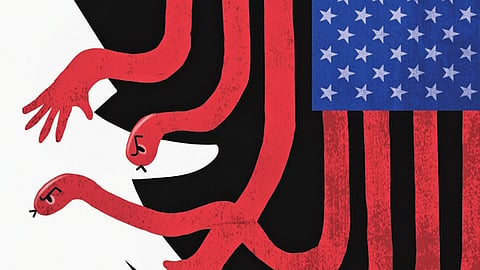

Shakespeare warned in Coriolanus that “friends now fast sworn, whose double bosoms seem to wear one heart” can, “on a dissension of a doit, break out to bitterest enmity”. Two centuries later, in 1848, Lord Palmerston told the UK House of Commons that nations have no eternal allies and no perpetual enemies, only eternal interests. India spent a quarter century under an illusionary conviction that it had graduated from America’s waiting room to its drawing room. Tragically, Donald Trump during his second stint is now showing New Delhi the door it came in through.
The latest surgical strike came last week from the White House itself. Speaking to the press, Vice President J D Vance announced that eight companies had been suspended from the US labour department’s PERM programme, the gateway to employer-sponsored green cards. Singling out Microsoft, he declared, “You cannot lay off American workers and then replace them with foreign indentured servants.”
It’s not a coincidence. It had a hidden message because seven of the eight—Microsoft, Adobe, Infosys, TCS, Wipro, HCL and Cognizant—were steered by Indians or people of Indian origin, with CapGemini the lone exception.
Indenture is a word that once shipped more than a million Indians to the cane fields of Fiji, Mauritius and the Caribbean, and flinging it at the engineers who write America’s software is a tight slap with a very long memory. The ministry of external affairs was right to call it deeply offensive.
The irony is almost ostentatious. Every evening, Vance returns home to Usha, the daughter of parents of Indian origin, and to his son named Vivek. So, the Vice President who brands Indian professionals as servants need look no further than his own dinner table to see what Indian mobility has in his own country.
The venomous formulations make more sense if these are read alongside the tardy trade calendar. For months, Washington has hammered at the gates of India’s farm and dairy sectors. India has justifiably refused to open them, because nearly half its population survives on agriculture. When a negotiator cannot win at the table, he sometimes kicks it.
If India recounts the administrative atrocities unleashed on Indians during the past two years, a hostile pattern emerges. Indian deportees were flown home in shackles on a military aircraft. The H-1B visa was slapped with a $100,000 fee. Last week, Trump’s government proposed that universities pay $70,000 for every foreign student entering the optional practical training programme. The target was India, America’s largest source of international students. And Trump has armed himself with legal power to impose tariffs of up to 100 percent on buyers of Russian oil. Taken alone, each action can pass for domestic housekeeping; but taken together, they look like a siege around India.
Meanwhile, the long awaited trade deal is dead. Finance Minister Nirmala Sitharaman admitted that negotiations have hit a plateau beyond which further give-and-take becomes very difficult. US Trade Representative Jamieson Greer, too, has conceded that a deal is not imminent.
The arithmetic Washington hates is simple, since India ran a surplus of about $12.3 billion with the US between April and July. Is this hard bargaining in a bully’s coat? Is India being punished for its strategic autonomy and its Russian crude? Or has the Indian techie become a convenient effigy for MAGA’s domestic bonfire?
Now look at another irony. Ambassador Sergio Gor has enjoyed a red-carpet run of India that few envoys get. He became the first US ambassador to visit Srinagar in six years and the first ever to Ladakh, moving freely through sensitive regions and hosting the chiefs of India’s armed forces at his residence. None of this is improper, and his words on J&K pleased New Delhi. But why do the velvet glove in Delhi and the iron fist in Washington belong to the same body? This is coercive, transactional diplomacy, the kind that treats a civilisational partner as a ledger entry to be balanced every quarter.
Henry Kissinger once quipped that it may be dangerous to be America’s enemy, but to be America’s friend is fatal. India dismissed that as cynicism through the nuclear deal, the Obama years, the stadium hugs of Trump’s first term and Biden’s technology pacts. The banyan of that relationship took decades to drop its aerial roots, and it is being hacked at in a single season.
Yet the probing torch must also turn inward. Did New Delhi mistake personal chemistry for institutional commitment, reading hugs and rallies as treaties? Why did we let our students’ futures and our IT earnings hang so heavily on one capital’s mood? And why are our universities still not good enough to keep our best minds at home?
The warning should be stated plainly. If Washington continues with confrontationist course, it should not get a pliant India—but one that hedges its bets with deepening its compact with Europe, keeps Russian energy flowing, explores a cautious thaw with Beijing and concludes that American promises carry an expiry date. The US would lose the one large Asian democracy that could balance China—all over a trade deficit smaller than a quarter’s profits at some of its tech giants.
The solution lies in firmness without hysteria. India should refuse to sign anything under duress and draw non-negotiable public red lines on agriculture and dairy. It should offer targeted bargains that shrink the surplus on its own terms, buying American energy, aircraft and defence equipment tied to co-production and technology transfer.
It should fast-track its agreements with the European Union, Britain, the Gulf and ASEAN so that no single market can hold its exporters hostage. It should treat the visa squeeze as a 1991 moment for higher education and build universities that reverse the brain drain. And it should work the American system itself through individuals who don’t double cross. They should cultivate Congress, governors, universities and the very companies now bleeding from these policies, with the diaspora as a bridge.
Protocol, too, must run both ways. So the way doors open for America’s envoy in Srinagar and Leh should open equally for India’s ambassador in Washington. Or shut the doors on Gor. A friendship that must be renegotiated every quarter is not a friendship but a lease. India has no need to be anyone’s tenant.
New Delhi should tell Washington—courteously, but without blinking—that it seeks a partner and not a bully, and that the window to choose is narrowing faster than the White House seems to realise.
Read all columns by Prabhu Chawla
Prabhu Chawla
prabhuchawla@newindianexpress.com
Follow him on X @PrabhuChawla
