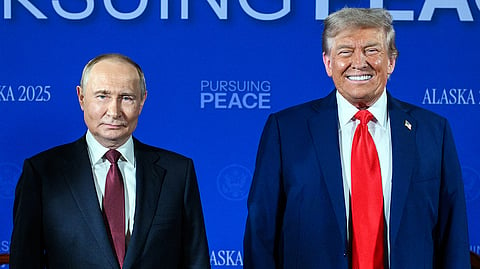

On October 9, President Donald Trump announced an agreement with President Vladimir Putin for Russian diesel supplies to the US and global markets. Trump said Russia would supply more than 300,000 tonnes immediately, 500,000 tonnes in November and further shipments that could bring the announced total to roughly 4.8 million tonnes. The US Treasury promptly issued a general licence permitting specified transactions involving Russian diesel valid for six months. Trump’s justification on Truth Social was straightforward: “Lower prices for Americans … is my greatest priority.”
Coming days before Washington’s own deadline of taking steps against buyers of Russian energy, the announcement exposes an uncomfortable double standard in US foreign policy: Washington has threatened punitive tariffs against major buyers of Russian energy, yet has made an exception for it’s own purchases when domestic diesel prices became a concern.
Three weeks earlier, on September 18, Trump had signed the Lindsey O. Graham Sanctioning Russia and Iran Act (SRIA) into law. Among other measures, it authorises the President to impose tariffs of up to 100% on goods from countries among the five largest importers of Russian origin crude oil or natural gas, as well as measures against certain facilitators of sanctions evasion. India, as a major buyer of Russian crude, could be affected. October 18 is the deadline for Trump to take the initial implementation steps prescribed by SRIA, though the precise application of the tariff provisions depends on the Act and Presidential decisions. The diesel pact, announced just nine days before that deadline, puts Washington’s own energy calculations under the spotlight.
India has earlier faced punitive US tariffs for buying Russian oil, including an additional 25% levy imposed in August that took the overall tariff burden on Indian goods to 50%, alongside threats of further secondary tariffs. Washington’s argument has been that Russian energy helps sustain Moscow’s war effort. Yet when domestic fuel prices became a pressing concern, the US turned to Russian diesel and issued a licence to permit the imports. The circumstances may differ, but the underlying question of national interest is the same.
The Trump-Putin diesel pact vindicates India’s position, which has consistently been that its energy choices must reflect the welfare of its 1.4 billion citizens and the requirements of its economy. Trump’s justification mirrors the logic India has invoked for its Russian crude purchases: affordable fuel is a legitimate domestic priority. If the US can weigh energy security against its wider objectives, India has the same right to do so. The principle either cuts both ways, or neither.
The pact exposes the limits of Washington’s campaign to use secondary tariffs to shape other countries’ energy choices. SRIA remains in force, and the US may still impose tariffs on India and other countries within its scope. The diesel licence does not repeal SRIA or dismantle the wider sanctions regime. It does, however, reveal the discretion with which restrictions can be applied when American interests demand it. A policy that demands sacrifice from others while reserving exceptions for oneself undermines its own credibility. Any move to penalise India for buying Russian energy will now face an obvious question: why should Washington enjoy an exemption it denies others?
SRIA embodies the illogic of forced trade: deploying tariffs, financial leverage and economic coercion to shape the commercial decisions of sovereign states. Every country pursues its national interests. The question is whether Washington can compel others to accept constraints it relaxes for itself. India’s energy security cannot be subordinated to another country’s domestic political pressures, still less to a standard that Washington does not apply to itself.
The diesel pact could ease price pressures in some markets, although the additional volumes may have only a limited effect on global prices. India should welcome any genuine easing of supply constraints. As a major energy importer, it has a direct interest in affordable fuel. Diesel underpins freight, agriculture and small industry, and its cost affects prices across the economy. Yet, the significance of the pact lies less in its immediate market impact than in what it reveals about the relationship between energy security and sanctions policy.
The implications extend to the India-US Comprehensive Global Strategic Partnership of 2020. Washington has treated its own need for affordable energy as sufficient reason to adjust policy, while questioning India’s equivalent calculations. That discrepancy belongs squarely in bilateral discussions. A genuine strategic partnership must accommodate differences over commercial choices without turning them into tests of loyalty. Strategic cooperation loses credibility when economic pressure becomes a means of demanding compliance on issues where national interests diverge.
The timing, with US midterm elections approaching on November 3, also highlights the importance of domestic political pressures. High fuel prices affect voters directly, giving the Trump administration an incentive to demonstrate that it is acting. The precise weight of electoral considerations in the decision is difficult to establish, but the broader lesson is clear: US policy, like that of other major powers, is shaped by domestic imperatives and can change when those imperatives change. India must plan accordingly rather than mistake strategic rhetoric for a guarantee of consistency.
This is not the first time Washington’s decisions have imposed costs on India. In 2019, the withdrawal of waivers for Iranian crude forced Indian refiners to reconfigure their supplies. More recently, changes to the US exemption for India’s Chabahar engagement with Iran complicated a port project in which New Delhi had invested for years. These cases arose under different circumstances, but they illustrate how American decisions can disrupt Indian economic and strategic initiatives. The diesel pact reinforces the need to account for such uncertainty when safeguarding India’s interests.
The pattern extends beyond energy. On October 7, Elon Musk publicly attacked delays in Starlink’s Indian regulatory approvals, alleging that entrenched interests were blocking competition and sarcastically calling Mukesh Ambani “the real boss of India”. The Government of India rejected Musk’s claims as “baseless and misconceived”. Starlink has a legitimate commercial interest in securing approval, but that process must be governed by Indian law, not pressure through public taunts. Regulatory sovereignty cannot be overridden by commercial clout or political connections abroad.
The following day, Vice President JD Vance described foreign workers replacing laid-off Americans as “foreign indentured servants”, prompting India’s Ministry of External Affairs to call the language “deeply offensive”. The US also suspended several technology firms, including major Indian IT companies, from its Permanent Labor Certification programme, restricting their ability to sponsor affected employees for permanent residency. Such rhetoric and restrictions sit uneasily with the language of strategic partnership.
Taken together, these episodes raise questions about the terms on which the India-US partnership is being conducted. India’s response should be firm, measured and practical. New Delhi should challenge the inconsistencies in bilateral talks, seek exclusion from secondary tariffs and press for sharp tariff reductions in current negotiations. It should also work with other affected countries through appropriate multilateral forums, diversify energy supplies and strengthen its capacity to withstand external economic pressure. Strategic autonomy is not merely the freedom to disagree; it is the practical ability to act on one’s own assessment of national interest.
If Washington increasingly treats India as an adversary on trade and energy, it cannot expect the wider strategic partnership to remain insulated from the consequences. Cooperation in areas important to the US also depends on reciprocity and respect for Indian interests. This is a reminder that the benefits of partnership must not flow in only one direction.
A strong and secure India cannot serve as anyone’s camp follower. India should neither abandon a valuable partnership with the US nor accept that partnership as a licence for economic coercion. Washington should not assume that the partnership will endure regardless of how it treats India’s interests. If it wants India to remain a comprehensive global strategic partner, it must respect India’s sovereign choices, recognise its legitimate interests and accept that reciprocity runs both ways.
(Views are personal)
Ajai Malhotra, IFS (Rtd)
Former Indian Ambassador to Russia
