
“The death of democracy is not likely to be an assassination from ambush. It will be a slow extinction from apathy, indifference and undernourishment.”
— Robert M Hutchins
Before entering public life as people’s elected representative, I spent years in classrooms as a professor and came to politics later than most. So, before anyone ever stood in line to vote for me, I was, like any other citizen, simply a voter—standing in line before dawn to cast a ballot that generations before me had fought to win. I never imagined that a day would come when I would realise how easily voters and their votes can be taken for granted, rendering the very foundation of democracy helpless.
So when I say that what is unfolding at the Election Commission of India frightens me, I do not say it as a politician reaching for a headline. I say it as someone who has watched for several months the quiet unmaking of the one institution every Indian is taught to trust without question.
On September 23, the ECI issued a press note declaring, “All decisions, including special intensive revisions, were outcomes of unanimous decisions of the full commission”. It spoke about dissent in general terms and never engaged with the objections that had been raised earlier. A second note was issued three days later following a meeting, which went some way towards addressing the questions raised. But its omissions were equally telling: some questions were answered directly, others subtly reframed, and several left entirely unaddressed.
Let’s start with what the note does say. On the letter to the Cabinet Secretary, the note says it was only about an officer on deputation, not policy or IT. The same note admits that an officer on deputation issued orders that two of the three commissioners overruled. Yet the note does not say who allowed the officer to issue those orders, why the two commissioners were not told, or what action has been taken.
The note also stresses that the special intensive revision order of June 2025 and its schedules were approved unanimously by the full Commission. But no one has said otherwise. Our concern is with what came after: decisions taken and work reassigned without two of the three commissioners being told. On those, the note offers no such assurance. It defends what no one questioned and stays silent on what they did.
Now, let’s see what the note does not say at all. It does not say whether the two commissioners agree with the revised versions, or whether their objections were withdrawn or ignored. It says nothing about the Chief Election Commissioner. The most revealing part is the list of ‘decisions’—agendas will be circulated in advance, minutes will be issued, directions given by commissioners be followed and new IT systems will be discussed before approval.
These are basic rules of any functioning institution. If the ECI had to decide to follow them, it is because they were not being followed. The first note spoke of strong “internal checks and balances”. The second admits those checks had to be put back. It does not say when they lapsed, who let them lapse, or whether decisions taken in the meantime will be reviewed. The ECI cannot deny the problem and announce the solution the same week.
Even the solution is weak. The review of the ECINET portal, as mentioned in the second note, will be headed by a senior officer of the commission, with one outside expert. There is no deadline, no defined scope and no promise that the report will be made public. The institution is being asked to investigate itself.
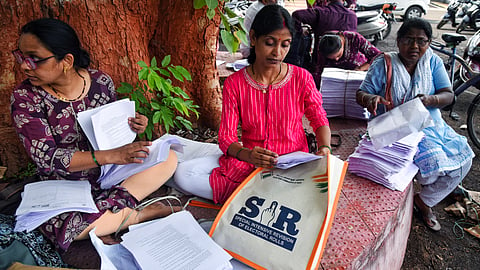
The concern is not only about how the system is being reviewed. It is also about what the exercise has meant on the ground. Let me speak of the state I represent, because these numbers are not abstractions to me. Tamil Nadu had 6.41 crore electors on its rolls as of October 27, 2025. Following the SIR, that number had fallen to 5.67 crore, a deletion of nearly 74 lakh voters.
No one disputes that electoral rolls need periodic cleaning; the DMK has never argued otherwise. What we object to is the manner in which this revision has been conducted. A clean roll and a rushed one are not the same, and 74 lakh is too large a number to have been arrived at carelessly. Each one is a mother, a daily-wager, a first-time voter, an elderly citizen who has voted faithfully for years, suddenly told their voice no longer counts, being tagged ‘absent’ or ‘duplicate’.
DKM president M K Stalin has said what needed to be said plainly: the CEC must go. An institution that has undermined its own credibility cannot be allowed to preside over elections, when the very people appointed to check its power are locked out of the room.
We are not asking for outrage for its own sake. We are asking for a court-monitored, independent investigation into every decision; an immediate pause on further SIR rollout until that investigation is complete; and the removal of a CEC who has lost the confidence of his own colleagues, let alone the public’s. I would add one more thing the second note should have given us and didn’t: a public, state-by-state account of every deletion and why, and a way to restore a wrongly-deleted name that does not put the burden back on the citizen. Every Assembly election held after a compromised SIR will carry a shadow over its result.
The issue is about whether citizens can trust that their names will remain on the electoral roll, and that when something goes wrong, there will be a transparent way to find out why and put it right. A democracy does not die in a single dramatic moment. It dies quietly, one deleted name at a time, while those responsible issue press notes insisting nothing is wrong. We refuse to let that happen without a fight.
Thamizhachi Thangapandian | MP from South Chennai and member of the Standing Committee on Education, Women, Children, Youth & Sports
(Views are personal)
