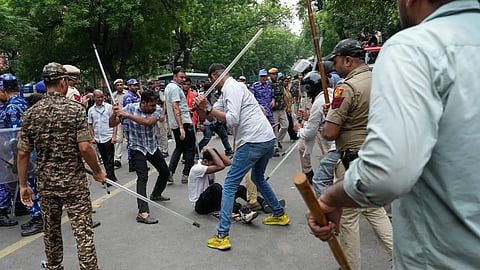

During the protests in central Delhi on October 10 and 11, the streets of the national capital witnessed an extraordinary mobilisation of armed personnel. The Delhi Police were joined by personnel from other state police forces and several hundred companies of the Central Armed Police Forces. These forces undertook widespread detentions of protesters, journalists and others attempting to assemble independently or in groups.
Regardless of whether the alleged demonstrators were standing in the streets, speaking to the media or raising slogans, they were manhandled and roughed up by the forces. Yet, a conspicuous exception to police action were several groups of men carrying saffron scarves and/or sporting tilaks. In viral videos from the protest sites, these men were seen standing alongside the police and, in full view of its personnel, participating in assaulting and detaining protesters. The striking asymmetry in police conduct with different groups foregrounds the familiar division of labour between the police and vigilante groups.
The protests stemmed from the Cockroach Janta Party's call for Chief Election Commissioner Gyanesh Kumar to resign over mass deletion of voters in the special intensive revisions of rolls. In its response, the authorities announced prohibitory orders under Section 163 of the Bharatiya Nagarik Suraksha Sanhita, called for an internet blockade, ordered cancellations of trains to Delhi, shut several metro stations in the city and barricaded roads. Despite this, central Delhi witnessed confrontations between students and armed personnel and the detainment of thousands, including the CJP leadership. Parallel to the standoffs, however, was the free movement of dozens of right-wing men, unhindered by the restrictions imposed on demonstrators.
On October 10, near Palika Bazaar, a group of over 30 men claiming to be from the Bajrang Dal, some of them armed with batons, threatened protesters and journalists. Reporters and independent media creators documented some of them saying, “We will protect Delhi police” [from being seen on camera]. Groups of men in Connaught Place were recorded on camera inciting violence and chanting, “Delhi Police tum lath bajao, hum tumhare saath hain” (Delhi Police, you swing the baton; we are with you).
On DDU Marg, as seen in a video shared on X, two men avowedly from the Hindu Raksha Dal assaulted students, repeatedly hit a woman and tackled her to the ground. The policeman, in whose presence this occurred, seemed to be alerting the attacker—which raises questions about whether the law officer was attempting to stop the assault or prevent its documentation. Near Delhi’s Civic Centre, men carrying lathis were captured on camera dragging, attacking and threatening protesters. Reportedly, these acts of intimidation and sloganeering in favour of the police went on throughout the week that followed in and around Connaught Place.
Such violence by the ‘friends of the police’ can be enabled only by an arrangement in which State coercion and non-State intimidation operate in partnership.
In my research on vigilantism, I describe this arrangement as the police-vigilante punitive continuum. The concept refers to circumstances under which police personnel operate with a vigilante ethos and collaborate with, or defer to, right-wing groups, who, in turn, carry out policing. It foregrounds a pattern in which the actions, omissions and institutional authority of the police enable extra-legal violence. At some points, these vigilantes serve as gau rakshaks; at other points, they serve as anti-Romeo squads, policing women’s ‘honour’, and during demonstrations such as the anti-Citizenship (Amendment) Act protests in 2019, they acted as the “friends of the police”.
The current events in Delhi offer a revealing illustration of this continuum, where such extra-legal self-styled ‘saviours’ re-cast themselves as second-tier contingency teams to back up the police. The videography from various protest sites captures right-wing groups members claiming that their vigilantism is in service of the State, with a willingness to fill in the violent gaps of legal policing.
The presence of the police then, instead of restraining the vigilantism, provided an appearance of legitimacy for it. This is evident in the admission of Hindu Raksha Dal leader Bhupendra Tomar or Pinky Bhaiya who, in a recent interview, took “full responsibility” for the vigilante violence and said that his organisation will continue to “deal with these people” and “teach them a lesson” since the Dal is “not bound by anything”.
This police-vigilante synergy thus works without formal orders, and needs only that the vigilante can expect the police to look away, and that the police can expect the vigilante to operate with them and often inflict violence in ways that legalities do not permit.
So, while student protesters and media persons out in the streets are subjected to forcible detention, these vigilantes continue to be extended allowances by the police on the ground. That asymmetry of police action on protesters and tolerance of vigilantes’ extra-legal force demonstrates the ways in which the vigilantes are treated as informal enforcers of an order that the State itself seeks to maintain. The State’s insistence on the maintenance of order, which the protesters are claimed to be flouting, loses meaning in the absence of equal enforcement of provisions on the streets.
Nidah Kaiser | Postdoctoral researcher, department of history, King's College, London
(Views are personal)
