
“The language of Europe is translation,” Umberto Eco had once said in his usual, resonant style. It was the early 1990s, a time of boundless optimism, especially among a certain kind of 20th century social-intellectual elite from Western Europe. The Soviet Union had collapsed, the reintegration of the Eastern bloc was at hand, and the clock had struck Maastricht.
Eco was speaking to Richard Kearney, who was putting together a remarkable set of interviews with continental thinkers to catch the spirit of the age. One after the other, they waxed about the future of Europe. They spoke of a cultural continuum, a continent of coffeehouses stretching from Lisbon to St Petersburg, recognisably one entity, rapt in gentle discourse. One citizenship, one currency, all of it was going to come as proof.
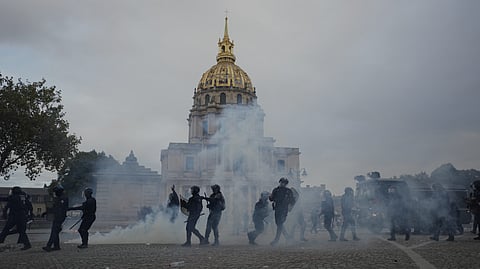
In the “Angry Autumn” of 2026, the shadows crowd in ominously over that vision. It’s not only France that resembles the haunting last scenes of Carl Dreyer’s silent-era classic, The Passion of Joan of Arc. At least 11 European nations, from Ireland to Albania, are seeing street protests. Portugal, Spain, Italy, Germany and Austria not excluded, so it’s not just a disturbance on the periphery. The common element is a deep economic insecurity.
Prices are skyrocketing for everything, from fuel to housing to education. The Euro crisis—a traumatic phase which felled governments like nine pins in at least half of Eurozone countries amidst IMF bailouts, structural adjustment, austerity and the like—evidently did not end in 2018. Mark the pandemic right after, and trace a straight line to the present. Cassandras are doing brisk business. Not just the EU, the future of Europe, as we knew it, itself seems up in the air.
Hearing second-hand of some conversations among transcontinental Millennial-Gen Z friends, I had had a faint premonition of this. A young French teacher in Marseilles, shifted to a school in the inner city, spoke of a kind of grubby misery that was very Third World. She encountered a broken system, marked by poverty, drug abuse, violence—a general lumpenisation that did not owe to everyone’s favourite scapegoat: the immigrants.
The latter only had to meld into a familiar landscape. To local eyes, the effect has been visible for years. Speaking on The Dream of Europe: Travels in a Troubled Continent, his 2019 follow-up to a rosier book of the same ilk about 20th century, Dutch journalist Geert Mak described semi-empty provincial towns across Europe—with rusty railways but no trains, where “one-third of the shops are closed and 20 percent of the houses abandoned”.
Misery was spreading on the ground, and Brussels didn’t know. Eco’s lovely vision is in danger because of a translation error—between the citizenry and the bureaucratic elite who run the EU. The latter belong decidedly to a technocratic school who won’t ordinarily socialise with, say, the Italian truckers who can’t buy diesel. Nor did national governments particularly care unless it was about to cost them an election. The old leadership of Europe is gone, largely replaced by a new ruling elite brewed in a kind of Americanised finance capital-led thinking.
The number of those in top perches now or in the recent past who were hedge fund managers and the like is not a joke. Macron was an investment banker at Rothschild, Merz came from BlackRock, Rishi Sunak from Goldman Sachs. Also count the Greek prime minister, two former Italian prime ministers… the list goes on. It’s a generalisation, of course, as a lot of truths are, but this neoliberal phase maps roughly onto deindustrialisation as well as a retreat from the kind of state-led social security Europe was once known for. The social-political effect, with the rise of far-right parties fragmenting the old social democrat-conservative binary, was a given.
Culturally, we are at some distance from Kearney’s integration. Britain Brexited, now they are even speaking of a Frexit! Indeed, even the two Germanys still survive as distinct zones. Eastern Europeans consistently report racism in the west. St Petersburg, of course, is totally off the map. Moscow and Berlin now talk as if we are back in 1945. Western Europe, conclusively vassalised by the US, has psyched itself into believing its own propaganda about a new Barbarian Invasion.
Even the one in history was a comforting illusion for historians: it was somehow better to trace the end of Rome to marauding hordes from outside. Only the more careful, latter-day historians have recovered the internal source. From Rome to the Mongol empire, from the Ottomans to our own Aurangzeb to Pax Britannica, imperial over-extension prepared the ground for collapse. The American version is being tested before our eyes in the Strait of Hormuz.
Poised on the verge of another round of war and economic bloodletting, that’s a reminder that Europe is hardly the only place in transition. Israel is two days away from what’s being called their “most seismic election in decades”—since most serious contenders represent views more extreme than the other, the commentariat does not offer a wide gap between the prospects of expansion and self-destruction.
Saudi Arabia has the good fortune of not having to face elections, but a fierce opposition is lurking just south of the border—again dire forecasts about the House of Saud aren’t absent. Today, you will read about which way the coin flips for Brazil—the ‘B’ of BRICS. If Bolsonaro’s son makes it past Lula, Trump might pocket the new oil they found off the mouth of the Amazon. A fiercely patriotic spirit may be burnt at the stake like the Joan of Arc, and the Donroe Doctrine will have had a second win after Venezuela. If it does, watch the streets of Rio.
Since we observe all this from a distance, we have the luxury of turning it into allegory. In international relations, like all countries, India has been left with a reduced sphere of opportunistic profit-taking and harm reduction, like a hapless retail investor in a volatile stock market. Having had to sacrifice some of its moral stature for ambivalence, it is not a market maker. Wisdom may lie in not betting too early.
Read all columns by Santwana Bhattacharya
Santwana Bhattacharya
Editor
Follow her on X @santwana99
