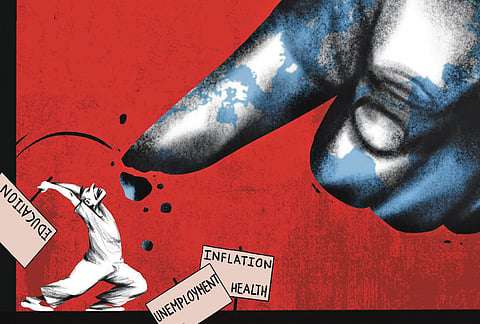

We are at the cusp of a new global order and, hopefully, a new national order. Gen Z around the world are uneasy. The global economic order has failed to deliver. High rates of unemployment, inflation and perceived autocratic regimes have sparked widespread protests. The closure of the Strait of Hormuz, the ongoing conflict in West Asia with no signs of subsiding and US President Donald Trump's desire to make America ‘Great Again’ have led to impositions that the world has resisted.
The balance of power seems to be shifting to our part of the world, with China and India providing the largest markets for future prosperity. Conflicts between Russia and Ukraine as well as Iran and Israel have resulted in uncertainties and shortfalls in the supply of oil and inputs necessary for economic prosperity. These conflicts have left inputs required by both the manufacturing and service industries in short supply, affecting agriculture and many other sectors. The fact that China has the largest accumulation of rare-earth elements also impacts the global balance of power. The United States has little choice but to collaborate with China due to the inter-dependence of the world’s two largest economies.
Relations between the United States and Europe, Canada and some countries in South America have come under strain, which is why Europe has negotiated a free trade agreement with India for mutual benefit. The spectre of high tariffs on Indian exports has led our businesses to seek new markets, which, in a sense, is a blessing in disguise. In the future, we may not be entirely dependent on the United States to sustain our export industry. However, the US will continue to be our largest trading partner in the years to come. We are not sure what the emerging global economic and political order will look like.
The seeds of change in India are visible. In recent protests, we have witnessed the anger of this country's youth. The organic nature of these protests reflects the scepticism of the poor and marginalised, marginalised along with the middle class, as the political establishment in India is not in a position to provide a just and fair framework that fulfils their aspirations. This government has not brought about the kind of change in education and healthcare needed to empower youth and develop the human capital India needs to compete with the rest of the world.
In education, the government has paid little attention to skilling our youth to meet the challenges of the emerging global economic order. The necessity of embracing artificial intelligence was not on the government’s radar, despite the fact that it is destined to play a crucial role in the years ahead. The traditional way of education does not even attempt to develop the kind of skills that the young in our country need to acquire. Disparities in education impact the marginalised, relatively poor and underprivileged as they seek to compete with children belonging to the middle class and the privileged. Middle-class youth are also feeling the pinch of rising unemployment; the educated have to compromise their aspirations by being underemployed. Displeasure among the young was clearly evident during the protests at Jantar Mantar.
As far as the health sector is concerned, it is vital not only for developing human capital, but also for ensuring that every family in the country has access to quality healthcare. It is perceived that an autocratic political system, which cares little for those who dissent, tends to use the State machinery to silence voices crying for change.
The situation became even more complicated in light of recent revelations about how the State machinery, in collaboration with the Chief Election Commissioner, manipulated the voters’ list, which resulted in the deletion of lakhs of voters. This has also taken a communal colour, as large sections of the minority community have been deleted from the electoral rolls as a matter of political strategy in order to woo the majority. The reason for these protests is no longer a matter of speculation. These are the culmination of years of the blatant and unjust exercise of State power against academics, journalists, political opponents and young students.
The country has also lost its leadership of the Global South due to its inability to raise its voice in support of the Palestinian cause and the two-state solution. Our ostensible siding with the United States and Israel has resulted in a loss of face, even as the United Kingdom and many European countries have condemned Israel for its actions against Palestine, especially against the young and vulnerable.
China's growing strength and our diminished economic clout have weakened our manoeuvrability as effective participants in the architecture of the emerging global political and economic order. Our growing trade imbalance with China and dependence on Chinese products and expertise, along with its imposing presence on our borders, both in eastern Ladakh and Arunachal Pradesh, leave us little room to make our presence felt. The influx of Chinese products, our inability to compete and the poor performance of our manufacturing sector make the economic situation quite depressing. The US-India trade deal has not yet been finalised, but the farmers of our country are extremely sceptical about the giveaways they suspect will affect our agriculture sector.
It is time for Chief Election Commissioner Gyanesh Kumar to resign. If he does not, it is time for the Prime Minister to let him go. This may have other political repercussions, which the present dispensation is wary of, given the country's current state of mind and the fact that the Bharatiya Janata Party has lost the people's confidence.
The time for change has come. It is time for us to use this crisis as an opportunity to change the way this country is governed. Let us make our political, economic and social systems fair and just to instill in the people of India the belief that they too are participants in the governance of this country, which is destined to be a global power.
Kapil Sibal | Senior lawyer, member of Rajya Sabha
(Views are personal)
(On X @KapilSibal)
