
Greetings on Valmiki Jayanti today, dear readers. In North India, it is also called Pargat Diwas, meaning the day of manifestation. It celebrates the birth of Rishi Valmiki, to whom we owe the foundational work of Indian culture, the Srimad Ramayanam in Sanskrit. It is the mool or root Ramayana, and all other Ramayanas derive from it.
Of the two great Indian epics—the Ramayana and the Mahabharata—the Ramayana, which came first, is considered the greater work. This is because, in terms of plot, it stays with the protagonist, unlike the Mahabharata, where Sri Krishna appears on and off and is not systematically followed, although he is the lynchpin of the epic. Vyasa made up for that afterwards in the Srimad Bhagavatam, which tells the story of Mahavishnu and his many avatars.
Whereas Valmiki’s Ramayana follows Rama steadily from birth through his trials and tribulations to his eventual triumph and coronation. ‘Raman’ means one who is happy and also makes others happy. Although the Ramayana is full of sorrowful partings, Sri Rama, Sita Mata, and Sri Hanuman shine like a light in the darkness, spellbindingly so.
Valmiki's life journey is well-known as a remarkable tale of inner transformation. He supported his wife and children as Ratnakar, a forest dacoit who preyed on travellers. However, when he tried to rob Lord Brahma’s son Narada Muni, the seer asked him for whom he committed his robberies. When Ratnakar said it was for his family, Narada asked him if they would share his karmic sin as equally as they did the booty. Sure that they would, Ratnakar went home to ask while the sage waited. To his shock, his family refused to share his sin, stating firmly that his bad deeds were his doing, not theirs. Heartbroken, Ratnakar returned weeping to Narada, who gently counselled him on the right path. He gave him two syllables to meditate on, Ma and Ra.
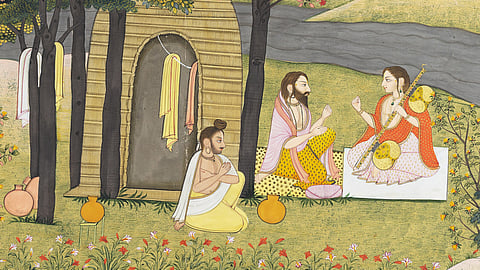
Ratnakar went into deep meditation, uttering these syllables which segued into Ra-Ma, Ra-Ma, Ra-Ma. A valmik or termite mound grew around him; he sat unmoving for so long. When he finally emerged, he became known as Valmiki, meaning ‘of the mound’.
He built his ashram by the river Tamasa, now known as the Tons river. It is a major left-bank tributary of the Ganga, flowing through Madhya Pradesh and Uttar Pradesh. There, he discovered the literary form, the shloka, and composed the 24,000 verses of the Srimad Ramayanam. The Vedas and Vedangas that came before the Ramayana, though set in various chhand or meters, are considered gadyam, ‘prose’ in Sanskrit, while the Ramayana is padyam, poetry, and Valmiki is hailed as the Adi Kavi or First Poet.
That first shloka, or verse, came about this way. Sage Narada paid Valmiki an unexpected visit. During their conversation, he disclosed the existence of a prince called Rama, who embodied all the sixteen good qualities demanded in a person by Valmiki. After that illuminating visit, Valmiki went for a swim in the river Tamasa, accompanied by Sage Bharadwaja. The water was so pure and clear that they could see all the way to the riverbed. Marvelling at its perfect clarity, they began making their way back to Valmiki’s ashram.
On the way, Valmiki caught sight of a pair of krauncha birds, demoiselle cranes called koonj in Hindi, with long white necks and striking plumage. They were dancing a graceful love duet, beautiful to behold. The sages were enchanted. Suddenly an arrow whizzed by, wounding the male bird, which fell in agonised death throes. The female bird fluttered around him, uttering pitiful cries. A hunter advanced triumphantly on the dead crane.
Imagine Valmiki’s state of mind at that moment. The day had begun on a great high with Narada’s visit. Inspired and excited that someone like Rama existed, the ideal he had imagined and hoped to find someday, Valmiki was already in an exalted state. The purity of the river Tamasa and his refreshing plunge into her waters became a metaphor for the purity the human soul could achieve when cleansed of negativity. In this state of mind-body-spirit happiness, Valmiki felt the beauty of creation and the Creator to the depths of his being in the love dance of the cranes. Its abrupt end was a rude shock. His heart burst its bounds with a great rush of compassion.
“Why did you kill that bird?” he asked the hunter angrily. “I am a hunter. It is my occupation to hunt,” said the hunter squarely. The agitated sage, once a hunter himself, said, “Ma nishada pratishtham tvamagamahsavati sama/Yat kraunchamithunaadekam avadhi kamamohitam.” Meaning, “O hunter! May you never be respected for killing that unsuspecting crane when it was happily dancing with its mate.” In Sanskrit, this came out as a rhythmic sequence of 32 syllables.
Shaken by his own words, Valmiki hurried home. Who did he find waiting at his ashram but Lord Brahma himself, in his swan chariot? Brahma had gone looking for Goddess Sarasvati. Discovering that she had flown by Valmiki’s ashram to bless him with eloquence, he stayed to bless Valmiki in his new role as a poet. This marked the birth of Indian poetry, and compassion was its trigger.
Especially dear, how can we ever thank Valmiki enough for giving us the sublime personas of Rama, Sita and Hanuman to love and live by in our inner and outer lives?
Renuka Narayanan | FAITHLINE | Senior journalist
(Views are personal)
(shebaba09@gmail.com)
