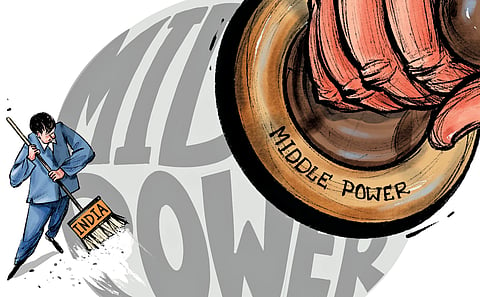

In Davos earlier this year, Canadian Prime Minister Mark Carney tried to rally the “middle powers” around by warning that “if we’re not at the table, we’re on the menu”. It was a reaction to Trump’s huge pressure on Canada. For Carney, middle powers essentially meant Western middle powers (and possibly a few non-Western ones who think like them) getting together to protect Western values, liberal order and, most importantly, status quo.
Without entering into the thicket of defining middle powers, suffice to say that these are countries that are big enough to influence geopolitics globally or regionally and also willing to use that power to do so. Hence, it combines capability with the will to use it.
After the Second World War, the Cold War blocs—the US and Soviet Union, which wanted the world order to be moulded in their own image—provoked the middle powers of that time—India, Yugoslavia, Egypt, Indonesia and Ghana—to found the Non-Alignment Movement, where the developing countries took this “third path”. Now history has come a full circle, though the world looks very different. It is the US and China pushing for their own vision of the future. There is now space—in fact, a need—to have a third voice or voices.
But how can Canada or larger European countries be that fulcrum for a third voice when all they want is to preserve the status quo of the old order from which they have hugely benefitted? Middle powers like France and Italy are also being severely challenged from within. Japan and Australia may think more independently, but they have not yet come out of their Western alliance mindset.
Even motivations are different. The West wants a buy-in from middle powers like India, Brazil, South Africa and Indonesia to strengthen multilateralism and the UN facing severe headwinds, especially from the US. But for the Global South, strengthening multilateralism means deep structural reforms and disrupting status quo. Dangling big power status in front of the Global South middle powers by including them in non-inclusive plurilateral bodies, even if it is as influential as G20, is merely sidestepping the central question of reform of the UN, WTO or IMF. The agenda of the forthcoming G20 summit in the US promises to be even less focused on the Global South.
Logically, it is only Global South middle powers, caught as they are between the US and China, which can shake-up status-quoists. For that they have to coalesce and lead, not merely be bridges to both sides or remain neutral. However, Global South middle powers are highly heterogenous with serious differences. For example, some middle powers in the expanded BRICS are at war with each other. Consequently, leadership can only come from those who not only have the capability and willingness to use it positively, but also create synergies with other like-minded middle powers.
After the dwindling American security umbrella in West Asia, we see the nascent realigning of middle powers in that region with Mecca defence pact between Pakistan, Saudi Arabia and Türkiye. They have now reached out to Iran, thereby signalling a willingness to talk to their adversary. More such realignments are bound to happen, especially encouraged by China and Russia to loosen Western hold over the Global South. In the face of the shrinking role of the US and European powers, the Global South is coming together to protect their immediate interests, security or economic, rather than having a grand design to stabilise the world order.
India is much bigger than almost all the middle powers and is rising. That’s probably why we are very touchy when the country is called a middle power, preferring it to be called a “rising power” or “civilisational power”. All that is true. But let us not forget that the focus is not on how ‘big’ we are, but on how big a ‘power’ we are, which includes geopolitical capability and the willingness to use it.
Once we called ourselves ‘emerging economy’ and defined ourselves in economic terms. Now we have outgrown that label and rightly so, even if, as the sixth largest economy, we are still one-fifth of China in GDP.
One can invoke power only if one starts exercising it. In recent years, we have contributed immensely to global commons, like supplying vaccines during the pandemic. What has not been palpable so far is India’s willingness to put this reach to geopolitical use.
We have only been marginally present in some of the raging geopolitical conflicts of our times—Ukraine, Gaza, Iran, Yemen or Sudan—even though we maintain close relations with both sides of the divides and have important stakes in their resolution. If we do not exercise our geopolitical clout, we are ceding strategic space to countries like Türkiye, Pakistan, Saudi Arabia and Qatar, not all of whom have India’s interests in mind. Our strong bilateral relations with countries in keeping with our multi-alignment policy should not become an impediment to being proactive in conflicts, but should actually help in finding solutions.
India’s four options include membership of West-centric middle power groups led by the US, like QUAD and I2U2, or facing dual pressures from the US and China (and their quest for G2), wedded as we are to strategic autonomy, or forming a coalition with like-minded middle powers of the Global South to break out of the status quo and take leadership, or having a combination of all three above. Our choices will depend on our geopolitical strengths, dependencies and vulnerabilities, not the least of which is having an adversarial China on our borders.
Therefore, instead of debating whether we are a big or rising or middle power, let us focus on the ‘power’ part. India’s rise must be measured not only by the capabilities it accumulates, but by the outcomes it can shape. The disintegrating world order provides us such an opportunity. Whether we do so by aligning with status-quoist Western middle powers or with reform-minded Global South middle powers or straddle both depends on our national interests.
The good news is that India has started playing a more active geopolitical role in conflicts. The three-part truce proposal put forward for the Ukraine conflict is a serious effort and has been welcomed by both sides. We need to start taking an active geopolitical role in West Asia too, with or without partners, where our stakes are much higher. It is time to convert our strengths into power and tell the world that we are ready to make a difference geopolitically.
T S Tirumurti | Chair of Steering Committee, Deccan Centre for International Relations, and former Permanent Representative of India to the UN, New York
(Views are personal)
