
On the morning of August 26, within minutes, a flash flood swept through the Nepal-China border region, taking homes, livelihoods, and lives with it. As rescue and recovery efforts continue, our thoughts remain with those still coming to terms with all they have lost.
Scientific assessments are still underway and it would still be premature to draw a firm conclusion about what triggered this disaster. Questions remain and answers will emerge as the investigations continue. But one lesson is already clear: climate risks in the Hindu Kush Himalaya are evolving faster than our capacity to understand, let alone anticipate, them.
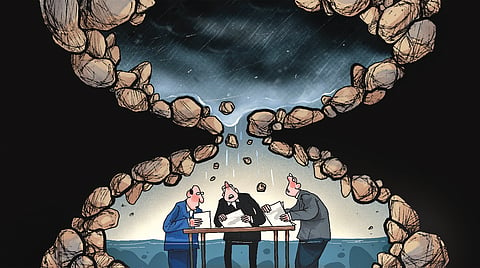
The challenge before us is not simply to learn more. It is to learn how to act in a world where uncertainty itself is becoming one of the defining features of climate risks.
What we witnessed was an extraordinary and devastating hazard rooted in changes to the cryosphere, where water exists mostly in solid form, unfolding with immense speed and force across borders. Climate change is destabilising high mountain environments. Ice, snow, rock, water, and mountain slopes are interacting in ways that are becoming increasingly dangerous and increasingly difficult to predict.
This is not an isolated event. For more than a decade, the Hindu Kush Himalaya has experienced major cryosphere disasters, including floods, landslides, glacial lake outburst floods, avalanches, thawing permafrost, and cascading hazards that have destroyed lives and erased years of development progress in a matter of hours.
The question before us is no longer whether such disasters will occur again. They will. The question is whether our institutions and investments are prepared for when they do. Historically, past events helped guide expectations about future risks. That assumption is becoming harder to sustain.
Climate change is altering glaciers, snow fall, permafrost, river systems and mountain slopes in ways that are reshaping the very conditions on which those historical assumptions were built. Past data and past experience remain essential. But they can no longer be treated as reliable guides to the future on their own.
In mountain regions particularly, this creates a profound challenge.
The Hindu Kush Himalaya cryosphere stretches across vast and often inaccessible terrain. Understanding what is happening across such a landscape is an enormous scientific undertaking. Many of the changes underway are difficult to observe, difficult to model, and even more difficult to predict.
Knowing when a hazard may occur is challenging. Knowing where it may emerge can be harder still.
At the same time, climate change is making research more difficult precisely when the need for knowledge has never been greater. Extreme weather events and shifting seasonal patterns increasingly disrupt field monitoring. Observation networks remain incomplete. Funding for long-term monitoring, modelling, and scientific observation continues to lag behind the scale of change that mountain regions are now experiencing.
The lesson from this tragedy is that uncertainty must be incorporated into how we plan, invest and prepare. Waiting for complete certainty before taking action is no longer a responsible option in a climate that is changing so rapidly.
Every major investment in these mountains must account for the risks posed by a warming and increasingly unstable climate. Infrastructure that appears economically viable today may carry far greater costs tomorrow if climate risks are underestimated. Risk can no longer be treated as a secondary consideration added at the end of planning processes. It must become a central consideration from the beginning.
This disaster also highlights another important lesson.
Given the region’s difficult terrain and limited resources, hard choices have always had to be made about where scientific attention is directed. Much of that attention has rightly focused on glaciers and glacial lakes, both of which have long been recognised as critical areas of concern. But recent events remind us that mountain hazards cannot be understood in isolation.
Rock-ice avalanches, thawing permafrost, unstable mountain slopes, changing snowpack conditions, and other interconnected processes must increasingly be considered together. The risks emerging across mountain environments are often linked. Understanding those connections may prove just as important as understanding any individual hazard on its own.
We cannot monitor everything, no institution can. But we can be smarter about where we focus our efforts and how we use the knowledge we generate. That requires stronger science, but science alone will not be enough.
For more than four decades, we have worked with our eight regional member countries to understand the changing cryosphere and the hazards associated with it. Yet the pace of change is testing the limits of what any one institution, or any one country, can manage on its own. The risks do not stop at national borders. Neither should the response. The events of recent days once again demonstrate that hazards in mountain regions can develop rapidly and affect multiple countries. In such a context, collaboration is not simply desirable. It is essential.
What this moment demands is not more reports sitting on shelves. It demands sharper science focused on the areas where risks are rising fastest. It demands stronger collaboration across disciplines and across borders. Most importantly, it demands faster route from scientific understanding to practical action.
The people living closest to these risks should never be the last to know what we know. That is what climate leadership means today.
Climate leadership is not the pursuit of perfect certainty. It is the willingness to make informed decisions despite uncertainty. It is recognising that a climate that no longer behaves as it did in the past, requires new ways of planning for the future. It is ensuring that science informs action before disaster strikes, not only after it.
Nature is sending increasingly clear warnings. The devastating tragedy of August 26 should not only be remembered for what happened that day. It should also be remembered for what it revealed: that the risks facing mountain communities are changing, that uncertainty itself has become a risk factor, and that our response must evolve accordingly.
We have the science. We have the expertise. What we need now is the collective will to act on what we know while continuing to strengthen what we do not yet know. Our mountains are giving us clear warnings. We must listen, and we must act.
Pema Gyamtsho | Director General of the International Centre for Integrated Mountain Development, Nepal
(Views are personal)
