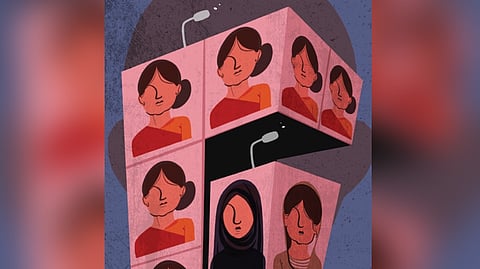

Seventy-nine years have passed since that stroke of midnight on August 15, 1947, when Pandit Jawaharlal Nehru proclaimed a “tryst with destiny” and “the soul of a nation, long suppressed, found utterance”. Yet, even after almost eight decades, not everyone’s voice has found utterance in the world’s largest democracy. Women remain under-represented in Parliament: they are 14 percent of the Lok Sabha, though they make up 48.5 percent of the population.
Some women citizens have fared worse than others. Only 20 Muslim women have ever entered the Lok Sabha since 1952. Today, there are just two Muslim women MPs—0.4 percent of the House, representing 7.1 per cent of the population. Rasheed Kidwai and Ambar Ghosh’s recent book, Missing from the House: Muslim Women in India’s Parliament, is a searing reminder of this fact, as well as a call to action, especially as India prepares to implement the Women’s Reservation Act, 2023.
The architects of modern India made women’s emancipation central to the freedom struggle and nation-building. For centuries, women were confined to household roles, denied education and subjected to indignities across social and religious strata. Though figures like Razia Sultan, Noor Jahan and Rani Lakshmibai of Jhansi blazed trails, they were exceptions. Religious dogma continued to sanction women’s suffering.
In the 19th century, reformers like Ishwar Chandra Vidyasagar, Raja Ram Mohan Roy, and Jyotiba and Savitribai Phule began railing against practices such as widow immolation and denial of education. Their crusade for justice passed into the hands of 20th-century leaders like B R Ambedkar and Jawaharlal Nehru. For Ambedkar, equal rights for women were indispensable. He saw women’s subjugation as central to caste oppression, fighting especially strongly against the “double discrimination” inflicted upon Dalit women.
Ambedkar condemned the Manusmriti for legitimising both caste and gender degradation, famously burning it in 1927. To him, women’s subjugation marked a society bereft of moral compass. Nehru concurred, declaring that “the women of India have an additional task… to free themselves from the tyranny of man-made customs and laws”. Both leaders sought egalitarian modernity, but their efforts did not—or could not, in the face of Indian society—go far enough.
Muslim women have been especially excluded from politics since independence. While India’s democratic arena promised individual agency, Muslim women’s participation has remained minimal. The issues most pressing for their welfare—maintenance after divorce (as in the Shah Bano case), triple talaq (in the Shayara Bano case) and polygamy—have been fought in courts and civil society forums rather than Parliament, where their absence has silenced their voices.
Even in the Constituent Assembly of 299 members, only 15 were women, and just one was Muslim: Begum Qudsia Aizaz Rasool. She championed civic nationalism and opposed communal representation. Later, as a Rajya Sabha member, she fought against clerical diktats, working to deliver Muslim women not as privileged as herself from the suffocating grasp of intra-religious domination, all in the face of formidable odds. “There was,” wrote she in her autobiography, From Purdah to Parliament, “much propaganda against me, especially a fatwa by the ulemas that it was un-Islamic to vote for a non-purdah Muslim woman.”
Before the first general elections, Nehru urged Chief Ministers to allow women provincial legislators to resign and contest Parliament. His vision of women MPs shaping laws and expanding rights has remained elusive. Out of the 18 Lok Sabhas till 2025, five had no Muslim woman MP at all. Never has their number exceeded four in a single tenure. Today we stand at half that number.
Women’s voices, and especially those of minority women, are indispensable in the nation’s highest deliberative forum because they bring lived experiences that differ profoundly from those of the male majority. Policies on education, healthcare, employment, family law, and social welfare affect women in ways that men cannot fully grasp.
Minority women, in particular, often face a double burden: discrimination on account of both gender and community. Their presence in Parliament ensures that legislation reflects the realities of those who are most vulnerable, and that the promise of democracy (and in particular of that much-vaunted trio, liberty, equality, fraternity) is not hollow rhetoric but a lived truth. Without their voices, the nation risks crafting laws blind to the needs of nearly half its citizens and deaf to the concerns of those pushed to the margins.
Yet the difficulty of bringing women, and especially minority women, into Parliament is not accidental. It stems from entrenched patriarchal structures within political parties themselves. Men dominate candidate selection processes, and tickets to contest elections are often denied to womenon the pretext that they are “unlikely to win”. This gatekeeping ensures that even when women are politically active at the grassroots, their path to Parliament is blocked at the nomination stage.
Add to this the financial and social barriers that confront women: limited access to campaign funds, lack of networks, and societal expectations that women prioritize family over public life. Muslim women face the fierce resistance of conservative clergy.
The result is a near-systemic exclusion. Until parties commit to nominating women in winnable constituencies, and until society dismantles the prejudices that keep them from being seen as leaders, the silence of minority women in Parliament will persist.
For decades, public discourse has paid lip service to nari shakti and women’s empowerment, but rhetoric has rarely translated into reality. The Kidwai-Ghosh book portrays the twenty Muslim women who did reach Parliament as exemplary legislators. As the authors note, their parliamentary conduct revealed proactive roles: asking questions, debating diverse issues, securing developmental work, and contributing to committees, all while battling conservative confines of home and community.
Raising the issue of Muslim women’s voices is a reminder of what Parliament was meant to be: a space for service, conviction, and empowerment of the excluded. The Kidwai-Ghosh book implores us to confront the silences we have allowed, the apathy we have indulged, and the futures we have failed to imagine—and to secure. Women’s reservation might yet prove the answer, provided we allow it to work.
(Views are personal)
(office@tharoor.in)
Shashi Tharoor
Lok Sabha MP, Chair of the Standing Committee on External Affairs and Sahitya Akademi-winning author
