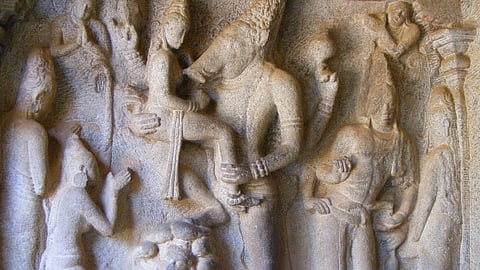

It’s Varaha Jayanti this Sunday, celebrating the appearance of Lord Vishnu’s third avatar as the celestial boar. While we tend to concentrate our worship on the Narasimha, Rama and Krishna avatars, we are not known to pay much heed to this particular avatar of the Lord. But our ancestors did, and how.
Two superstar images of the Varaha avatar are beautifully found on either side of the Vindhyas. I mean the Varaha sculpture at the Udayagiri Caves, from the 5th-century Gupta period, close to the Sanchi Stupa in Madhya Pradesh, and at Badami Cave 3 in Karnataka, from the 6th-century Chalukya period. They are two of India's finest rock-cut masterpieces ever, not just as Varaha images. They depict Varaha rescuing Mother Earth, Bhudevi, from the cosmic waters where she had been kidnapped by the demon Hiranyaksha.
At Udayagiri, we get to see the massive statue commissioned by King Chandragupta II. It is a colossal 13-foot-high, open-air rock-cut relief carved into a shallow cliff niche. It features a powerful male body with a wild boar's head, the form called Naravaraha. He steps firmly on a subdued serpent king at the base and lifts Bhudevi gracefully on his broad shoulder. He exudes raw power and might.
At Badami, Cave 3 was inaugurated in November 578 CE, in the reign of King Kirtivarman Mangalesha. It contains a red sandstone monolithic relief, showing a dynamic Bhuvaraha stance, where Varaha lifts Bhudevi, who clings to his tusk. It is set against the backdrop of multi-hooded water serpents, and surrounded by rich decorative carvings, bracket figures and celestial witness panels. What punches your gut is the emotion of love and the feeling of protection emanating from these sculptures. Our sculptors knew what they were trying to say through their art, not only to their generation but also to those who would come long after them, namely us.
Other stunning carvings of Bhuvaraha appear at Aihole in Karnataka from the early Chalukya period, and at Mahabalipuram from the reign of the Pallavas. The Varaha temple in Khajuraho has a majestic image of Varaha as a wild boar, dated between 900 and 925 CE.
The Varaha was the royal emblem of the 12-14th-century Kakatiyas of Warangal in Telangana and of the Vijayanagar Empire, whose capital was Hampi. Vijayanagar’s royal insignia, or rajamudra, featured four primary symbols: the Varaha, a vertical dagger, the sun and the moon. This composite emblem was widely used on temple walls, coins and copper-plate land grants to signify both the sovereign’s authority and divine protection. It also marked historical continuity with the Chalukyas. The emblem was carefully chosen to signify the defence of the land and the preservation of dharma.
I have had the good luck of seeing them all, except the Bhuvarahaswamy temple at Warangal, which I hope to one day. If you’d like to see them, too, I can safely say they’re breathtaking and well worth the trip. We are blessed to have them in our heritage even today.
But why was Bhudevi kidnapped in the first place? The Puranas tell a tale with a touching twist. They say that Jaya and Vijaya, two dwarapalas, or gatekeepers, to Lord Vishnu at Vaikunth, arrogantly turned away four wandering sages, for which they were cursed to be born on Earth. Apparently, they were given a choice: return to Vaikunth after seven births each as good people or after three births as bad people. They begged to be granted three births, even as evil persons, so that they could return sooner to the Lord.
In the Satya Yuga, they were born as the demon brothers Hiranyaksha and Hiranyakashipu, slain by the Varaha and Narasimha avatars. In the Treta Yuga, they were born as Ravana and Kumbhakarna, slain by Sri Rama. In the Dvapara Yuga, they were born as Shishupala and Dantavakra, slain by Sri Krishna.
Isn’t it fascinating how one strand is seamlessly woven into the other in Indian theology? We are blessed, too, to have had such master storytellers, whose vivid verbal descriptions were committed to stone as sculptures, and as vigraha or images for worship in a multitude of materials; and also expressed across the land through our devotion-driven performing arts like music, dance and theatre. Each is a powerful component of a holistic civilisation, married to the land through innumerable tirthas and kshetras, complete with sacred groves, trees and flowers. Even the stars in the sky are part of this civilisational consciousness.
This led me to the deeper meaning of the Varaha avatar. It’s not just a story about Mahavishnu’s might in doing right. It’s a strong message to us, as Earth’s children, that we, too, should protect our planet, its air, water, trees and soil. That if we break our connection with and concern for Nature, we are sinning against the very earth that sustains our lives, bears every pain we inflict on her and still gives endlessly. Her fury erupts only when too many limits are crossed.
As small but collectively big personal steps, we could be conscientious about not littering and intentionally reduce our plastic use. Plastic bags look ugly and undignified at pujas and temples. We could easily switch to cloth, coir and jute bags. Our beautiful gods would be restored to their rightful aesthetic among us, and the avatar’s purpose, too, will begin to be served. What do you say?
Renuka Narayanan | FAITHLINE | Senior journalist
(Views are personal)
(shebaba09@gmail.com)
