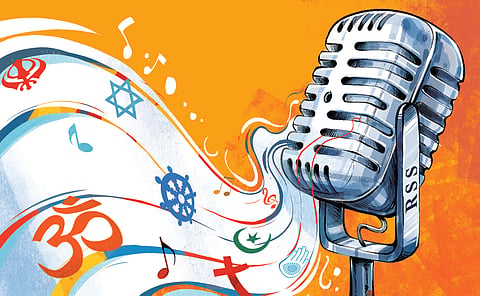

‘Hindus respect all, Hindus accept all.’ That was the central theme of RSS Sarsanghchalak Mohan Bhagwat’s recent speeches in the US and Canada. The RSS chief’s blunt and forceful elucidation of the Hindu mission and India’s global vision and destiny in the organisation’s centenary-year itinerary generated acclaim. The absence of controversies disappointed the critics who were waiting for Bhagwat to explode an ideological atom bomb. They were disappointed because Bhagwat spoke more like an Indian Hindu statesman than as the chief of a great organisation.
Some expected Bhagwat to be assertive and belligerent on the occasion of the RSS’s outreach as part of the organisation’s centenary year. Rather, he chose to speak less about the RSS and more about the Vedic Hindu tradition and how people of Indian origin should become global in their role as citizens of different countries. The RSS chief, explaining the beauty of the oneness of humankind, India’s natural unity in diversity and pluralism in the West, spoke about the mission of India developed through centuries of living in harmony with nature.
Clearly, Bhagwat has mastered the art of communicating Hindu ideology while admiring the feel-good sensitivities of Western audiences. At every place, his speech had a different theme—fresh and with the underlining message of caring and sharing.
He obliquely referred to the ideas of domination, protection and exploitation that have fashioned Western thought. He made a remarkable departure and emphasised the Indian cultural ethos of unity and oneness of all animate and inanimate beings.
This was obviously not the occasion for the RSS chief to expound his organisational priorities and ideological goals. In a way, it was an exercise to reach out to the global community. And Bhagwat avoided all trigger points.
He said that even in times when modern communication and transport were not available, Indians travelled across the globe carrying the message of universal brotherhood—vasudhaiva kutumbakam. He said nowhere did these travellers try to invade or convert.
India, for centuries, gave protection and asylum to every human being who was persecuted or had fallen victim to bigotry. The modern-day mission for every person of Indian origin is to spread this message of oneness, living in harmony with nature and world communities as India’s mission.
Bhagwat’s philosophical approach disappointed those who were looking for a conspiracy before the RSS chief’s US visit. There were groups demanding that the RSS leader not be allowed to visit America. Some groups, particularly evangelical ones, cited stray incidents in parts of India against missions to prevent Bhagwat’s visit. New York Mayor Zohran Mamdani, a known critic of the Sangh parivar, finding no issue to criticise the RSS leader after the event, only said Bhagwat had enjoyed the freedom of speech that the US had extended.
Bhagwat’s North American visit has to be seen from a number of perspectives. One, that it was a part of his organisation’s centenary celebrations. All the top leaders of the RSS have been visiting various parts of the world for the past year, as is its customary practice. After all, Bhagwat is heading the world’s largest cultural organisation, whose political wing has been ruling India and most Indian states for over a decade. In that sense, the RSS leader is a spokesman for India’s modern worldview.
Secondly, Bhagwat explained how even people who came as invaders like some Muslims, others like Parsis and Jews who came as asylum seekers, and Christians—all live in harmony in new India.
While the RSS leader was at his eloquent best explaining Hindu tradition, he was very tactical in speaking about the RSS. Critics in the media tried to chronicle the recent announcements of the RSS chief that are conciliatory and accommodative, like ‘one need not search for idols under every mosque’, and the more recent one that ‘those who want Muslims to go out are not Hindus’. Headline hunters tried to provoke the traditional RSS constituencies by highlighting this approach of the RSS chief as soft-pedalling on the core ideology.
These people misread the RSS chief’s larger goal. He is on a mission to unite people on the strong cultural mosaic of Hindutva. Bhagwat has not said anything new when he defined the Vedic mission. In Canada, he spoke about the great sacrifice of the Sikh gurus in upholding dharma.
At every function the RSS chief addressed, dignitaries and celebrities from all walks of life in the US and Canada shared the dais with him. Though the audiences were largely Hindus and swayamsevaks, local participation was significantly noticeable. Everywhere, the RSS chief received critically significant coverage. His speeches were keenly monitored and discussed in intellectual circuits.
The RSS chief did not want to kick up controversies in the centenary year. Quoting Vivekananda and Aurobindo, he emphasised new India’s world vision. To the people of Indian origin, he said, be loyal and committed to the countries of your choice. ‘Whatever you can do to relate to India, you may do, but always remember, as an individual of Indian origin, India’s message of brotherhood is what you have to keep in mind.’
Bhagwat emphasised the value Indian tradition preserved for debate and dialogue. He stressed how India preserved knowledge even by sacrificing human life when he narrated the return journey of the Chinese traveller Xuanzang (or Hiuen Tsang) from Nalanda. When the boat he was travelling in was about to sink because of the weight of the books he was carrying, some of his disciples volunteered to jump into the river to save the sacred treasure of the books.
The RSS leader’s speeches were generous with anecdotes and gripping narrations from ancient Indian texts. The novelty of his speeches and his modern approach fascinated the Western audience. It was not a new perspective of the RSS, but new India’s mission and destiny that the RSS chief highlighted to his global listeners and viewers. That is why it received thunderous applause.
R Balashankar | Former National Convener, BJP’s Intellectual Cell; former Editor, Organiser; and member of the BJP’s all-India training and publication department
(Views are personal)
