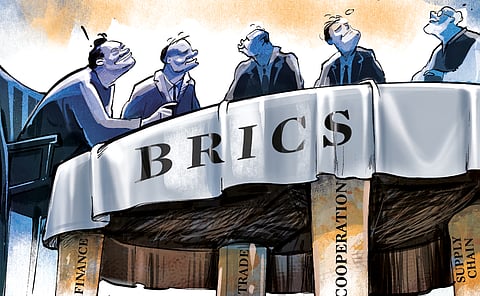

If BRICS chair India’s aim is to hold a ‘successful’ 18th summit in New Delhi, it can be said with near certainty almost on the eve of the conclave that it will indeed be a success. The key to defining this outcome, however, is that success in this context is a relative term. For India, if the summit passes without discord—as did the 2023 G20 summit in New Delhi—it will be deemed a success.
Plurilateral summits hosted by India are only partially aimed at their member countries or the rest of the world. Indian foreign policy is now equally aimed at convincing the domestic Indian population that India is a heavy-lifter on the global stage. This was evident during the 18th G20 summit, when all of India was energised and contributed to it in some way as if it was an occasion of historic significance.
Since then, Brazil and South Africa have hosted G20 summits without any such fanfare. The 21st G20 summit later this year in Miami will be no different except for US President Donald Trump’s tantrums in its run-up and possibly at the event itself.
For one of the BRIC—without ‘S’ then—founding members, China, a successful summit is one where its laser-sharp focus is on promoting its national interests. For China, which will host the organisation’s next summit in 2027, the greater good of BRICS is secondary to its use for China’s own good. If it can move the plurilateral group even a little bit towards acting as a hedge against the US, it will consider the conclave a success.
China will measure the New Delhi summit’s success—from its point of view—if its 400-member delegation accompanying President Xi Jinping can convince India to abolish or reduce the high tariff on Made in China electric vehicles. China produces over two-thirds of the world’s EVs.
During the deliberations in New Delhi, China and Russia—another founding member—will push towards creating BRICS credit rating agencies to catalyse the process of attracting foreign direct investments into BRICS countries. As a past victim of the whims of Western credit rating agencies like Moody’s, Standard & Poor’s and Fitch, India ought to be sympathetic to this idea. But these credit-raters have powerful lobbies in many BRICS governments. So, if China and Russia do not get their way this weekend in New Delhi, they will try their utmost during next year’s Chinese presidency to achieve this objective.
It will be the same with the US-controlled SWIFT (Society for Worldwide Interbank Financial Telecommunication), the backbone of cross-border money transactions. Russia has immensely suffered because Western sanctions have cut off its banks from SWIFT transactions. So has Iran because of unilateral US sanctions. An alternative to SWIFT may not emerge at the New Delhi summit, but in-depth discussions and a determined push towards it may see its birth under Chinese chairship.
Realities, not ideology, will determine the emergence of financial multipolarity, which is the desire not only of many BRICS countries, but also of the Global South as a whole. They feel excluded from decision-making in the post-Second World War financial architecture, of which the Bretton Woods institutions are emblematic.
The Shanghai-headquartered New Development Bank (NDB), popularly known as BRICS Bank, is not anywhere close to replacing the World Bank or the International Monetary Fund. But in its short 11-year existence, the NDB has funded the equivalent of almost $43 billion on 139 projects, most of which Bretton Woods institutions would not have looked at. NDB projects have a high level of social development content.
It is significant that nearly a quarter of all NDB funding has been in local currencies. Sixty-five percent of intra-BRICS trade is now in local currencies. Add to this China’s decision to drop the US dollar for Iranian oil purchases in favour of the renminbi and that 45 percent of Saudi oil is now sold to China in renminbi. Specialised banks have been set up—where else but in Dubai—to handle these transactions, bypassing Western institutions.
So, de-dollarisation in BRICS is actually under way—howsoever small its beginnings maybe—without having to shout from rooftops about it and rock the global financial system in any way. India and Brazil do not want the US dollar to be pulled down. Nor do Saudi Arabia or the UAE. But they all believe the process is inevitable and BRICS would be wise to quietly flow with this tide of history.
Trump’s tariff wars, especially with China, brought out the stark reality of Beijing’s hold on critical minerals and rare earths, up to 90 percent of global deposits in some cases. India has been wise to prioritise supply chain resilience on the agenda of the 18th summit, given this context. New Delhi already has the experience of setting up a mechanism for this along with Tokyo and Canberra after supply chains were disrupted during the Covid-19 pandemic. China would much rather cooperate with its BRICS partners in this effort than with the US.
Two of the many writings on the wall make it logical that this weekend’s summit will be a success by India’s yardstick. Prime Minister Narendra Modi said at last year’s summit that during India’s chairship, the acronym would be “redefined” as “building resilience and innovation for cooperation and sustainability” since the organisation has now expanded beyond its five early members. Its change in name went through smoothly, and it is the new BRICS—in name—that is getting set to meet this weekend.
The second such straw in the wind is that the BRICS foreign ministers’ meeting in New Delhi in May ended with a 63-paragraph ‘Chair’s Statement and Outcome Document’. Detractors of the organisation focused on the meeting’s inability to come out with a joint statement. This setback received global news coverage. The positive side of this was that the foreign ministers disagreed only on one point during their deliberations—the current Iran vs Arab Gulf situation, several ministers said on the background. Hence no joint statement. This means there is near-complete consensus on the summit outcome even before it has begun. What defines success better than this?
K P Nayar | Strategic analyst
(Views are personal)
(kpnayar@gmail.com)
