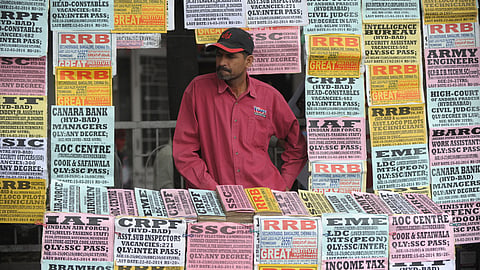

For decades, Indian families believed a college degree guaranteed a stable job. That belief is now under strain. Higher education enrolment in India grew by nearly a third over a decade, according to the All India Survey on Higher Education (AISHE) 2023-24, with women’s enrolment now close to parity with men’s and more students than ever coming from smaller towns. However, undergraduate enrolment fell by nearly one lakh students from the previous year, the first such decline since AISHE began. One year does not establish a trend, but it raises a question: are families doubting the value of a bachelor’s degree?
Employment data suggests this concern has some basis. The latest Periodic Labour Force Survey (PLFS) puts graduate unemployment at 11.2 percent, more than three times the national unemployment rate of 3.2 percent. In most countries, higher education reduces the risk of unemployment. In India, it currently does not.
One explanation deserves attention. Some economists argue educated youth can afford to wait for suitable jobs, while less educated workers cannot. High graduate unemployment partly reflects a choice to wait rather than a failure of demand. This is acceptable if the wait is short and the odds are good. But it does not explain why so many graduates eventually accept work far below their qualifications. If waiting were a rational bet on better jobs, more of it should end in success. It mostly does not.
The data bears this out. The State of Working India 2026 report found that fewer than 7 percent of male graduates secure a permanent salaried job within a year of graduation. Many of those counted as employed work in informal, temporary or gig jobs unrelated to their qualifications. The report also identifies ‘waiting unemployment’, where young people spend years preparing for government recruitment exams while outside both employment and skill development. This weakens the argument against the voluntary-wait explanation. The waiting builds no skills and leads to no better job. In fact, it is time lost.
A similar gap appears in women’s employment for different reasons. Women’s labour force participation almost doubled between 2017-18 and 2024-25, rising from 23.3 percent to about 42 percent in 2023-24. But most of that rise came from rural self-employment and unpaid family work, a category that often reflects agrarian distress, not new opportunity. Urban salaried employment for women has grown only modestly, not because of unwillingness to work, but because there aren’t enough formal jobs.
Both patterns point to the same underlying gap. Several developments explain the wider mismatch. The first is the slow pace of change within higher education. University curriculums are revised through lengthy regulatory processes, whereas employers change hiring requirements much faster. Employers increasingly look for problem-solving ability, communication, teamwork, digital competence and project experience. Universities remain organised around lectures and examinations, and institutional incentives continue to reward enrolment and infrastructure expansion over graduate outcomes.
The second is technological change. Artificial intelligence is beginning to change hiring for entry-level roles by automating routine tasks such as data analysis, coding and drafting. This extends beyond technology firms into finance, law, media and consulting—sectors that traditionally absorbed large numbers of graduates. NASSCOM reports that workforce growth in IT services has slowed even as revenue continues to grow. Entry-level hiring, too, has fallen sharply as firms adopt smaller AI-supported teams.
The third development is competition for credentials. Postgraduate and doctoral enrolment continues to rise even as undergraduate enrolment softens. Some pursue advanced study for genuine specialisation, but the rise also reflects graduates seeking additional qualifications to compete for the same limited jobs, thereby extending the time and cost of entering the labour market without creating new demand.
This should be read alongside a broader fact. India’s formal economy has not generated enough salaried jobs at any education level for over a decade. Graduate unemployment is one visible symptom of that slower, economy-wide problem, not something universities alone caused or curriculum reform alone can fix.
Naturally, these realities are reflected in real life. In May 2026, the Supreme Court upheld the dismissal of a government employee who had concealed his graduate qualification to obtain a post reserved for less-qualified candidates, holding that overqualified applicants deprive genuinely eligible candidates of opportunities. A similar ruling had come weeks earlier.
These judgements reflect graduates and postgraduates applying for jobs that need only school-level qualifications. The courts are responding to a mismatch that policy has yet to resolve. The mismatch also shows in study choices. Niti Aayog notes that for every foreign student studying in India, roughly 25 Indian students leave to study overseas in the hopes of stronger job prospects.
These decisions, whether to wait, settle or study abroad, are made with little data to guide them. AISHE tracks who enters higher education, but not what happens after: how long graduates take to find work, whether jobs match qualifications and how earnings change over time. Without this data, policy keeps responding to enrolment numbers instead of outcomes.
Of course, fixing this does not mean turning universities into training centres for industry. The role of universities is to create knowledge, develop critical thinking and prepare informed citizens. But they must also equip students to apply knowledge and adapt to new technologies. A practical step is to link university accreditation and funding to graduate employment data, not enrolment alone. That alone won’t fix a slow-growing labour market, but it would show which institutions help and which don’t. Until outcomes are measured and acted on, the gap between degree holders and matching jobs will keep widening.
John J Kennedy | Former Professor and Dean, Christ (Deemed) University, Bengaluru
(Views are personal)
